Results by title
615 books match the query 'England' and 21 start with b
BEYOND THE REPRODUCTIVE BODY
Politics of Women’s Health & Work in Early Victorian EnglandMarjorie Levine-Clark
The Ohio State University Press, 2004

Barbarous Play
Race on the English Renaissance StageLara Bovilsky
University of Minnesota Press, 2008
Like our own, early modern beliefs about race depended on metaphorical, selective, and contradictory understandings of how membership in groups is determined. Although race took distinctive forms in the past, the fallacies that underlie early modern racial experience generally are precisely-and surprisingly-the same as those in contemporary culture.
Exploring the similar underpinnings of early modern and contemporary ideas of difference, Barbarous Play examines English Renaissance understandings of race as depicted in drama. Reading plays by Shakespeare, Marlowe, Webster, and Middleton, Bovilsky offers case studies of how racial meanings are generated by narratives of boundary crossing-especially miscegenation, religious conversion, class transgression, and moral and physical degeneracy. In the process, she reveals deep parallels between the period’s conceptions of race and gender.
Barbarous Play contests the widely held view that race and racism depend on modern science for their existence and argues that understanding just what is false and figurative in past depictions of race, such as those found in Othello, The Merchant of Venice, The White Devil, and The Changeling, can clarify the illogic of present-day racism.
Lara Bovilsky is assistant professor of English at Washington University in St. Louis.
Becoming Arab in London
Performativity and the Undoing of IdentityRamy M. K. Aly
Pluto Press, 2015
Drawing on the work of Judith Butler, Aly emphasizes the need to move away from the concept of identity and toward the idea of race, gender, and class as performance. Based on seven years of fieldwork, during which time the author immersed himself in London’s Arab community, Becoming Arab in London is an innovative and necessary contribution to the study of diaspora and difference in contemporary Britain.
Becoming Somebody Else
Blackouts, Addiction, and Agency amongst London's HomelessJoshua Burraway
HAU, 2025
What does it mean to exist outside the normative temporality of life, of housed living, and, ultimately, of selfhood? Becoming Somebody Else takes up this question, offering a window into the fragmented and chaotic lives of people experiencing homelessness in urban London as they drink and drug themselves into blackout in post-austerity Britain. A state of being where time, body, agency, and self collapse into a memoryless abyss, the blackout is a prism into how human beings make and unmake their selfhood in the wake of social suffering and personal trauma. Attending to the words and histories of several individuals, Joshua Burraway knits together structural, psychological, and phenomenological approaches to understand the ways in which memory, agency, and selfhood are sites of struggle and belonging, and in doing so, suggests new ways of thinking about addiction, homelessness, and therapeutic possibility.
Before Intimacy
Asocial Sexuality in Early Modern EnglandDaniel Juan Gil
University of Minnesota Press, 2006
Engaging the poems of Wyatt, Sidney’s Astrophil and Stella, Spenser’s Amoretti and The Faerie Queene, and Shakespeare’s Troilus and Cressida and the Sonnets, Gil demonstrates how sexuality was conceived as a relationship system inhabited by men and women interchangeably—set apart from the “norm” and not institutionalized in a private or domestic realm. Going beyond the sodomy-as-transgression analytic, he asserts the existence of socially inconsequential sexual bonds while recognizing the pleasurable effects of violating the supposed traditional modes of bonding and ideals of universal humanity and social hierarchy.
Celebrating the ability of corporeal emotions to interpret connections between people who share nothing in terms of societal structure, Before Intimacy shows how these works of early modern literature provide a discourse of sexuality that strives to understand status differences in erotic contexts and thereby question key assumptions of modernity.
Daniel Juan Gil is assistant professor of English at TCU.
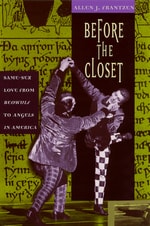
Before the Closet
Same-Sex Love from "Beowulf" to "Angels in America"Allen J. Frantzen
University of Chicago Press, 1998
With its ambitious scope and elegant style, Before the Closet sets same-sex relations in Anglo-Saxon sources in relation to the sexual themes of contemporary opera, dance, and theatre. Frantzen offers a comprehensive analysis of sources from the seventh to the twelfth century and traces Anglo-Saxon same-sex behavior through the age of Chaucer and into the Renaissance.
"Frantzen's marvelous book . . . opens up a world most readers will never have even known was there. It's a difficult topic, but Frantzen's comprehensive, readable and even wryly funny treatment makes this an unexpected pleasure."—Publishers Weekly, starred review
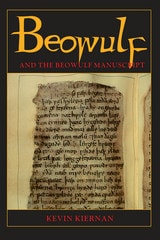
Beowulf and the Beowulf Manuscript
Kevin S. Kiernan
University of Michigan Press, 1997
Kevin S. Kiernan, one of the world's foremost Beowulf scholars, has studied the manuscript extensively with the most up-to-date methods, including fiber-optic backlighting and computer digitization. This volume reprints Kiernan's earlier study of the manuscript, in which he presented his novel conclusions about the date of Beowulf. It also offers a new Introduction in which the author describes the value of electronic study of Beowulf, and a new Appendix that lists all the letters and parts of letters revealed by backlighting.
This important volume will be a must-read not only for the scholar of early English history and literature, but for all those who are interested in practical applications of the new technologies.
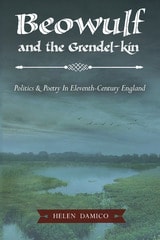
Beowulf and the Grendel-Kin
Politics and Poetry in Eleventh-Century EnglandHelen Damico
West Virginia University Press, 2014
In Beowulf and the Grendel-kin: Politics and Poetry in Eleventh-Century England, Helen Damico presents the first concentrated discussion of the initiatory two-thirds of Beowulf’s 3,182 lines in the context of the sociopolitically turbulent years that composed the first half of the eleventh century in Anglo-Danish England.
Damico offers incisive arguments that major historical events and personages pertaining to the reign of Cnut and those of his sons recorded in the Anglo-Saxon Chronicle, the Encomium Emmae Reginae, and major continental and Scandinavian historical texts, hold striking parallels with events and personages found in at least eight vexing narrative units, as recorded by Scribe A in BL, Cotton Vitellius A.xv, that make up the poem’s quasi sixth-century narrative concerning the fall of the legendary Scyldings.
Given the poet’s compositional skill—widely relational and eclectic at its core—and his affinity with the practicing skalds, these strings of parallelisms could scarcely have been coincidental. Rather, Damico argues that examined within the context of other eleventh-century texts that either bemoaned or darkly satirized or obversely celebrated the rise of the Anglo-Danish realm, the Beowulfian units may bring forth a deeper understanding of the complexity of the poet’s compositional process.
Damico illustrates the poet’s use of the tools of his trade—compression, substitution, skillful encoding of character—to reinterpret and transform grave sociopolitical “facts” of history, to produce what may be characterized as a type of historical allegory, whereby two parallel narratives, one literal and another veiled are simultaneously operative.
Beowulf and the Grendel-Kin lays out the story of Beowulf, not as a monster narrative nor a folklorish nor solely a legendary tale, but rather as a poem of its time, a historical allegory coping with and reconfiguring sociopolitical events of the first half of eleventh-century Anglo-Saxon England.

Better Times Than This
Youth Homelessness in BritainTom Hall
Pluto Press, 2003

Blessed Mary and the Monks of England, 1000-1215
Matthew J. Mills
Catholic University of America Press, 2024
Blood Relations
Christian and Jew in The Merchant of VeniceJanet Adelman
University of Chicago Press, 2008
Adelman locates the promise—or threat—of Jewish conversion as a particular site of tension in the play. Drawing on a variety of cultural materials, she demonstrates that, despite the triumph of its Christians, The Merchant of Venice reflects Christian anxiety and guilt about its simultaneous dependence on and disavowal of Judaism. In this startling psycho-theological analysis, both the insistence that Shylock’s daughter Jessica remain racially bound to her father after her conversion and the depiction of Shylock as a bloody-minded monster are understood as antidotes to Christian uneasiness about a Judaism it can neither own nor disown.
In taking seriously the religious discourse of The Merchant of Venice, Adelman offers in Blood Relations an indispensable book on the play and on the fascinating question of Jews and Judaism in Renaissance England and beyond.

Bloody Tyrants and Little Pickles
Stage Roles of Anglo-American Girls in the Nineteenth CenturyMarles Schweitzer
University of Iowa Press, 2020
Bloody Tyrants and Little Pickles traces the theatrical repertoire of a small group of white Anglo-American actresses as they reshaped the meanings of girlhood in Britain, North America, and the British West Indies during the first half of the nineteenth century. It is a study of the possibilities and the problems girl performers presented as they adopted the manners and clothing of boys, entered spaces intended for adults, and assumed characters written for men. It asks why masculine roles like Young Norval, Richard III, Little Pickle, and Shylock came to seem “normal” and “natural” for young white girls to play, and it considers how playwrights, managers, critics, and audiences sought to contain or fix the at-times dangerous plasticity they exhibited both on and off the stage.
Schweitzer analyzes the formation of a distinct repertoire for girls in the first half of the nineteenth century, which delighted in precocity and playfulness and offered up a model of girlhood that was similarly joyful and fluid. This evolving repertoire reflected shifting perspectives on girls’ place within Anglo-American society, including where and how they should behave, and which girls had the right to appear at all.
Bodily Matters
The Anti-Vaccination Movement in England, 1853–1907Nadja Durbach
Duke University Press, 2005
Analyzing historical documents on both sides of the vaccination debate, Durbach focuses on the key events and rhetorical strategies of the resistance campaign. She shows that those for and against the vaccine had very different ideas about how human bodies worked and how best to safeguard them from disease. Individuals opposed to mandatory vaccination saw their own and their children’s bodies not as potentially contagious and thus dangerous to society but rather as highly vulnerable to contamination and violation. Bodily Matters challenges the notion that resistance to vaccination can best be understood, and thus easily dismissed, as the ravings of an unscientific “lunatic fringe.” It locates the anti-vaccination movement at the very center of broad public debates in Victorian England over medical developments, the politics of class, the extent of government intervention into the private lives of its citizens, and the values of a liberal society.
Bodleian Library Treasures
David Vaisey
Bodleian Library Publishing, 2017
Rare books, music, manuscripts, ephemera, and maps, many of the treasures photographed and described for this lavish volume are well-loved around the world, from Jane Austen’s manuscript of The Watsons to notebooks created by the poet Percy Bysshe Shelley, a map of Narnia drawn by C. S. Lewis, and the original manuscript of the renowned children’s work The Wind in the Willows. Others are known for their beauty or historical significance, including the Gutenberg Bible, Magna Carta, and the extraordinary medieval manuscript the Douce Apocalypse. Still others hold poignant stories like the small handwritten book presented as a New Year’s present in 1545 to Katherine Parr by an eleven-year-old stepdaughter who would later become Queen Elizabeth I. Vaisey brings these and other treasures together in chronological order, showcasing the Bodleian Library’s renowned collections.
Book M
A London Widow's Life WritingsKatherine Austen, Edited by Pamela S. Hammons
Iter Press, 2013
—Margaret J. M. Ezell
Distinguished Professor of English and John and Sara Lindsay Chair of Liberal Arts
Texas A&M University

Book and Verse
A Guide to Middle English Biblical LiteratureJames H. Morey
University of Illinois Press, 2000
Book and Verse is an indispensable guide to the variety and extent of biblical literature in England, exclusive of drama and the Wycliffite Bible that appeared between the twelfth and the fifteenth centuries. Entries provide detailed information on how much of what parts of the Bible appear in Middle English and where this biblical material can be found. Comprehensive indexing by name, keyword, and biblical verse allows a researcher to find, for example, all the occurrences of the Flood Story or of the encounter between Elijah and the Widow of Sarephta. An invaluable resource, Book and Verse provides the first easy access to the "popular Bible" assembled before and after John Wyclif's translation of the Vulgate into English.
Books of Secrets
Natural Philosophy in England, 1550-1600Allison Kavey
University of Illinois Press, 2007
Both from the Ears and Mind
Thinking about Music in Early Modern EnglandLinda Phyllis Austern
University of Chicago Press, 2020

Bowie
An Illustrated LifeBy María Hesse and Fran Ruiz; translated by Ned Sublette
University of Texas Press, 2019
David Bowie was a master of artifice and reinvention. In that same spirit, illustrator María Hesse and writer Fran Ruiz have created a vivid retelling of the life of David Robert Jones, from his working-class childhood to glam rock success to superstardom, concluding with the final recording sessions after his cancer diagnosis.
Narrated from the rock star’s point of view, Bowie colorfully renders both the personal and the professional turning points in a life marked by evolution and innovation. We see Bowie facing the sorrow of his brother’s mental illness, kicking a cocaine habit while other musicians succumbed to deadly overdoses, contending with a tumultuous love life, and radiating joy as a father. Along the way, he describes how he shattered the boundaries of song and society with a counterculture cast that included Iggy Pop, Brian Eno, and Freddie Mercury—as well as his own creations, Ziggy Stardust and the Thin White Duke.
Evocatively illustrated from start to finish, Bowie is a stellar tribute to an inimitable star.

Broken Pieces
Michael Gorman
American Library Association, 2011
Bulbs for Warm Climates
By Thad M. Howard
University of Texas Press, 2001
Bulb gardening in the southwestern and southern United States presents challenges unknown in cooler climates. Bulbs that turn Holland into a kaleidoscope of color droop and fade in our mild winters, hot summers, and uncertain rainfall. Yet hundreds of native and naturalized species of bulbs thrive in these same conditions and offer as many colors, shapes, and fragrances as even the most demanding gardener desires. These are the bulbs that Thad Howard describes in this comprehensive guide to bulbs that will grow in USDA gardening zones 8 and 9.
Writing from more than forty-five years' experience in collecting and cultivating bulbs, Howard offers expert advice about hundreds of little-known, hybrid, and common species and varieties that grow well in warm climates. His species accounts, which are grouped by family, describe each plant and its growing requirements and often include interesting stories from his collecting expeditions. Lovely color photos illustrate many of the species.
Howard also gives reliable information about refrigerating bulbs, using them in the landscape and in containers, choosing scented ones, making potpourri, buying, collecting, cultivating, and hybridizing bulbs, and dealing with pests and diseases. He concludes with lists of plant societies and suppliers and a helpful glossary and bibliography.