403 books match the query 'Environmental Science' and 23 start with b
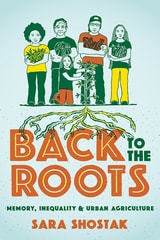
cover of Back to the Roots: Memory, Inequality, and Urban Agriculture

Back to the Roots

Memory, Inequality, and Urban Agriculture

Sara Shostak

Rutgers University Press, 2021

Across the Commonwealth of Massachusetts, urban farmers and gardeners are reclaiming cultural traditions linked to food, farming, and health; challenging systemic racism and injustice in the food system; demanding greater community control of resources in marginalized neighborhoods; and moving towards their visions of more equitable urban futures. As part of this urgent work, urban farmers and gardeners encounter and reckon with both the cultural meanings and material legacies of the past. Drawing on their narratives, Back to the Roots demonstrates that urban agriculture is a critical domain for explorations of, and challenges to, the long standing inequalities that shape both the materiality of cities and the bodies of their inhabitants.
 
[more]
cover of Bataille’s Peak: Energy, Religion, and Postsustainability

Bataille’s Peak

Energy, Religion, and Postsustainability

Allan Stoekl

University of Minnesota Press, 2007

As the price of oil climbs toward $100 a barrel, our impending post-fossil fuel future appears to offer two alternatives: a bleak existence defined by scarcity and sacrifice or one in which humanity places its faith in technological solutions with unforeseen consequences. Are there other ways to imagine life in an era that will be characterized by resource depletion?

The French intellectual Georges Bataille saw energy as the basis of all human activity—the essence of the human—and he envisioned a society that, instead of renouncing profligate spending, would embrace a more radical type of energy expenditure: la dépense, or “spending without return.” In Bataille’s Peak, Allan Stoekl demonstrates how a close reading of Bataille—in the wake of Giordano Bruno and the Marquis de Sade— can help us rethink not only energy and consumption, but also such related topics as the city, the body, eroticism, and religion. Through these cases, Stoekl identifies the differences between waste, which Bataille condemned, and expenditure, which he celebrated.

The challenge of living in the twenty-first century, Stoekl argues, will be to comprehend—without recourse to austerity and self-denial—the inevitable and necessary shift from a civilization founded on waste to one based on Bataillean expenditure.

Allan Stoekl is professor of French and comparative literature at Penn State University. He is the author of Agonies of the Intellectual: Commitment, Subjectivity, and the Performative in the Twentieth-Century French Tradition and translator of Bataille’s Visions of Excess: Selected Writings, 1927–1939 (Minnesota, 1985).
[more]
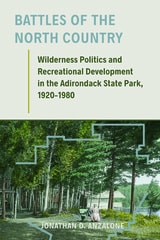
cover of Battles of the North Country: Wilderness Politics and Recreational Development in the Adirondack State Park, 1920-1980

Battles of the North Country

Wilderness Politics and Recreational Development in the Adirondack State Park, 1920-1980

Jonathan D. Anzalone

University of Massachusetts Press, 2018

The Adirondack region is trapped in a cycle of conflict. Nature lovers advocate for the preservation of wilderness, while sports enthusiasts demand infrastructure for recreation. Local residents seek economic opportunities, while environmentalists fight industrial or real estate growth. These clashes have played out over the course of the twentieth century and continue into the twenty-first.

Through a series of case studies, historian Jonathan D. Anzalone highlights the role of public and private interests in the region and shows how partnerships frayed and realigned in the course of several key developments: the rise of camping in the 1920s and 1930s; the 1932 Lake Placid Olympics; the construction of a highway to the top of Whiteface Mountain; the postwar rise of downhill skiing; the completion of I-87 and the resulting demand for second homes; and the 1980 Lake Placid Olympics. Battles of the North Country reveals how class, economic self-interest, state power, and a wide range of environmental concerns have shaped modern politics in the Adirondacks and beyond.
[more]
cover of Behavioral and Distributional Effects of Environmental Policy

Behavioral and Distributional Effects of Environmental Policy

Edited by Carlo Carraro and Gilbert E. Metcalf

University of Chicago Press, 2001
Most people would agree that it makes sense to tax a company that pollutes in a way that directly reflects the amount of environmental and social damage it has done. Yet in practice, such taxes are fraught with difficulty and have far-reaching implications. A company facing a new tax may lay off workers, for example, exacerbating an unemployment problem. This volume focuses on such external issues and examines in detail the trade-offs involved in designing policies to deal with environmental problems. Reflecting the broad nature of the subject, the contributors include leading economists in the areas of public finance, industrial organization, and trade theory, as well as environmental economists. Integrating both theoretical and empirical methods, they examine environmental policy design as it relates to location decisions, compliance costs, administrative costs, effects on research and development, and international factor movements. Shedding light on an extraordinarily complex and important topic, this collection will be of interest to all those involved in designing effective environmental policy.
[more]
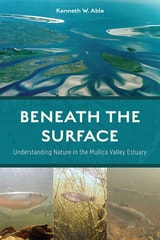
cover of Beneath the Surface: Understanding Nature in the Mullica Valley Estuary

Beneath the Surface

Understanding Nature in the Mullica Valley Estuary

Kenneth W. Able

Rutgers University Press, 2020

2021 winner of Non-fiction popular category: New Jersey Studies Academic Alliance

The Mullica Valley estuary and its watershed, formed over the last 10,000 years, are among the cleanest estuaries along the east coast of the United States. This 365,000-acre ecosystem benefits from a combination of protected watershed, low human population density, and general lack of extensive development. In Beneath the Surface, marine scientist Ken Able helps the reader penetrate the surface and gain insights into the kinds of habitats, animals, and plants that live there. Readers will gain a better understanding of the importance of these shallow waters; how the amount of salt in the water determines where animals and plants are found in estuaries; the day-night, seasonal, and annual variation in their occurrence; and how change is occurring as the result of climate variation. Throughout the book are insightful sidebars telling intimate stories of where various animals came from and where they are going as they travel through the estuary on their way to and from other portions of the east coast. Beneath the Surface emphasizes the kinds and importance of the animals and plants that live beneath the surface of this unique ecosystem.
[more]
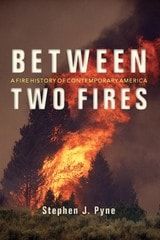
cover of Between Two Fires: A Fire History of Contemporary America

Between Two Fires

A Fire History of Contemporary America

Stephen J. Pyne

University of Arizona Press, 2015

From a fire policy of prevention at all costs to today's restored burning, Between Two Fires is America's history channeled through the story of wildland fire management. Stephen J. Pyne tells of a fire revolution that began in the 1960s as a reaction to simple suppression and single-agency hegemony, and then matured into more enlightened programs of fire management. It describes the counterrevolution of the 1980s that stalled the movement, the revival of reform after 1994, and the fire scene that has evolved since then.

Pyne is uniquely qualified to tell America’s fire story. The author of more than a score of books, he has told fire’s history in the United States, Australia, Canada, Europe, and the Earth overall. In his earlier life, he spent fifteen seasons with the North Rim Longshots at Grand Canyon National Park.

In Between Two Fires, Pyne recounts how, after the Great Fires of 1910, a policy of fire suppression spread from America’s founding corps of foresters into a national policy that manifested itself as a costly all-out war on fire. After fifty years of attempted fire suppression, a revolution in thinking led to a more pluralistic strategy for fire’s restoration. The revolution succeeded in displacing suppression as a sole strategy, but it has failed to fully integrate fire and land management and has fallen short of its goals.

Today, the nation’s backcountry and increasingly its exurban fringe are threatened by larger and more damaging burns, fire agencies are scrambling for funds, firefighters continue to die, and the country seems unable to come to grips with the fundamentals behind a rising tide of megafires. Pyne has once again constructed a history of record that will shape our next century of fire management. Between Two Fires is a story of ideas, institutions, and fires. It’s America’s story told through the nation’s flames.
 
[more]
cover of Between Two Pines: Ushering in a Sustainable Future Through an Art-Science Practice

Between Two Pines

Ushering in a Sustainable Future Through an Art-Science Practice

Edgar Cardenas

Michigan Publishing Services, 2019

The stories we tell matter. They shape and frame how we identify, understand, and address challenges. Many of the sustainability stories being told and re-told have been predicated on the idea that techno-scientific solutions will be our salvation. Rarely do they deeply interrogate the cultural and aesthetic factors that contribute to our human-environment relationships. Between Two Pines builds on the growing realization that artists must contribute to and enlarge our current conceptions of sustainability. This book explores how conceptions of the sublime, beauty, and the picturesque influenced the development of our natural aesthetic sensibilities and resolves that sustainability stewardship will require the intersection of ecology, aesthetics, and ethics. Pivoting off the history of landscape photography, Cardenas proposes a sustainability aesthetic, a framework for how the arts can reposition themselves for a sustainability social practice. The book concludes with one hundred little dramas, a body of photographic work that puts to practice his sustainability aesthetic. Between Two Pines places scholarship and art on equal footing, ultimately providing a framework and examples of how art practice can and must be integrated into dialogues and narratives on transitioning into a more sustainable future.
 
*   *   *

“I am truly thankful that Dr. Edgar Cardenas’s thoughtful research is now available in this beautiful book. I have recommended his work to more people, both in my personal and professional spheres of my life, than I can count, and I’m glad to have this provocative and elegant publication to put into people’s hands. Cardenas shows us how each of us really can make a difference.”
Rebecca A. Senf, Chief Curator, Center for Creative Photography, University of Arizona, and author of Making a Photographer
 
“A truly beautiful and thought provoking treatise on the productive relationship between art and science. In Between Two Pines, Cardenas breaks new interdisciplinary ground through an innovative rethinking of sustainability. This book is a call to action that forces the reader to rethink the antiquated and often paralyzing divisions between the arts and the hard sciences.”
Jason De León, Anthropology and Chicana/o Studies, UCLA, MacArthur Fellow, and author of The Land of Open Graves
 
“Understanding that broad and complex fields of inquiry must be committed to multiple approaches, Edgar Cardenas makes a cogent and well-grounded case for artistic research in the literatures of sustainability. He also offers his own visual essay—punctuated by philosophical reference and personal reflection—on what it means to live fully engaged with the often unnoticed world at our fingertips. Between Two Pines is an insightful offering on how to open the door to artistic practices in research.”
Joey Orr, Andrew W. Mellon Curator for Research, Spencer Museum of Art, University of Kansas

“Between Two Pines anticipates and leads the discussion of scholarship around questions of land and landscape. This work brilliantly and ethically refocuses our vision, from distanced scrutiny to connection and proximity, rooted in daily care-taking and ecological efforts. Thoughtfully imaged, the photographs offer an aesthetic that is based in balanced, enduring reflection, rather than on the grand view. These beautiful images reveal discoveries that bridge the arts, ecology, and sociology, and will serve to reconnect every reader with the world in their backyard and beyond.”
Rebekah Modrak, School of Art & Design, University of Michigan, and author of Reframing Photography

“Drawing from a long photographic tradition of examining the relationship between humans and their environment, Edgar Cardenas has found a voice that is as compassionate as it is poignant. Yet he is not content for his photographs to be mere observations, recording the relationship. Between Two Pines is a call to action – a platform by which we might imagine together, with all of the tools in our tool kit, a sustainable future.”
J.D. Talasek, Director, Cultural Programs of the National Academy of Sciences
 
"This book is about many things.  It is about storytelling, and it tells stories.  It is about aesthetics and awareness, and it envelopes us in its distinctive aesthetic and heightens our awareness.  It presents science and art as complementary modes of inquiry, and uses art and science to guide us along a path of inquiry.  Words and images combine to carry us along an exploration of what sustainability means as a principle in everyday life.  "One hundred little dramas" complete the book by immersing the reader--who has now become an observer and inquirer, collaborating with the author--in a world re-enchanted through compassionate observation, free of glamour or pity." 
Edward J. Hackett, Vice Provost for Research, Brandeis University
[more]
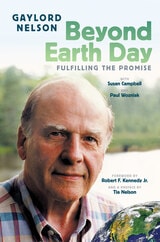
cover of Beyond Earth Day: Fulfilling the Promise

Beyond Earth Day

Fulfilling the Promise

Gaylord Nelson; With Susan Campbell and Paul Wozniak; Foreword by Robert F. Kennedy Jr.; Preface by Tia Nelson

University of Wisconsin Press, 2002

Gaylord Nelson’s legacy is known and respected throughout the world. He was a founding father of the modern environmental movement and creator of one of the most influential public awareness campaigns ever undertaken on behalf of global environmental stewardship: Earth Day.
    Nelson died in 2005, but his message in this book is still timely and urgent, delivered with the same eloquence with which he articulated the nation’s environmental ills throughout the decades. He details the planet’s most critical concerns—from species and habitat losses to global climate change and population growth. In outlining strategies for planetary health, Nelson inspires citizens to reassert environmentalism as a national priority. Included in this reprint is a new preface by Gaylord Nelson’s daughter, Tia Nelson.
[more]
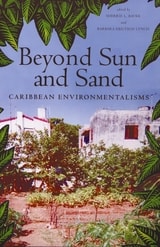
cover of Beyond Sun and Sand: Caribbean Environmentalisms

Beyond Sun and Sand

Caribbean Environmentalisms

Edited by Sherrie L. Baver and Barbara Deutsch Lynch

Rutgers University Press, 2006

Filtered through the lens of the North American and European media, the Caribbean appears to be a series of idyllic landscapes-sanctuaries designed for sailing, diving, and basking in the sun on endless white sandy beaches. Conservation literature paints a similarly enticing portrait, describing the region as a habitat for endangered coral reefs and their denizens, parrots, butterflies, turtles, snails, and a myriad of plant species.

In both versions, the image of the exotic landscape overshadows the rich island cultures that are both linguistically and politically diverse, but trapped in a global economy that offers few options for development. Popular depictions also overlook the reality that the region is fraught with environmental problems, including water and air pollution, solid waste mismanagement, destruction of ecosystems, deforestation, and the transition from agriculture to ranching.

Bringing together ten essays by social scientists and activists, Beyond Sun and Sand provides the most comprehensive exploration to date of the range of environmental issues facing the region and the social movements that have developed to deal with them. The authors consider the role that global and regional political economies play in this process and provide valuable insight into Caribbean environmentalism. Many of the essays by prominent Caribbean analysts are made available for the first time in English.
[more]
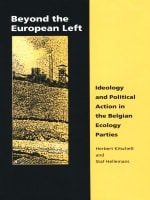
cover of Beyond the European Left: Ideology and Political Action in the Belgian Ecology

Beyond the European Left

Ideology and Political Action in the Belgian Ecology

Herbert Kitschelt and Staf Hellemans

Duke University Press, 1990

Drawing on recent research on the internal politics of the Belgian ecology parties, Agalev and Ecolo, this work demonstrates how political careers in contemporary social movements lead to activism in left-libertarian politics and influence political ideology. Beyond the European Left is the first comprehensive survey of ecology parties in Europe that presents detailed empirical information on the careers, organizational practices, and political beliefs of the activists involved.
The authors employ a new research methodology—surveying party militants—that is better adapted to the study of micropolitics than are expert interviews. Herbert Kitschelt and Staf Hallemans show that European Green party activists express an egalitarian and libertarian vision of a desirable social order that builds on, but radically transforms, ideas of the traditional socialist European left. The authors then examine the debates and disagreements among militants on political objectives and the consequences of conflicting views for party organization and strategy. Their findings illuminate the unique dynamics of left-libertarian politics in a number of Western European countries with obvious relevance to current developments in Eastern Europe.
[more]
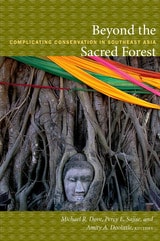
cover of Beyond the Sacred Forest: Complicating Conservation in Southeast Asia

Beyond the Sacred Forest

Complicating Conservation in Southeast Asia

Michael R. Dove, Percy E. Sajise, and Amity A. Doolittle, eds.

Duke University Press, 2011

Reflecting new thinking about conservation in Southeast Asia, Beyond the Sacred Forest is the product of a unique, decade-long, interdisciplinary collaboration involving research in Indonesia, Malaysia, and the Philippines. Scholars from these countries and the United States rethink the translation of environmental concepts between East and West, particularly ideas of nature and culture; the meaning of conservation; and the ways that conservation policy is applied and transformed in the everyday landscapes of Southeast Asia. The contributors focus more on folk, community, and vernacular conservation discourses than on those of formal institutions and the state. They reject the notion that conservation only takes place in bounded, static, otherworldly spaces such as protected areas or sacred forests. Thick with ethnographic detail, their essays move beyond the forest to agriculture and other land uses, leave behind orthodox notions of the sacred, discard outdated ideas of environmental harmony and stasis, and reject views of the environment that seek to avoid or escape politics. Natural-resource managers and policymakers who work with this more complicated vision of nature and culture are likely to enjoy more enduring success than those who simply seek to remove the influence and impact of humans from conserved landscapes. As many of the essays suggest, this requires the ability to manage contradictions, to relinquish orthodox ideas of what conservation looks like, and to practice continuously adaptive management techniques.

Contributors. Upik Djalins, Amity A. Doolittle, Michael R. Dove, Levita Duhaylungsod, Emily E. Harwell, Jeyamalar Kathirithamby-Wells, Lye Tuck-Po, Percy E. Sajise, Endah Sulistyawati, Yunita T. Winarto
[more]
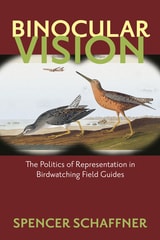
cover of Binocular Vision: The Politics of Representation in Birdwatching Field Guides

Binocular Vision

The Politics of Representation in Birdwatching Field Guides

Spencer Schaffner

University of Massachusetts Press, 2011

From meadows to marshlands, seashores to suburbs, field guides help us identify many of the things we find outdoors: plants, insects, mammals, birds. In these texts, nature is typically represented, both in words and images, as ordered, clean, and untouched by human technology and development. This preoccupation with species identification, however, has produced an increasingly narrow view of nature, a “binocular vision,” that separates the study of individual elements from a range of larger, interconnected environmental issues. In this book, Spencer Schaffner reconsiders this approach to nature study by focusing on how birds are presented in field guides.

Starting with popular books from the late nineteenth century and moving ultimately to the electronic guides of the current day, Binocular Vision contextualizes birdwatching field guides historically, culturally, and in terms of a wide range of important environmental issues. Schaffner questions the assumptions found in field guides to tease out their ideological workings. He argues that the sanitized world represented in these guides misleads readers by omitting industrial landscapes and so-called nuisance birds, leaving users of the guides disconnected from environmental degradation and its impact on bird populations.

By putting field guides into direct conversation with concerns about species conservation, environmental management, the human alteration of the environment, and the problem of toxic pollution, Binocular Vision is a field guide to field guides that takes a novel perspective on how we think about and interact with the world around us.
[more]
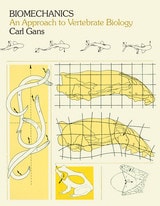
cover of Biomechanics: An Approach to Vertebrate Biology

Biomechanics

An Approach to Vertebrate Biology

Carl Gans

University of Michigan Press, 1980
Offers an approach to the study of functional anatomy
[more]
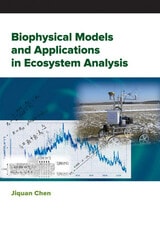
cover of Biophysical Models and Applications in Ecosystem Analysis

Biophysical Models and Applications in Ecosystem Analysis

Chen, Jiquan

Michigan State University Press, 2021

The past five decades have witnessed a rapid growth of computer models for simulating ecosystem functions and dynamics. This has been fueled by the availability of remote sensing data, computation capability, and cross-disciplinary knowledge. These models contain many submodules for simulating different processes and forcing mechanisms, albeit it has become challenging to truly understand the details due to their complexity. Most ecosystem models, fortunately, are rooted in a few core biophysical foundations, such as the widely recognized Farquhar model, Ball-Berry-Leuning and Medlyn family models, Penman-Monteith equation, Priestley-Taylor model, and Michaelis-Menten kinetics. After an introduction of biophysical essentials, four chapters present the core algorithms and their behaviors in modeling ecosystem production, respiration, evapotranspiration, and global warming potentials. Each chapter is composed of a brief introduction of the literature, in which model algorithms, their assumptions, and performances are described in detail. Spreadsheet (or Python codes) templates are included in each chapter for modeling exercises with different input parameters as online materials, which include datasets, parameter estimation, and real-world applications (e.g., calculations of global warming potentials). Users can also apply their own datasets. The materials included in this volume serve as effective tools for users to understand model behaviors and uses with specified conditions and in situ applications. 
[more]
cover of Birds of the Lower Colorado River Valley

Birds of the Lower Colorado River Valley

Kenneth V. Rosenberg, Robert D. Ohmart, William C. Hunter, and Bertin W. Anderson

University of Arizona Press, 1991

The original March 1991 publication is now an ebook.

"A tremendous amount of information is included in this book for banders, birders, and people working to restore the 'Nile of the American Southwest.'" —North American Bird Bander

"A report on several years of scientific research undertaken to investigate the ecological relationships among desert riparian wildlife. . . . Well writen and very informative book." —The Canadian Field Naturalist

"This work is a great achievment." —Birding

[more]
cover of Black Ecologies of Zone A: More-Than-Human Relations on New York's Colonial Shoreline

Black Ecologies of Zone A

More-Than-Human Relations on New York's Colonial Shoreline

Ayasha Guerin

Duke University Press, 2027

In Black Ecologies of Zone A, Ayasha Guerin examines how the intertwined forces of colonialism, racial capitalism, and environmental transformation produced New York City’s coastal flood zones. Seen through the lens of Black ecologies, flooding is not a natural disaster, but a condition deliberately imposed through historical processes of landmaking, labor exploitation, and ecological disruption. Drawing on a range of resources like environmental and labor histories, law, archaeology, and memoir, they trace how centuries of settlement transformed wetlands, waterways, and shorelines into sites of extraction, enclosure, and vulnerability. However, Guerin also highlights waterfront spaces as sites of fugitivity, mutual aid, and abolitionist organizing where Black and Indigenous communities forge alternative relations of care and survival. Engaging contemporary artists alongside historical archives, Guerin foregrounds creative practice as a method for interpreting and reimagining socio-ecological histories, calling for relational repair grounded in ecological remediation, decolonization, and interspecies care.
[more]
cover of Black Environmentalisms

Black Environmentalisms

Cajetan Iheka and Jonathan Howard, editors

Duke University Press, 2027
In Black Environmentalisms, editors Cajetan Iheka and Jonathan Howard reengage African and African Diaspora studies around the urgent question of environmental crisis. Probing the continuities between global antiblackness and the endangerment of planetary life, contributors argue that black life and expressive culture constitute unique sources of ecological thought and practice. Across a wide variety of black geographies and thought, their essays bear witness to not only black ecological precarity but also the cultivational practices that people of African descent have summoned over time to combat their exploitation and enact a living relationship to the earth. As they show, the rich practices of black communities emerge from a radical alignment with, rather than paternalistic conservation of, the nonhuman natural world. Reimagining environmentalism beyond the limits of western humanism, Black Environmentalisms charts new pathways of environmental criticism by foregrounding the ecological worldmaking practices of black people across the planet.
[more]
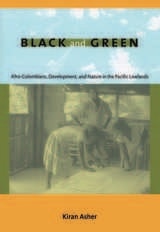
cover of Black and Green: Afro-Colombians, Development, and Nature in the Pacific Lowlands

Black and Green

Afro-Colombians, Development, and Nature in the Pacific Lowlands

Kiran Asher

Duke University Press, 2009

In Black and Green, Kiran Asher provides a powerful framework for reconceptualizing the relationship between neoliberal development and social movements. Moving beyond the notion that development is a hegemonic, homogenizing force that victimizes local communities, Asher argues that development processes and social movements shape each other in uneven and paradoxical ways. She bases her argument on ethnographic analysis of the black social movements that emerged from and interacted with political and economic changes in Colombia’s Pacific lowlands, or Chocó region, in the 1990s.

The Pacific region had yet to be overrun by drug traffickers, guerrillas, and paramilitary forces in the early 1990s. It was better known as the largest area of black culture in the country (90 percent of the region’s population is Afro-Colombian) and as a supplier of natural resources, including timber, gold, platinum, and silver. Colombia’s Law 70, passed in 1993, promised ethnic and cultural rights, collective land ownership, and socioeconomic development to Afro-Colombian communities. At the same time that various constituencies sought to interpret and implement Law 70, the state was moving ahead with large-scale development initiatives intended to modernize the economically backward coastal lowlands. Meanwhile national and international conservation organizations were attempting to protect the region’s rich biodiversity. Asher explores this juxtaposition of black rights, economic development, and conservation—and the tensions it catalyzed. She analyzes the meanings attached to “culture,” “nature,” and “development” by the Colombian state and Afro-Colombian social movements, including women’s groups. In so doing, she shows that the appropriation of development and conservation discourses by the social movements had a paradoxical effect. It legitimized the presence of state, development, and conservation agencies in the Pacific region even as it influenced those agencies’ visions and plans.
[more]
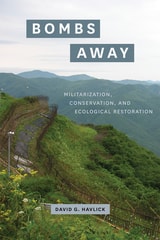
cover of Bombs Away: Militarization, Conservation, and Ecological Restoration

Bombs Away

Militarization, Conservation, and Ecological Restoration

David G. Havlick

University of Chicago Press, 2018

When viewed from space, the Korean Peninsula is crossed by a thin green ribbon. On the ground, its mix of dense vegetation and cleared borderlands serves as home to dozens of species that are extinct or endangered elsewhere on the peninsula. This is Korea’s demilitarized zone—one of the most dangerous places on earth for humans, and paradoxically one of the safest for wildlife. Although this zone was not intentionally created for conservation, across the globe hundreds of millions of acres of former military zones and bases are being converted to restoration areas, refuges, and conservation lands. David G. Havlick has traveled the world visiting these spaces of military-to-wildlife transition, and in Bombs Away he explores both the challenges—physical, historical, and cultural—and fascinating ecological possibilities of military site conversions.

Looking at particular international sites of transition—from Indiana’s Big Oaks National Wildlife Refuge to Cold War remnants along the former Iron Curtain—Havlick argues that these new frontiers of conservation must accomplish seemingly antithetical aims: rebuilding and protecting ecosystems, or restoring life, while also commemorating the historical and cultural legacies of warfare and militarization. Developing these ideas further, he shows that despite the ecological devastation often wrought by military testing and training, these activities need not be inconsistent with environmental goals, and in some cases can even complement them—a concept he calls ecological militarization. A profound, clear explication of landscapes both fraught and fecund, marked by death but also reservoirs of life, Bombs Away shows us how “military activities, conservation goals, and ecological restoration efforts are made to work together to create new kinds of places and new conceptions of place.”
[more]
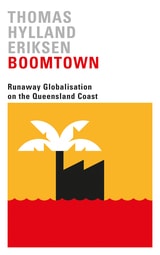
cover of Boomtown: Runaway Globalisation on the Queensland Coast

Boomtown

Runaway Globalisation on the Queensland Coast

Thomas Hylland Eriksen

Pluto Press, 2018

Sitting next to the Great Barrier Reef, steeped in coal and gas, the industrial boomtown of Gladstone, Australia embodies many of the contradictions of the “overheated” world: prosperous yet polluted, growing and developing, yet always on the precipice of crisis.
            Capturing Gladstone at the peak of its accelerated growth in 2013–14, Thomas Hylland Eriksen dissects here the boomtown phenomenon in all its profound ambivalence. Based on ethnographic fieldwork, the book examines local identity, family life, infrastructure, and local services and explores the tensions and resentments surrounding migrant workers.
            Writ large in Boomtown are the clashes of scale at the heart of the town’s contradictions, where the logic of big industry and the state compete with those of the individual and the local community and ecology, crystallizing the current crisis of political legitimacy that is unfurling all over the world.

 
[more]
cover of Breaking the Banks: Representations and Realities in New England Fisheries, 1866-1966

Breaking the Banks

Representations and Realities in New England Fisheries, 1866-1966

Matthew McKenzie

University of Massachusetts Press, 2018

With skillful storytelling, Matthew McKenzie weaves together the industrial, cultural, political, and ecological history of New England's fisheries through the story of how the Boston haddock fleet—one of the region's largest and most heavily industrialized—rose, flourished, and then fished itself into near oblivion before the arrival of foreign competition in 1961. This fleet also embodied the industry's change during this period, as it shucked its sail-and-oar, hook-and-line origins to embrace mechanized power and propulsion, more sophisticated business practices, and political engagement.

Books, films, and the media have long portrayed the Yankee fisherman's hard-scrabble existence, as he faced brutal weather on the open seas and unnecessary governmental restrictions. As McKenzie contends, this simplistic view has long betrayed commercial fisheries' sophisticated legislative campaigns in Washington, DC, as they sought federal subsidies and relief and, eventually, fewer constricting regulations. This clash between fisheries' representation and their reality still grips fishing communities today as they struggle to navigate age-old trends of fleet consolidation, stock decline, and intense competition.
[more]
cover of Bristlecone Pine in the White Mountains of California: Growth and Ring-Width Characteristics

Bristlecone Pine in the White Mountains of California

Growth and Ring-Width Characteristics

Harold C. Fritts

University of Arizona Press, 1969

Papers of the Laboratory of Tree-Ring Research, No. 4
“[An] excellent study of the bristlecone pine (Pinus aristata Engelm.) from the White Mountains of California . . . Many aspects of tree growth and a multitude of growth factors are considered in great detail. . . . An intensive study was made of six small, rather young trees using dendrographs, dendrometers, soil-moisture units, weather-recording instruments, and cambial sampling for the years 1962, 1963, and 1964. . . . The author has done an enormous amount of work in statistics, botany, and ecology.”—Arctic and Alpine Research
 
[more]
cover of Bureaucracy vs. Environment: The Environmental Costs of Bureaucratic Governance

Bureaucracy vs. Environment

The Environmental Costs of Bureaucratic Governance

John Baden and Richard L. Stroup, Editors

University of Michigan Press, 1981

Bureaucracy vs. Environment: The Environmental Costs of Bureaucratic Governance explores a provocative and under-examined reality: that the very institutions created to protect and manage America’s natural resources often become the source of environmental harm. Edited by John Baden and Richard L. Stroup and featuring contributions from prominent economists and policy analysts, this volume challenges the widely held assumption that bureaucratic governance and collective management are inherently more environmentally responsible than private enterprise.Drawing on frameworks such as property rights theory and public choice economics, the book demonstrates that when authority to manage resources is separated from responsibility for the consequences, self-interest and perverse incentives drive public decision-makers—just as they do in the private sector. Bureaucrats, operating outside the discipline of market pressures and profits, may consistently expand their agencies’ activities for personal or institutional gain, often at the expense of both taxpayers and the environment. Case studies on water management, public lands grazing, and energy policy show how these distorted incentives can lead to overexploitation, inefficiency, and environmental degradation.The collection not only critiques misplaced trust in bureaucratic benevolence but also highlights a surprising potential alliance between environmentalists and advocates of market-based solutions. The contributors argue that genuine environmental stewardship requires institutional reforms that link authority with responsibility, foster accountability, and harness incentives for efficiency.Both a warning and a call to action, Bureaucracy vs. Environment provides vital analytical tools for policymakers, scholars, and citizens interested in how to realistically align public institutions with the goals of environmental sustainability and economic sense. The book stands as a seminal contribution to the ongoing debate over the best ways to protect natural resources in the face of complex political and economic pressures.
[more]