Results by title
60 books match the query 'Evangelicalism' and 3 start with b

Battle for the Soul
Mètis Children Encounter Evangelical Protestants at Mackinaw Mission, 1823-1837Keith R. Widder
Michigan State University Press, 1999
In 1823 William and Amanda Ferry opened a boarding school for Métis children on Mackinac Island, Michigan Territory, setting in motion an intense spiritual battle to win the souls and change the lives of the children, their parents, and all others living at Mackinac. Battle for the Soul demonstrates how a group of enthusiastic missionaries, empowered by an uncompromising religious motivation, served as agents of Americanization. The Ferrys' high hopes crumbled, however, as they watched their work bring about a revival of Catholicism and their students refuse to abandon the fur trade as a way of life. The story of the Mackinaw Mission is that of people who held differing world views negotiating to create a "middle-ground," a society with room for all.
Widder's study is a welcome addition to the literature on American frontier missions. Using Richard White's "middle ground" paradigm, it focuses on the cultural interaction between French, British, American, and various native groups at the Mackinac mission in Michigan during the early 19th century. The author draws on materials from the American Board of Commissioners for Foreign Missions archives, as well as other manuscript sources, to trace not only the missionaries' efforts to Christianize and Americanize the native peoples, but the religious, social, and cultural conflicts between Protestant missionaries and Catholic priests in the region. Much attention has been given to the missionaries to the Indians in other areas of the US, but little to this region.
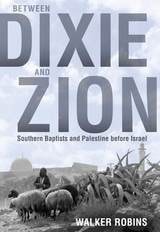
Between Dixie and Zion
Southern Baptists and Palestine before IsraelWalker Robins
University of Alabama Press, 2020
Explores the roots of evangelical Christian support for Israel through an examination of the Southern Baptist Convention
One week after the establishment of the State of Israel in 1948, delegates to the Southern Baptist Convention (SBC) repeatedly and overwhelmingly voted down resolutions congratulating fellow Southern Baptist Harry Truman on his role in Israel’s creation. From today’s perspective, this seems like a shocking result. After all, Christians—particularly the white evangelical Protestants who populate the SBC—are now the largest pro-Israel constituency in the United States. How could conservative evangelicals have been so hesitant in celebrating Israel’s birth in 1948? How did they then come to be so supportive?
Between Dixie and Zion: Southern Baptists and Palestine before Israel addresses these issues by exploring how Southern Baptists engaged what was called the “Palestine question”: whether Jews or Arabs would, or should, control the Holy Land after World War I. Walker Robins argues that, in the decades leading up to the creation of Israel, most Southern Baptists did not directly engage the Palestine question politically. Rather, they engaged it indirectly through a variety of encounters with the land, the peoples, and the politics of Palestine. Among the instrumental figures featured by Robins are tourists, foreign missionaries, Arab pastors, converts from Judaism, biblical interpreters, fundamentalist rebels, editorialists, and, of course, even a president. While all revered Palestine as the Holy Land, each approached and encountered the region according to their own priorities.
Nevertheless, Robins shows that Baptists consistently looked at the region through an Orientalist framework, broadly associating the Zionist movement with Western civilization, modernity, and progress over and against the Arabs, whom they viewed as uncivilized, premodern, and backward. He argues that such impressions were not idle—they suggested that the Zionists were bringing to fruition Baptists’ long-expressed hopes that Israel would regain the prosperity it had held in the biblical era, the Holy Land would one day be revived, and biblical prophecies preceding the return of Christ would be fulfilled.

Between Jesus and the Market
The Emotions that Matter in Right-Wing AmericaLinda Kintz
Duke University Press, 1997
With texts from such organizations as the Christian Coalition, the Heritage Foundation, and Concerned Women for America, and writings by Elizabeth Dole, Newt Gingrich, Pat Robertson, and Rush Limbaugh, Kintz traces the usefulness of this activism for the secular claim that conservative political economy is, in fact, simply an expression of the deepest and most admirable elements of human nature itself. The discussion of Limbaugh shows how he draws on the skepticism of contemporary culture to create a sense of absolute truth within his own media performance—its truth guaranteed by the market. Kintz also describes how conservative interpretations of the Holy Scriptures, the U.S. Constitution, and the Declaration of Independence have been used to challenge causes such as feminism, women’s reproductive rights, and gay and lesbian rights. In addition to critiquing the intellectual and political left for underestimating the power of right-wing grassroots organizing, corporate interests, and postmodern media sophistication, Between Jesus and the Market discusses the proliferation of militia groups, Christian entrepreneurship, and the explosive growth and "selling" of the Promise Keepers.