Results by title
80 books match the query 'Foreign economic relations' and 5 start with b
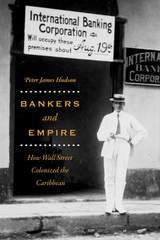
Bankers and Empire
How Wall Street Colonized the CaribbeanPeter James Hudson
University of Chicago Press, 2017
From the end of the nineteenth century until the onset of the Great Depression, Wall Street embarked on a stunning, unprecedented, and often bloody period of international expansion in the Caribbean. A host of financial entities sought to control banking, trade, and finance in the region. In the process, they not only trampled local sovereignty, grappled with domestic banking regulation, and backed US imperialism—but they also set the model for bad behavior by banks, visible still today. In Bankers and Empire, Peter James Hudson tells the provocative story of this period, taking a close look at both the institutions and individuals who defined this era of American capitalism in the West Indies. Whether in Wall Street minstrel shows or in dubious practices across the Caribbean, the behavior of the banks was deeply conditioned by bankers’ racial views and prejudices. Drawing deeply on a broad range of sources, Hudson reveals that the banks’ experimental practices and projects in the Caribbean often led to embarrassing failure, and, eventually, literal erasure from the archives.
[more]

Banking on Stability
Japan and the Cross-Pacific Dynamics of International Financial Crisis ManagementSaori N. Katada
University of Michigan Press, 2001
Saori N. Katada examines international financial stability in the aftermath of financial crises--and how such stability is maintained through collective action among major financial powers across the Pacific, the United States, and Japan. She explores the important role that financial support by the Japanese government played in solving the Latin American debt crisis in the 1980s, as well as its lack of support for the Mexican rescue in 1994--95 and its inconsistency during the recent Asian financial crisis.
Banking on Stability looks at Japan's willingness to cooperate financially with the United States--its most important trade partner--in cases where such compliance yields an improvement in relations. Katada argues that the Japanese government carefully weighs the benefits arising in international and domestic realms when taking on the role of collective crisis manager and concludes that Japan is no exception in having private gain as a central motivation during international financial crises.
Saori Katada is Assistant Professor, School of International Relations, University of Southern California.
[more]

Breeds of Empire
The Invention of the Horse in Southeast Asia and Southern Africa 1500-1950Edited by Greg Bankoff and Sandra Swart
National University of Singapore Press, 2007
Ships of empire carried not just merchandise, soldiers and administrators but also equine genes from as far afield as Europe, Arabia, the Americas, China and Japan. In the process, they introduced horses into parts of the world not native to that animal in historical times. As a result, horses in Thailand, the Philippine Horses, the Cape Horse in South Africa and the Basotho Pony in the mountain kingdom of Lesotho share a genetic lineage with the horse found in the Indonesian archipelago.This book explores the 'invention' of specific breeds of horse in the context of imperial design and colonial trade routes. Here, it focuses on the introduction, invention and use of the horse in Thailand, the Philippines and southern Africa as well as examining its roots and evolution within Indonesia. In addition, it examines the colonial trade in horses within the Indian Ocean and discusses the historiographical and methodological problems associated with writing a more species- or horse-centric history. This is a fascinating study that will appeal not only to scholars but also to the broad horse-reading public interested in all things equine.
[more]

Britain and the Greek Economic Crisis, 1944-1947
From Liberation to the Truman DoctrineAthanasios Lykogiannis
University of Missouri Press, 2002
Britainand the Greek Economic Crisis, 1944–1947 concentrates on Anglo-Greek interactions in economic matters during the political and economic turmoil between the Axis occupation of Greece and the Greek civil war. By analyzing the Greek crisis primarily in economic terms, Athanasios Lykogiannis avoids the political partisanship that has colored much previous writing on the subject and throws light on many issues neglected by earlier authors. Drawing on a range of untapped British, American, and Greek archival sources, as well as extensive secondary sources, the author examines the interplay of political and economic factors, such as the ingrained polarization of Greek society and the weakness and timidity of the country’s governments, that aggravated and prolonged the crisis.
Lykogiannis critically examines Greece’s policies, and the actors behind them, and assesses the British involvement in the episode: the quality of the measures recommended to the Greeks, the constraints facing British advisers in the country, and the reasons for the ultimate failure of British intervention. He also compares the two periods of western tutelage of Greece: the British and the American, from the announcement of the Truman Doctrine to the inauguration of the European Recovery Program.
Britain and the Greek Economic Crisis, 1944–1947 argues that even if the Germans were to blame for the conditions that led to hyperinflation, the mediocre results of successive attempts to stabilize the economy were caused by internal factors such as the fiscal ineptitude of the postwar Greek governments and their ignorance of, and hostility toward, any form of economic management. Whereas many have blamed foreign intervention for prolonging the crisis, Lykogiannis makes clear that the decisions of successive Greek governments were far more significant. His book demonstrates how firmly the crisis of post-liberation Greece was rooted in the country’s political, economic, and social past.
[more]
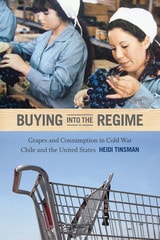
Buying into the Regime
Grapes and Consumption in Cold War Chile and the United StatesHeidi Tinsman
Duke University Press, 2014
Buying into the Regime is a transnational history of how Chilean grapes created new forms of consumption and labor politics in both the United States and Chile. After seizing power in 1973, Augusto Pinochet embraced neoliberalism, transforming Chile’s economy. The country became the world's leading grape exporter. Heidi Tinsman traces the rise of Chile's fruit industry, examining how income from grape production enabled fruit workers, many of whom were women, to buy the commodities—appliances, clothing, cosmetics—flowing into Chile, and how this new consumerism influenced gender relations, as well as pro-democracy movements. Back in the United States, Chilean and U.S. businessmen aggressively marketed grapes as a wholesome snack. At the same time, the United Farm Workers and Chilean solidarity activists led parallel boycotts highlighting the use of pesticides and exploitation of labor in grape production. By the early-twenty-first century, Americans may have been better informed, but they were eating more grapes than ever.
[more]