Results by title
484 books match the query 'Foreign relations' and 16 start with b
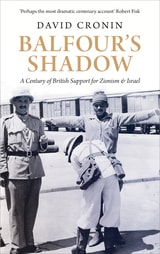
Balfour's Shadow
A Century of British Support for Zionism and IsraelDavid Cronin
Pluto Press, 2017
This is the infamous Balfour Declaration, which began one hundred years of conflict with the Palestinian people. Penned in 1917 by British Foreign Secretary Arthur James Balfour, these words had an immense impact on history that still emanates a century later. In the controversial, fast-paced Balfour’s Shadow, David Cronin traces the story of the rhetorical and practical assistance that Britain has given to the Zionist movement and the state of Israel since that day. Skillfully and engagingly written, Balfour’s Shadow uses previously unreleased sources and archives to reveal a new side to an old story. Cronin focuses on important historical events such as the Arab Revolt, the Nakba and establishment of the state, the ‘56 and ‘67 wars, the Cold War, and controversial public figures like Tony Blair. Marking the 100th anniversary of the Balfour Declaration, Cronin provides a fascinating take on this oft-maligned, important history.
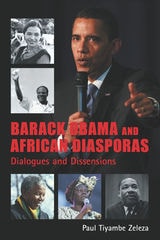
Barack Obama and African Diasporas
Dialogues and DissensionsPaul Tiyambe Zeleza
Ohio University Press, 2009
In the title essay, Zeleza analyzes the significance of the election of a member of the African diaspora to the presidency of the United States. He also addresses Africa’s urgent political concerns: China’s role in Africa, South Africa's difficulties in making the transition to a postapartheid society, the agony of Zimbabwe, and a discussion of Pan-Africanism, its history and contemporary challenges. Other posts introduce the reader to the rhythms of daily life, including football and other leisure activities, in capturing the different aspects of Africa.
An original and respected voice, Zeleza engages the reader in a series of passionate public conversations on issues and events of utmost importance to the globalized world. He deserves a wide readership.

Between East and West
Trieste, the United States, and the Cold War, 1941–1954Roberto G. Rabel
Duke University Press, 1988
Rabel explains the causes, significance, and consequences of American involvement in this classic European territorial dispute. The author sees U.S. involvement as closely linked to the larger issues of American participation in World War II and belief in democracy and self-determination, as well as to the subsequent unfolding of the Cold War. After 1945, Rabel asserts, American policy interest shifted to concern for Trieste due to its geographic and symbolic position between the Eastern and Western blocs. U.S. policies toward the Trieste issue were therefore shaped by several factors; a commitment to the principle of self-determination; the exigencies of maintaining stability and effective administration under the occupation; the need for close cooperation with the British; and the larger realities of the Cold War, especially in terms of American perceptions of the changing roles of Italy and Yugoslavia in that conflict. By examining the dynamic interplay of these factors, Between East and West seeks to explain the origins and evolution of U.S. Cold War policy, as well as its impact on the traditional American liberal principles of democracy and self-determination.

Beyond Left and Right
Insurgency and the EstablishmentDavid A. Horowitz
University of Illinois Press, 1997
Beyond Left and Right is a sweeping overview of political insurgency in the United States from the 1880s to the present. It is at once a stunning synthesis, drawing on a large number of scholarly works, and an ambitious and original piece of research. The book ranges over diverse individuals and groups that have attacked the established order, from the left and the right, from the Populists of the 1890s to Ross Perot and the religious right of our times, dealing along the way with non-interventionists, Klans, monetary radicals, McCarthyites, Birchers, and Reaganites, among many others.
Beyond Smoke and Mirrors
Mexican Immigration in an Era of Economic IntegrationDouglas S. Massey
Russell Sage Foundation, 2002
Bio-Imperialism
Disease, Terror, and the Construction of National FragilityGwen Shuni D'Arcangelis
Rutgers University Press, 2021

Biopower in Putin’s Russia
From Taking Care to Taking LivesSergei Medvedev
Central European University Press, 2024
In this book, Makarychev and Medvedev examine the importance of biopolitics in fueling Russia’s confrontation with the West. In their view, the development of Putin’s illiberal authoritarianism was largely triggered by what they call a biopolitical turn. This shift is exemplified by the use of an increasing number of regulatory mechanisms to discipline and constrain the human body. Such political practices concern issues of sexuality, reproductive behavior, adoption, fertility, family planning, public hygiene, and demography. This turn created a new disciplinary framework for the population and the elite. Bans and restrictions of a biopolitical nature, became one of the main tools for articulating the rules of belonging in the political community and drawing its political boundaries. Biopolitical discourses have taken up the core of the Russian identity formation, which contrasts a positive “conservative Russia” with a supposedly vicious “liberal West.”
The presentation of the political genealogy of the body-centric structures of power and hegemony in Russia implies their transformation from bio- to necropolitics. Necropolitical (repressive and life-depriving) components are inscribed in the biopolitical regimes of power: they form the core of Putin’s rule over Russia and are a key factor behind the war against Ukraine.
Blessings from Beijing
Inside China's Soft-Power War on TibetGreg C. Bruno
University Press of New England, 2018
Body and Nation
The Global Realm of U.S. Body Politics in the Twentieth CenturyEmily S. Rosenberg and Shanon Fitzpatrick, eds.
Duke University Press, 2014
Contributors. Frank Costigliola, Janet M. Davis, Shanon Fitzpatrick, Paul A. Kramer, Shirley Jennifer Lim, Mary Ting Yi Lui, Natalia Molina, Brenda Gayle Plummer, Emily S. Rosenberg, Kristina Shull, Annessa C. Stagner, Marilyn B. Young
Border Diplomacy
The Caroline and McLeod Affairs in Anglo-American-Canadian Relations, 1837-1842Kenneth R. Stevens
University of Alabama Press, 1989
Long after Americans and Britons signed treaties ending the Revolutionary War and the War of 1812, ill will between the two nations simmered under the surface of their relations and periodically boiled over. In the mid-nineteenth century, Americans, the British, and British subjects in Canada continued to dispute borders, sovereign rights and responsibilities, and the American republican experiment.
Some of the antagonism arose from a fundamental difference in attitude toward democracy. Britons believed that democratic government was inadequate to control the baser elements of a population. Further, they disliked the aggressiveness and arrogance of their former colonists. Americans sensed and resented this contempt; in turn, they regarded British aristocratic pretensions with scorn and believed that country sought world domination. In view of such attitudes, even relatively minor incidents threatened to erupt into violence between the two nations. Such was the case in 1837, when British troops set fire to the American steamer Caroline in American waters, killing a United States citizen, and in 1840, when the state of New York arrested a Canadian, Alexander McLeod, for the murder.
These events, taken together, are not simply examples of diplomatic relations or political problems for particular administrations. The dash of attitudes and loyalties along the American-Canadian frontier also demonstrates the instability of the border region, socially as well as politically, and conflicting motives of patriotism and political opportunism in both the American and British governments. Thus, the Caroline and McLeod affairs, occurring as they did at a pivotal moment in American history, reveal how the republic began to mature in its relations with its long-established forebear, refined its own definitions of state and federal powers, and established itself as a nation contributing to, as well as influenced by, international law.
Border Odyssey
Travels along the U.S./Mexico DivideBy Charles D. Thompson, Jr.
University of Texas Press, 2015
“We were trying to change the vision and the conversation about border fears.”
Border Odyssey takes us on a drive toward understanding the U.S./Mexico divide: all 1,969 miles—from Boca Chica to Tijuana—pressing on with the useful fiction of a map.
“We needed to go to the place where countless innocent people had been kicked, cussed, spit on, arrested, detained, trafficked, and killed. It would become clear that the border, la frontera, was more multifaceted and profound than anything we could have invented about it from afar.”
Along the journey, five centuries of cultural history (indigenous, French, Spanish, Mexican, African American, colonist, and U.S.), wars, and legislation unfold. And through observation, conversation, and meditation, Border Odyssey scopes the stories of the people and towns on both sides.
“Stories are the opposite of walls: they demand release, retelling, showing, connecting, each image chipping away at boundaries. Walls are full stops. But stories are like commas, always making possible the next clause.”
Among the terrain traversed: walls and more walls, unexpected roadblocks and patrol officers; a golf course (you could drive a ball across the border); a Civil War battlefield (you could camp there); the southernmost plantation in the United States; a hand-drawn ferry, a road-runner tracked desert, and a breathtaking national park; barbed wire, bridges, and a trucking-trade thoroughfare; ghosts with guns; obscured, unmarked, and unpaved roads; a Catholic priest and his dogs, artwork, icons, and political cartoons; a sheriff and a chain-smoking mayor; a Tex-Mex eatery empty of customers and a B&B shuttering its doors; murder-laden newspaper headlines at breakfast; the kindness of the border-crossing underground; and too many elderly, impoverished, ex-U.S. farmworkers, braceros, lined up to have Thompson take their photograph.
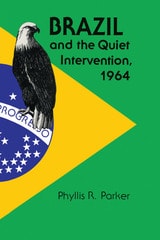
Brazil and the Quiet Intervention, 1964
By Phyllis R. Parker
University of Texas Press, 1979
When the Brazilian military overthrew President João Goulart in 1964, American diplomats characterized the coup as a "100 percent Brazilian movement." It has since become apparent, largely through government documents declassified during the course of research for this book, that the United States had an invisible but pervasive part in the coup.
Relying principally on documents from the Johnson and Kennedy presidential libraries, Phyllis Parker unravels the events of the coup in fascinating detail. The evidence she presents is corroborated by interviews with key participants.
U.S. interference in the Goulart regime began when normal diplomatic pressure failed to produce the desired enthusiasm from him for the Alliance of Progress. Political and economic manipulations also proving ineffective, the United States stood ready to back a military takeover of Brazil's constitutional democracy.
U.S. operation "Brother Sam" involved shipments of petroleum, a naval task force, and tons of arms and ammunition in preparation for intervention during the 1964 coup. When the Brazilian military gained control without calling on the ready assistance, U.S. policy makers immediately accorded recognition to the new government and set in motion plans for economic support.
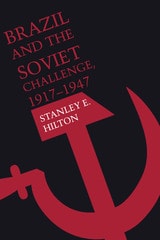
Brazil and the Soviet Challenge, 1917–1947
By Stanley E. Hilton
University of Texas Press, 1991
Between 1918 and 1961, Brazil and the USSR maintained formal diplomatic ties for only thirty-one months, at the end of World War II. Yet, despite the official distance, the USSR is the only external actor whose behavior, real or imagined, influenced the structure of the Brazilian state in the twentieth century. In Brazil and the Soviet Challenge, 1917–1947, Stanley Hilton provides the first analysis in any language of Brazilian policy toward the Soviet Union during this period.
Drawing on American, British, and German diplomatic archives and unprecedented access to official and private Brazilian records, Hilton elucidates the connection between the Brazilian elite’s perception of a communist threat and the creation of the authoritarian Estado Novo (1937–1945), the forerunner of the post-1964 national security state. He shows how the 1935 communist revolt, prepared by Comintern agents, was a pivotal event in Brazilian history, making prophets of conservative alarmists and generating irresistible pressure for an authoritarian government to contain the Soviet threat. He details the Brazilian government’s secret cooperation with the Gestapo during the 1930s and its concomitant efforts to forge an anti-Soviet front in the Southern Cone. And he uncovers an unexplored aspect of Brazil’s national security policy, namely, the attempt to build counterintelligence capabilities not only within Brazil but also in neighboring countries.
While the history of the Brazilian communist movement has been extensively studied, this is the first work to explore how images of the Soviet Union and its policies influenced the Brazilian foreign policy elite. It will be important reading for all students of twentieth-century political history.
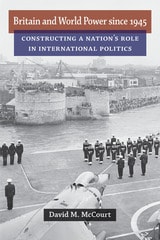
Britain and World Power since 1945
Constructing a Nation's Role in International PoliticsDavid M. McCourt
University of Michigan Press, 2014

Britain, France and the Decolonization of Africa
Future Imperfect?Edited by Andrew W.M. Smith and Chris Jeppesen
University College London, 2017
Building the Cold War Consensus
The Political Economy of U.S. National Security Policy, 1949-51Benjamin O. Fordham
University of Michigan Press, 1998