Results by title
522 books match the query 'Gender' and 17 start with b
Beyond Partition
Gender, Violence and Representation in Postcolonial IndiaDeepti Misri
University of Illinois Press, 2014
Deepti Misri shows how Partition began a history of politicized animosity associated with the differing ideas of ""India"" held by communities and in regions on one hand, and by the political-military Indian state on the other. She moves beyond that formative national event, however, in order to examine other forms of gendered violence in the postcolonial life of the nation, including custodial rape, public stripping, deturbanning, and enforced disappearances. Assembling literary, historiographic, performative, and visual representations of gendered violence against women and men, Misri establishes that cultural expressions do not just follow violence but determine its very contours, and interrogates the gendered scripts underwriting the violence originating in the contested visions of what ""India"" means.
Ambitious and ranging across disciplines, Beyond Partition offers both an overview of and nuanced new perspectives on the ways caste, identity, and class complicate representations of violence, and how such representations shape our understandings of both violence and India.

Beyond Terror
Gender, Narrative, Human RightsElizabeth Swanson Goldberg
Rutgers University Press, 2007
In traditional narrative contexts-legal, psychoanalytic, and documentary-the ethics of representing violations of human rights are widely acknowledged. But what are the principles that guide the creation and dissemination of historically based fictional narratives? Are such representations capable of shaping, changing, or even effectively depicting "real" human atrocities? How do existing ideas about gender influence the way these narratives are written and perceived?
In Beyond Terror , Elizabeth Swanson Goldberg argues that after human rights violations have occurred, the realm of representation-actual and fictional-is precisely the ground upon which struggles for justice and peace are waged in legal, emotional, and cultural terms. Moving beyond the myriad of fictional accounts that have portrayed the carnage of World War II, the Holocaust, and the Vietnam War, Goldberg focuses on emerging narratives about recent abuses, including those in South Africa, Rwanda, and Iraq.
Through the lens of literary, feminist, and human rights theory, this important book examines the meaning and influence of films such as Cry Freedom, Three Kings, and Salvador , and novels such as Gil Courtemanche's A Sunday at the Pool in Kigali , Pat Barker's Double Vision , and Edwidge Danticat's The Farming of Bones .
Beyond the Typewriter
Gender, Class, and the Origins of Modern American Office Work, 1900-1930Sharon Hartman Strom
University of Illinois Press, 1992
Blindness Through the Looking Glass
The Performance of Blindness, Gender, and the Sensory BodyGili Hammer
University of Michigan Press, 2019
Bodies on the Front Lines
Performance, Gender, and Sexuality in Latin America and the CaribbeanBrenda Werth and Katherine Zien, Editors
University of Michigan Press, 2024
The volume’s contributors draw from rich legacies of theater, performance, and activism in the region, as well as decolonial and intersectional theorizing, to demonstrate the ways that performance practices enable activists to sustain their movements. The chapters engage diverse perspectives from Argentina, Brazil, Bolivia, Chile, Colombia, Cuba, the Dominican Republic, transnational Central America, Peru, Puerto Rico, and Mexico.
Rather than taking an approach that simplifies complexities among states, Bodies on the Front Lines takes seriously the geopolitical stakes of examining Latin America and the Caribbean as a heterogeneous site of nations and networks. In chapters covering this wide geographical area, leading scholars in the fields of theater and performance studies showcase the aesthetic, social, and political work of performance in generating and fortifying gender and sexual activism in the Americas.
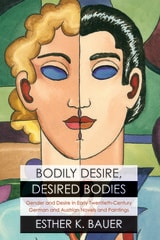
Bodily Desire, Desired Bodies
Gender and Desire in Early Twentieth-Century German and Austrian Novels and PaintingsEsther K. Bauer
Northwestern University Press, 2014
Bodily Desire, Desired Bodies examines the diverse ways that literary works and paintings can be read as screens onto which new images of masculinity and femininity are cast. Esther Bauer focuses on German and Austrian writers and artists from the 1910s and 1920s —specifically authors Franz Kafka, Vicki Baum, and Thomas Mann, and painters Otto Dix, Christian Schad, and Egon Schiele—who gave spectacular expression to shifting trends in male and female social roles and the organization of physical desire and the sexual body.
Bauer’s comparative approach reveals the ways in which artists and writers echoed one another in undermining the gender duality and highlighting sexuality and the body. As she points out, as sites of negotiation and innovation, these works reconfigured bodies of desire against prevailing notions of sexual difference and physical attraction and thus became instruments of social transformation.

Body Against Soul
Gender and Sowlehele in Middle English AllegoryMasha Raskolnikov
The Ohio State University Press, 2009
The topic of this book is one that runs through all of Western history and remains of primary interest to modern theorists—how “my” body relates to “me.” In the allegorical tradition traced by this study, a male person could imagine himself as a being populated by female personifications, because Latin and Romance languages tended to gender abstract nouns as female. However, since Middle English had ceased to inflect abstract nouns as male or female, writers were free to gender abstractions like “Will” or “Reason” any way they liked. This permitted some psychological allegories to avoid the representational tension caused by placing a female soul inside a male body, instead creating surprisingly queer same-sex inner worlds. The didactic intent driving sowlehele is, it turns out, complicated by the erotics of the struggle to establish a hierarchy of the self’s inner powers.
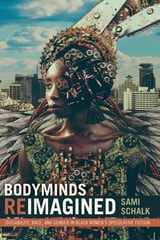
Bodyminds Reimagined
(Dis)ability, Race, and Gender in Black Women's Speculative FictionSami Schalk
Duke University Press, 2018
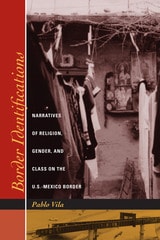
Border Identifications
Narratives of Religion, Gender, and Class on the U.S.-Mexico BorderBy Pablo Vila
University of Texas Press, 2005
From poets to sociologists, many people who write about life on the U.S.-Mexico border use terms such as "border crossing" and "hybridity" which suggest that a unified culture—neither Mexican nor American, but an amalgamation of both—has arisen in the borderlands. But talking to people who actually live on either side of the border reveals no single commonly shared sense of identity, as Pablo Vila demonstrated in his book Crossing Borders, Reinforcing Borders: Social Categories, Metaphors, and Narrative Identities on the U.S.-Mexico Frontier. Instead, people living near the border, like people everywhere, base their sense of identity on a constellation of interacting factors that includes regional identity, but also nationality, ethnicity, and race.
In this book, Vila continues the exploration of identities he began in Crossing Borders, Reinforcing Borders by looking at how religion, gender, and class also affect people's identifications of self and "others" among Mexican nationals, Mexican immigrants, Mexican Americans, Anglos, and African Americans in the Cuidad Juárez-El Paso area. Among the many fascinating issues he raises are how the perception that "all Mexicans are Catholic" affects Mexican Protestants and Pentecostals; how the discourse about proper gender roles may feed the violence against women that has made Juárez the "women's murder capital of the world"; and why class consciousness is paradoxically absent in a region with great disparities of wealth. His research underscores the complexity of the process of social identification and confirms that the idealized notion of "hybridity" is only partially adequate to define people's identity on the U.S.-Mexico border.
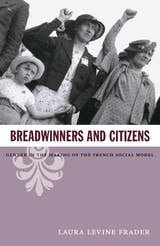
Breadwinners and Citizens
Gender in the Making of the French Social ModelLaura Levine Frader
Duke University Press, 2008
Frader’s analysis moves between the everyday lives of ordinary working women and men and the actions of national policymakers, political parties, and political movements, including feminists, pro-natalists, and trade unionists. In the years following World War I, the many women and an increasing number of immigrant men in the labor force competed for employment and pay. Family policy was used not only to encourage reproduction but also to regulate wages and the size of the workforce. Policies to promote married women’s and immigrants’ departure from the labor force were more common when jobs were scarce, as they were during the Depression. Frader contends that gender and ethnicity exerted a powerful and unacknowledged influence on French social policy during the Depression era and for decades afterward.

Breaking the Chains
Gender, Context, and the Politics of Writing in Modern ChinaDong Limin
Seagull Books, 2025
How has literature shaped gender politics in modern China? How has the concept of “woman” evolved within the shifting sociopolitical landscape? Old Chains and New delves into these questions by examining the dynamic interplay between literature, gender, and historical change. Drawing from literary studies, history, and sociology, this book reveals how women’s writing has not only reflected but also actively shaped cultural and national transformations.
From the late Qing era, when the “woman question” emerged as part of China’s response to imperialist pressures, to the ongoing evolution of feminist literary scholarship, this study argues that gender and literature are deeply interwoven. Women’s liberation in modern China was never solely about gender equality—it became a driving force for broader social change and national identity formation. Engaging with the complexities of women’s literature through a cultural-political lens, this book challenges static definitions and calls for a reevaluation of women’s literature not just as a literary category but as a key component in shaping China’s modern intellectual and cultural history.
By adopting the framework of “China as method,” Old Chains and New reimagines the role of literature in ideological and cultural shifts. It highlights women’s writing as a unique form of aesthetic politics—one with the power to intervene in and transform reality.

Bringing It All Back Home
Class, Gender and Power in the Modern Household TodayPluto Press, 1994

Bringing the Empire Home
Race, Class, and Gender in Britain and Colonial South AfricaZine Magubane
University of Chicago Press, 2003
Bringing the Empire Home tracks colonial images of blackness from South Africa to England and back again to answer questions such as these. Before the mid-1800s, black Africans were considered savage to the extent that their plight mirrored England's internal Others—women, the poor, and the Irish. By the 1900s, England's minority groups were being defined in relation to stereotypes of black South Africans. These stereotypes, in turn, were used to justify both new capitalist class and gender hierarchies in England and the subhuman treatment of blacks in South Africa. Bearing this in mind, Zine Magubane considers how marginalized groups in both countries responded to these racialized representations.
Revealing the often overlooked links among ideologies of race, class, and gender, Bringing the Empire Home demonstrates how much black Africans taught the English about what it meant to be white, poor, or female.
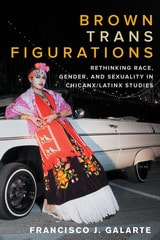
Brown Trans Figurations
Rethinking Race, Gender, and Sexuality in Chicanx/Latinx StudiesBy Francisco J. Galarte
University of Texas Press, 2021
Honorable Mention for the National Women’s Studies Association's 2021 Gloria E. Anzaldúa Book Prize
2021 Finalist Best LGBTQ+ Themed Book, International Latino Book Awards
2022 John Leo & Dana Heller Award for Best Single Work, Anthology, Multi-Authored, or Edited Book in LGBTQ Studies, Popular Culture Association
The Alan Bray Memorial Book Prize, GL/Q Caucus, Modern Language Association (MLA)
2022 AAHHE Book of the Year Award, American Association of Hispanics in Higher Education
Within queer, transgender, and Latinx and Chicanx cultural politics, brown transgender narratives are frequently silenced and erased. Brown trans subjects are treated as deceptive, unnatural, nonexistent, or impossible, their bodies, lives, and material circumstances represented through tropes and used as metaphors. Restoring personhood and agency to these subjects, Francisco J. Galarte advances “brown trans figuration” as a theoretical framework to describe how transness and brownness coexist within the larger queer, trans, and Latinx historical experiences.
Brown Trans Figurations presents a collection of representations that reveal the repression of brown trans narratives and make that repression visible and palpable. Galarte examines the violent deaths of two transgender Latinas and the corresponding narratives that emerged about their lives, analyzes the invisibility of brown transmasculinity in Chicana feminist works, and explores how issues such as transgender politics can be imagined as part of Chicanx and Latinx political movements. This book considers the contexts in which brown trans narratives appear, how they circulate, and how they are reproduced in politics, sexual cultures, and racialized economies.
Brown on Brown
Chicano/a Representations of Gender, Sexuality, and EthnicityBy Frederick Luis Aldama
University of Texas Press, 2005
Common conceptions permeating U.S. ethnic queer theory tend to confuse aesthetics with real-world acts and politics. Often Chicano/a representations of gay and lesbian experiences in literature and film are analyzed simply as propaganda. The cognitive, emotional, and narrational ingredients (that is, the subject matter and the formal traits) of those representations are frequently reduced to a priori agendas that emphasize a politics of difference.
In this book, Frederick Luis Aldama follows an entirely different approach. He investigates the ways in which race and gay/lesbian sexuality intersect and operate in Chicano/a literature and film while taking into full account their imaginative nature and therefore the specific kind of work invested in them. Also, Aldama frames his analyses within today's larger (globalized) context of postcolonial literary and filmic canons that seek to normalize heterosexual identity and experience. Throughout the book, Aldama applies his innovative approach to throw new light on the work of authors Arturo Islas, Richard Rodriguez, John Rechy, Ana Castillo, and Sheila Ortiz Taylor, as well as that of film director Edward James Olmos. In doing so, Aldama aims to integrate and deepen Chicano literary and filmic studies within a comparative perspective. Aldama's unusual juxtapositions of narrative materials and cultural personae, and his premise that literature and film produce fictional examples of a social and historical reality concerned with ethnic and sexual issues largely unresolved, make this book relevant to a wide range of readers.

Bubbles and Machines
Gender, Information and Financial CrisesMicky Lee
University of Westminster Press, 2019
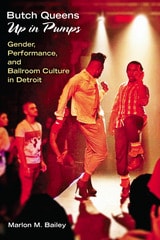
Butch Queens Up in Pumps
Gender, Performance, and Ballroom Culture in DetroitMarlon M. Bailey
University of Michigan Press, 2013
Butch Queens Up in Pumpsexamines Ballroom culture, in which inner-city LGBT individuals dress, dance, and vogue to compete for prizes and trophies. Participants are affiliated with a house, an alternative family structure typically named after haute couture designers and providing support to this diverse community. Marlon M. Bailey’s rich first-person performance ethnography of the Ballroom scene in Detroit examines Ballroom as a queer cultural formation that upsets dominant notions of gender, sexuality, kinship, and community.