Results by title
97 books match the query 'Geopolitics' and 7 start with b
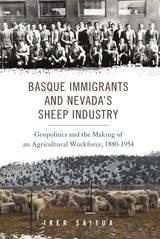
Basque Immigrants and Nevada's Sheep Industry
Geopolitics and the Making of an Agricultural Workforce, 1880-1954Iker Saitua
University of Nevada Press, 2019
Basque Immigrants and Nevada’s Sheep Industry is a rich and complex exploration of the history of Basque immigration to the rangelands of Nevada and the interior West. It looks critically at the Basque sheepherders in the American West and more broadly at the modern history of American foreign relations with Spain after the Second World War.
Between the 1880s and the 1950s, the western open-range sheep industry was the original economic attraction for Basque immigrants. This engaging study tracks the development of the Basque presence in the American West, providing deep detail about the sheepherders’ history, native and local culture, the challenges they faced, and the changing conditions under which the Basques lived and worked. Saitua also shows how Basque immigrant sheepherders went from being a marginalized labor group to a desirable, high-priced workforce in response to the constant demand for their labor power.
As the twentieth century progressed, the geopolitical tide in America began to change. In 1924, the Restrictive Immigration Act resulted in a truncated labor supply from the Basque Country in Spain. During the Great Depression and the Second World War, the labor shortage became acute. In response, Senator Patrick McCarran from Nevada lobbied on behalf of his wool-growing constituency to open immigration doors for Basques, the most desirable laborers for tending sheep in remote places. Subsequently, Cold War international tensions offered opportunities for a reconciliation between the United States and Francisco Franco, despite Spain’s previous sympathy with the Axis powers.
This fresh portrayal shows how Basque immigrants became the backbone of the sheep industry in Nevada. It also contributes to a wider understanding of the significance of Basque immigration by exploring the role of Basque agricultural labor in the United States, the economic interests of Western ranchers, and McCarran’s diplomacy as catalysts that eventually helped bring Spain into the orbit of western democracies.
[more]
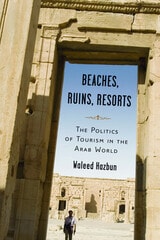
Beaches, Ruins, Resorts
The Politics of Tourism in the Arab WorldWaleed Hazbun
University of Minnesota Press, 2008
How Arab states use tourism for their own ends
Despite being viewed as a dangerous region to visit, leisure travel across the Middle East has thrived even in the post–9/11 era. In Beaches, Ruins, Resorts, Waleed Hazbun investigates this overlooked industry to show how tourism is shaping the economic development and international relations of the region in dramatic ways.
Following Europeans seeking Mediterranean beaches, Israelis crossing into Jordan as leisure tourists, and visitors discovering Dubai, Hazbun offers an original perspective on the Middle East and North Africa and challenges common portrayals of Arab nations as disconnected from the rest of the world. Rather, Hazbun reveals how government elites are using tourism to take part in globalization while, at the same time, crafting it to serve state interests. Paradoxically, the expansion of travel in the region has allowed states to encourage integration into the global economy while simultaneously expanding control over their society. Beaches, Ruins, Resorts also explores tourism’s broader beneficial effects on the region, such as aiding the peace process between Israel and Jordan, fostering Tunisia’s economic connection with Europe, and transforming Arab cities into hubs of international travel.Hazbun tells the new and surprising story of how the draw of glittering beaches, luxury hotels and resorts, and sightseeing at ancient ruins impacts the Arab world—promoting both economic globalization and political authoritarianism. In doing so, Beaches, Ruins, Resorts provides a much-needed guide for those interested in the changing nature of this fraught region and its place in the world.[more]
Beyond Britannia
Reshaping UK Foreign PolicySimon McDonald
Haus Publishing, 2023
An argument for a new approach to foreign policy in the United Kingdom.
What should the future of British foreign policy look like? For too long, successive governments have shied away from acknowledging uncomfortable truths about the decline of Britain’s military capabilities. As we approach the middle years of the twenty-first century, a new set of urgent and daunting challenges lie ahead, including climate change, technological development, the rise of AI, and a growing threat from China. The need for us to reconcile ourselves with our position in the world has never been more acute. In Beyond Britannia: Reshaping UK Foreign Policy, Simon McDonald persuasively argues that the United Kingdom’s significant soft-power strengths can be harnessed to expand its international influence. Such a shift will only be possible, he says, if we first acknowledge the challenges of Brexit and the need to reduce our unrealistic hard-power ambitions. Excellence in areas that other countries care about will keep the United Kingdom internationally relevant in the second half of the century in a way that nostalgia for a lost pre-eminence will not.
What should the future of British foreign policy look like? For too long, successive governments have shied away from acknowledging uncomfortable truths about the decline of Britain’s military capabilities. As we approach the middle years of the twenty-first century, a new set of urgent and daunting challenges lie ahead, including climate change, technological development, the rise of AI, and a growing threat from China. The need for us to reconcile ourselves with our position in the world has never been more acute. In Beyond Britannia: Reshaping UK Foreign Policy, Simon McDonald persuasively argues that the United Kingdom’s significant soft-power strengths can be harnessed to expand its international influence. Such a shift will only be possible, he says, if we first acknowledge the challenges of Brexit and the need to reduce our unrealistic hard-power ambitions. Excellence in areas that other countries care about will keep the United Kingdom internationally relevant in the second half of the century in a way that nostalgia for a lost pre-eminence will not.
[more]
Beyond Britannia
Reshaping UK Foreign PolicySimon McDonald
Haus Publishing, 2023
An argument for a new approach to foreign policy in the United Kingdom.
What should the future of British foreign policy look like? For too long, successive governments have shied away from acknowledging uncomfortable truths about the decline of Britain’s military capabilities. As we approach the middle years of the twenty-first century, a new set of urgent and daunting challenges lie ahead, including climate change, technological development, the rise of AI, and a growing threat from China. The need for us to reconcile ourselves with our position in the world has never been more acute. In Beyond Britannia: Reshaping UK Foreign Policy, Simon McDonald persuasively argues that the United Kingdom’s significant soft-power strengths can be harnessed to expand its international influence. Such a shift will only be possible, he says, if we first acknowledge the challenges of Brexit and the need to reduce our unrealistic hard-power ambitions. Excellence in areas that other countries care about will keep the United Kingdom internationally relevant in the second half of the century in a way that nostalgia for a lost pre-eminence will not.
What should the future of British foreign policy look like? For too long, successive governments have shied away from acknowledging uncomfortable truths about the decline of Britain’s military capabilities. As we approach the middle years of the twenty-first century, a new set of urgent and daunting challenges lie ahead, including climate change, technological development, the rise of AI, and a growing threat from China. The need for us to reconcile ourselves with our position in the world has never been more acute. In Beyond Britannia: Reshaping UK Foreign Policy, Simon McDonald persuasively argues that the United Kingdom’s significant soft-power strengths can be harnessed to expand its international influence. Such a shift will only be possible, he says, if we first acknowledge the challenges of Brexit and the need to reduce our unrealistic hard-power ambitions. Excellence in areas that other countries care about will keep the United Kingdom internationally relevant in the second half of the century in a way that nostalgia for a lost pre-eminence will not.
[more]
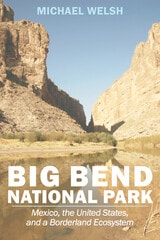
Big Bend National Park
Mexico, the United States, and a Borderland EcosystemMichael Welsh
University of Nevada Press, 2021
Known as a place of stark beauty, dramatic geographic dimension, and challenging desert terrain, Big Bend National Park is located in West Texas on the north bank of the Rio Grande, adjacent to the Mexican states of Coahuila and Chihuahua. Although a place of natural grandeur, the unique location of this 118-mile long, 1.5 million-acre corridor has led to many challenges between the United States and Mexico, two nations who share one ecosystem but inhabit different political worlds.
Big Bend National Park explores the cultural and diplomatic history of this transborder region that was designated a national park on the US side and the site of a long-hoped-for “international peace park” on the other. Michael Welsh demonstrates the challenges faced and lessons learned by both the US and Mexico as they struggled against political and environmental vicissitudes in their attempts to realize the creation of a shared frontier.
Geopolitical and environmental conflicts such as Cold War fears, immigration, the war on drugs, international water rights, and more stringent American border security measures after 9/11 all hindered relations between the two countries. But more recently, renewed cooperation and ongoing diplomatic relations have led to new developments. Mexican park personnel began assisting American officials with efforts to re-wild the American side of the river with animal species that had been eliminated, and the Obama administration relaxed some post-9/11 restrictions, allowing American visitors to cross over to the Mexican park and its nearby towns.
The ambition of developing a park for peace has yet to materialize, even as individuals and their governments continue to work toward an accord. Big Bend National Park provides a greater understanding of this complex borderland and hopes to help fulfill the aspiration of creating a shared ecosystem and the dream of a park for peace.
[more]
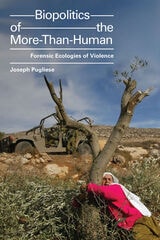
Biopolitics of the More-Than-Human
Forensic Ecologies of ViolenceJoseph Pugliese
Duke University Press, 2020
In Biopolitics of the More-Than-Human Joseph Pugliese examines the concept of the biopolitical through a nonanthropocentric lens, arguing that more-than-human entities—from soil and orchards to animals and water—are actors and agents in their own right with legitimate claims to justice. Examining occupied Palestine, Guantánamo, and sites of US drone strikes in Afghanistan, Pakistan, Somalia, and Yemen, Pugliese challenges notions of human exceptionalism by arguing that more-than-human victims of war and colonialism are entangled with and subject to the same violent biopolitical regimes as humans. He also draws on Indigenous epistemologies that invest more-than-human entities with judicial standing to argue for an ethico-legal framework that will enable the realization of ecological justice. Bringing the more-than-human world into the purview of justice, Pugliese makes visible the ecological effects of human war that would otherwise remain outside the domains of biopolitics and law.
[more]
Biopolitics, Geopolitics, Life
Settler States and Indigenous PresenceRené Dietrich and Kerstin Knopf, editors
Duke University Press, 2023
The contributors to Biopolitics, Geopolitics, Life investigate biopolitics and geopolitics as two distinct yet entangled techniques of settler-colonial states across the globe, from the Americas and Hawai‘i to Australia and Aotearoa/New Zealand. Drawing on literary and cultural studies, social sciences, political theory, visual culture, and film studies, they show how biopolitics and geopolitics produce norms of social life and land use that delegitimize and target Indigenous bodies, lives, lands, and political formations. Among other topics, the contributors explore the representations of sexual violence against Native women in literature, Indigenous critiques of the carceral state in North America, Indigenous elders’ refusal of dominant formulations of aging, the governance of Indigenous peoples in Guyana, the displacement of Guaraní in Brazil, and the 2016 rule to formally acknowledge a government-to-government relationship between the US federal government and the Native Hawaiian community. Throughout, the contributors contend that Indigenous life and practices cannot be contained and defined by the racialization and dispossession of settler colonialism, thereby pointing to the transformative potential of an Indigenous-centered decolonization.
Contributors René Dietrich, Jacqueline Fear-Segal, Mishuana Goeman, Alyosha Goldstein, Sandy Grande, Michael R. Griffiths, Shona N. Jackson, Kerstin Knopf, Sabine N. Meyer, Robert Nichols, Mark Rifkin, David Uahikeaikaleiʻohu Maile
Contributors René Dietrich, Jacqueline Fear-Segal, Mishuana Goeman, Alyosha Goldstein, Sandy Grande, Michael R. Griffiths, Shona N. Jackson, Kerstin Knopf, Sabine N. Meyer, Robert Nichols, Mark Rifkin, David Uahikeaikaleiʻohu Maile
[more]