Results by title
66 books match the query 'Government & Business' and 2 start with b
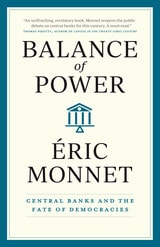
Balance of Power
Central Banks and the Fate of DemocraciesÉric Monnet
University of Chicago Press, 2024
Central banks now stand between societies and collapse, but are they still democratic?
Two decades of financial crises have dramatically expanded central banks’ powers. In 2008, and then again in 2020, unelected banking officials found themselves suddenly responsible for the public welfare—not just because it was necessary but based on an idea that their independence from political systems would insulate them from the whims of populism. Now, as international crises continue and the scope of monetary interventions grows in response, these bankers have become increasingly powerful.
In Balance of Power, economist and historian Éric Monnet charts the rise of central banks as the nominally independent—but unavoidably political—superpowers of modern societies. This trajectory, Monnet argues, is neither inevitable nor unstoppable. By embracing the political natures of today’s central banks, we can construct systems of accountability for how they interact with states and societies. Monnet shows that this effort will do more than guard against unjust power; it will put the banks to work for greater, more democratic ends.
With existential challenges looming and the work of the Federal Reserve and European Central Bank more important than ever, Balance of Power offers a trenchant case for what this century’s central banks can—and must—become.
[more]
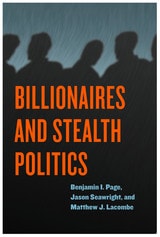
Billionaires and Stealth Politics
Benjamin I. Page, Jason Seawright, and Matthew J. Lacombe
University of Chicago Press, 2018
In 2016, when millions of Americans voted for Donald Trump, many believed his claims that personal wealth would free him from wealthy donors and allow him to “drain the swamp.” But then Trump appointed several billionaires and multimillionaires to high-level positions and pursued billionaire-friendly policies, such as cutting corporate income taxes. Why the change from his fiery campaign rhetoric and promises to the working class? This should not be surprising, argue Benjamin I. Page, Jason Seawright, and Matthew J. Lacombe: As the gap between the wealthiest and the rest of us has widened, the few who hold one billion dollars or more in net worth have begun to play a more and more active part in politics—with serious consequences for democracy in the United States.
Page, Seawright, and Lacombe argue that while political contributions offer a window onto billionaires’ influence, especially on economic policy, they do not present a full picture of policy preferences and political actions. That is because on some of the most important issues, including taxation, immigration, and Social Security, billionaires have chosen to engage in “stealth politics.” They try hard to influence public policy, making large contributions to political parties and policy-focused causes, leading policy-advocacy organizations, holding political fundraisers, and bundling others’ contributions—all while rarely talking about public policy to the media. This means that their influence is not only unequal but also largely unaccountable to and unchallengeable by the American people. Stealth politics makes it difficult for ordinary citizens to know what billionaires are doing or mobilize against it. The book closes with remedies citizens can pursue if they wish to make wealthy Americans more politically accountable, such as public financing of political campaigns and easier voting procedures, and notes the broader types of reforms, such as a more progressive income tax system, that would be needed to increase political equality and reinvigorate majoritarian democracy in the United States.
Page, Seawright, and Lacombe argue that while political contributions offer a window onto billionaires’ influence, especially on economic policy, they do not present a full picture of policy preferences and political actions. That is because on some of the most important issues, including taxation, immigration, and Social Security, billionaires have chosen to engage in “stealth politics.” They try hard to influence public policy, making large contributions to political parties and policy-focused causes, leading policy-advocacy organizations, holding political fundraisers, and bundling others’ contributions—all while rarely talking about public policy to the media. This means that their influence is not only unequal but also largely unaccountable to and unchallengeable by the American people. Stealth politics makes it difficult for ordinary citizens to know what billionaires are doing or mobilize against it. The book closes with remedies citizens can pursue if they wish to make wealthy Americans more politically accountable, such as public financing of political campaigns and easier voting procedures, and notes the broader types of reforms, such as a more progressive income tax system, that would be needed to increase political equality and reinvigorate majoritarian democracy in the United States.
[more]