Results by title
75 books match the query 'Historic Preservation' and 7 start with b
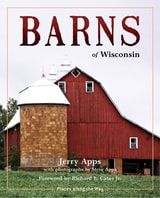
Barns of Wisconsin (Revised Edition)
Jerry Apps
Wisconsin Historical Society Press, 2010
Bending the Future
Fifty Ideas for the Next Fifty Years of Historic Preservation in the United StatesEdited by Max Page and Marla R. Miller
University of Massachusetts Press, 2016
The year 2016 marks the fiftieth anniversary of the National Historic Preservation Act, the cornerstone of historic preservation policy and practice in the United States. The act established the National Register of Historic Places, a national system of state preservation offices and local commissions, set up federal partnerships between states and tribes, and led to the formation of the standards for preservation and rehabilitation of historic structures. This book marks its fiftieth anniversary by collecting fifty new and provocative essays that chart the future of preservation.
The commentators include leading preservation professionals, historians, writers, activists, journalists, architects, and urbanists. The essays offer a distinct vision for the future and address related questions, including, Who is a preservationist? What should be preserved? Why? How? What stories do we tell in preservation? How does preservation contribute to the financial, environmental, social, and cultural well-being of communities? And if the “arc of the moral universe . . . bends towards justice,” how can preservation be a tool for achieving a more just society and world?
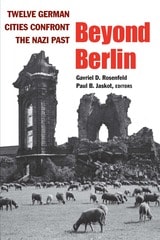
Beyond Berlin
Twelve German Cities Confront the Nazi PastGavriel D. Rosenfeld and Paul B. Jaskot, Editors
University of Michigan Press, 2015
Beyond Berlin breaks new ground in the ongoing effort to understand how memorials, buildings, and other spaces have figured in Germany's confrontation with its Nazi past. The contributors challenge reigning views of Germany's postwar memory work by examining how specific urban centers apart from the nation's capital have wrestled with their respective Nazi legacies. A wide range of West and East German cities is profiled in the volume: prominent metropolises like Hamburg, dynamic regional centers like Dresden, gritty industrial cities like Wolfsburg, and idyllic rural towns like Quedlinburg. In employing historical, art historical, anthropological, and geographical methodologies to examine these and other important urban centers, the volume's case studies shed new light upon the complex ways in which the confrontation with the Nazi past has directly shaped the German urban landscape since the end of the Second World War.
"Beyond Berlin is one of the most fascinating, deeply probing collections ever published on Germany's ongoing confrontation with its Nazi past. Its editors, Gavriel Rosenfeld and Paul Jaskot, have taken the exploration of Germany's urban memorial landscape to its highest level yet."
---James E. Young, Professor and Chair, Department of Judaic and Near Eastern Studies, University of Massachusetts Amherst, and author of The Texture of Memory and At Memory's Edge
"This is a top-notch collection of essays that positions itself in the populated field of memory studies by bringing together original contributions representing the best of new scholarship on architecture, urban design, monuments, and memory in East and West Germany. Taken together, the essays remind readers that the Nazi past is always present when German architects, urban planners, and politicians make decisions to tear down, rebuild, restore, and memorialize."
---S. Jonathan Wiesen, Department of History, Southern Illinois University, Carbondale
Beyond Preservation
Using Public History to Revitalize Inner CitiesAuthored by Andrew Hurley
Temple University Press, 2010
Across the United States, historic preservation has become a catalyst for urban regeneration. Entrepreneurs, urban pioneers, and veteran city dwellers have refurbished thousands of dilapidated properties and put them to productive use as shops, restaurants, nightclubs, museums, and private residences. As a result, inner-cities, once disparaged as zones of poverty, crime, and decay have been re-branded as historic districts. Although these preservation initiatives, often supported by government tax incentives and rigid architectural controls, deserve credit for bringing people back to the city, raising property values, and generating tourist revenue, they have been less successful in creating stable and harmonious communities.
Beyond Preservation proposes a framework for stabilizing and strengthening inner-city neighborhoods through the public interpretation of historic landscapes. Its central argument is that inner-city communities can best turn preserved landscapes into assets by subjecting them to public interpretation at the grass-roots. Based on an examination of successful projects in St. Louis, Missouri and other U.S. cities, Andrew Hurley demonstrates how rigorous historical analysis can help communities articulate a local identity and plan intelligently on the basis of existing cultural and social assets.
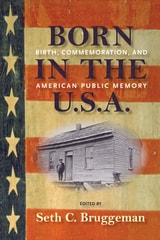
Born in the U.S.A.
Birth, Commemoration, and American Public MemorySeth C. Bruggeman
University of Massachusetts Press, 2012
Beyond asking why it is that Americans care about birthplaces and how they choose which ones to commemorate, Born in the U.S.A. offers insights from historians, curators, interpretive specialists, and others whose experience speaks directly to the challenges of managing historical sites. Each essay points to new ways of telling old stories at these mainstays of American memory. The case of the modern house museum receives special attention in a provocative concluding essay by Patricia West.
In addition to West and the editor, contributors include Christine Arato, Dan Currie, Keith A. Erekson, David Glassberg, Anna Thompson Hajdik, Zachary J. Lechner, Paul Lewis, Hilary Iris Lowe, Cynthia Miller, Laura Lawfer Orr, Robert Paynter, Angela Phelps, and Paul Reber.
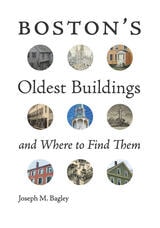
Boston's Oldest Buildings and Where to Find Them
Joseph M. Bagley
Brandeis University Press, 2021
As Boston approaches its four-hundredth anniversary, it is remarkable that it still maintains its historic character despite constant development. The fifty buildings featured in this book all pre-date 1800 and illustrate Boston’s early history. This is the first book to survey Boston’s fifty oldest buildings and does so through an approachable narrative which will appeal to nonarchitects and those new to historic preservation. Beginning with a map of the buildings’ locations and an overview of the historic preservation movement in Boston, the book looks at the fifty buildings in order from oldest to most recent. Geographically, the majority of the buildings are located within the downtown area of Boston along the Freedom Trail and within easy walking distance from the core of the city. This makes the book an ideal guide for tourists, and residents of the city will also find it interesting as it includes numerous properties in the surrounding neighborhoods. The buildings span multiple uses from homes to churches and warehouses to restaurants. Each chapter features a building, a narrative focusing on its historical significance, and the efforts made to preserve it over time. Full color photos and historical drawings illustrate each building and area. Boston’s Oldest Buildings and Where to Find Them presents the ideals of historic preservation in an approachable and easy-to-read manner appropriate for the broadest audience. Perfect for history lovers, architectural enthusiasts, and tourists alike.
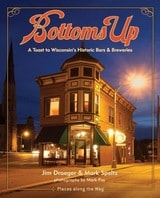
Bottoms Up
A Toast to Wisconsin's Historic Bars and BreweriesJim Draeger
Wisconsin Historical Society Press, 2017
Bottoms Up celebrates Wisconsin’s taverns and the breweries that fueled them. Beginning with inns and saloons, the book explores the rise of taverns and breweries, the effects of temperance and Prohibition, and attitudes about gender, ethnicity, and morality. It traces the development of the megabreweries, dominance of the giants, and the emergence of microbreweries. Contemporary photographs of unusual and distinctive bars and breweries of all eras, historical photos, postcards, advertisements, and breweriana illustrate the story of how Wisconsin came to dominate brewing—and the place that bars and beer hold in our social and cultural history.
Seventy featured taverns and breweries represent diverse architectural styles, from the open-air Tom’s Burned Down Cafe on Madeline Island to the Art Moderne Casino in La Crosse, and from Club 10, a 1930s roadhouse in Stevens Point, to the well-known Wolski’s Tavern in Milwaukee. There are bars in barns and basements and brewpubs in former ice cream factories and railroad depots. Bottoms Up also includes a heady mix of such beer-related topics as ice harvesting, barrel making, bar games, Old-Fashioneds, bar fixtures, and the queen of the bootleggers. Now in paperback for the first time!