Results by title
178 books match the query 'Identification' and 13 start with b
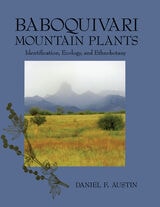
Baboquivari Mountain Plants
Identification, Ecology, and EthnobotanyDaniel F. Austin
University of Arizona Press, 2010
The term “sky island” was first used by Weldon Heald in 1967 to describe mountain ranges that are separated from each other by valleys of grassland or desert. The valleys create barriers to the spread of plant species in a way that is similar to the separation of islands in an ocean. The 70,000-square-mile Sky Islands region of southeastern Arizona, southwestern New Mexico, and northwestern Mexico is of particular interest to botanists because of its striking diversity of plant species and habitats. With more than 3,000 species of plants, the region offers a surprising range of tropical and temperate zones. Although others have written about the region, this is the first book to focus exclusively on the plant life of the Baboquivari Mountains.
The book offers an introduction to the history of the region, along with a discussion of human influences, and includes a useful appendix that lists all of the plants known to be growing in the Baboquivari Mountain chain.
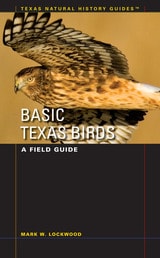
Basic Texas Birds
A Field GuideBy Mark W. Lockwood
University of Texas Press, 2007
Finding all the birds in Texas can be a lifetime pursuit. Basic Texas Birds, an easy-to-use field guide, will help you identify over 180 species of birds that are found across the state, including a selection of the rarer "Texas specialties" that draw birders to Texas from around the world. These are the birds that form the basis of a birder's life list for Texas.
Basic Texas Birds is organized by bird families to aid in identifying any bird you see in the wild. It is loaded with resources, including:
- 200 full-color, close-up photos of the birds
- State-of-the-art range maps—the most accurate of any currently available—that show each species' distribution within the state
- Up-to-date species accounts that provide a wealth of current and historical information, including each bird's appearance, habitat, status, and distribution, and that also identify similar species
- A glossary of terms used in bird identification
- A list of selected readings for learning more about birds found in Texas
- The Texas Ornithological Society's list of birds documented in Texas
Much more convenient for identifying common birds than a comprehensive state or national field guide, Basic Texas Birds is a must-have resource for both beginning and experienced birders.
Birding the Hudson Valley
Kathryn J. Schneider
University Press of New England, 2018
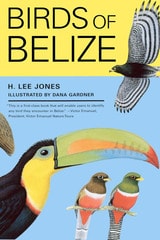
Birds of Belize
By H. Lee Jones
University of Texas Press, 2003
With nearly six hundred identified species of birds—and an average of five "new" species discovered annually—Belize is becoming a birding hotspot for amateur and professional birders from around the globe. Thousands of birders visit the country each year to enjoy Belize's amazing abundance and variety of both temperate and tropical birds in natural habitats that remain largely unspoiled. But until now, despite the growing need for an authoritative identification guide, birders have had to rely on regional field guides that offer only limited information on Belizean birds.
Birds of Belize provides the first complete guide to the identification of all currently known species—574 in all. The birds are grouped by families, with an introduction to each family that highlights its uniquely identifying characteristics and behaviors. The species accounts include all the details necessary for field identification: scientific and common names, size, plumage features, thorough voice descriptions, habitat, distribution, and status in Belize. Full color, expertly drawn illustrations by noted bird artist Dana Gardner present male and female, juvenile and adult, and basic and alternate plumages to aid visual identification throughout the year, while 234 range maps show the birds' distribution and seasonality in Belize. A comprehensive bibliography completes the volume.
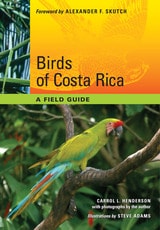
Birds of Costa Rica
A Field GuideText and photographs by Carrol L. Henderson
University of Texas Press, 2010
At the biological crossroads of the Americas, Costa Rica hosts an astonishing array of plants and animals—over half a million species! Ecotourists, birders, and biologists come from around the world, drawn by the likelihood of seeing more than three or four hundred species of birds and other animals during even a short stay. To help all of these visitors, as well as local residents, identify and enjoy the wildlife of Costa Rica, Carrol Henderson published Field Guide to the Wildlife of Costa Rica in 2002, and it became the instant and indispensable guide.
Now Henderson has created a dedicated field guide to the birds that travelers are most likely to see, as well as to the unique or endemic species that are of high interest to birders. Birds of Costa Rica covers 310 birds—an increase of 124 species from the earlier volume—with fascinating accounts of the birds' natural history, identification, and behavior gleaned from Henderson's forty years of traveling and birding in Costa Rica. All of the accounts include beautiful photographs of the birds, most of which were taken in the wild by Henderson. There are new updated distribution maps and a detailed appendix that identifies many of the country's best bird-watching locations and lodges, including contact information for trip planning purposes.
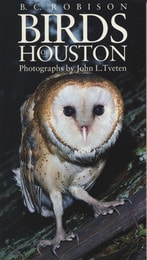
Birds of Houston
By B. C. Robison
University of Texas Press, 1997
No matter where you see birds in the city—in parks or woodlands, on power lines or in parking lots—they are the natural soul of the urban landscape. They enhance the city and the lives of those who watch them.
Nature writer B. C. Robison and wildlife photographer John Tveten have teamed up to produce this field guide for birders who want to identify the birds most commonly seen in Houston. Fifty-five species are included, ranging from such well-known favorites as the mockingbird and cardinal to the more exotic yellow-crowned night heron.
A full-color photograph for each bird appears alongside warm and often witty description. For quick reference, a summary of the primary field marks of the adult bird is also provided. This summary includes not only identifying features of the bird but also its habitats, the time of year it can be found, and its distinctive behavioral traits.
Aimed at the beginning birder, the guide also gives tips on buying binoculars and on attracting birds to your yard.
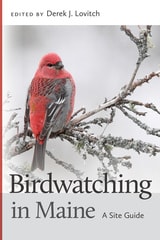
Birdwatching in Maine
A Site GuideEdited by Derek J. Lovitch
University Press of New England, 2017
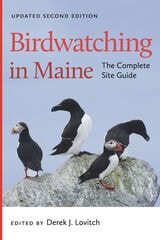
Birdwatching in Maine
The Complete Site GuideDerek J. Lovitch
Brandeis University Press, 2024
With over 470 species of birds recorded, Maine offers an abundance of birding opportunities for people of all levels of interest and experience, from those looking beyond their backyards for the first time to knowledgeable visitors looking to plug a hole in their list of sightings. The state’s wealth of undeveloped land and its extensive coastline, countless islands, and varied habitat combine to host an impressive diversity of birds at all times of the year. Birders travel to Maine from near and far to seek hard-to-find species, from the only Atlantic puffins breeding in the United States on offshore islands to Bicknell’s thrushes high in the mountains.
This book fills an important niche for the birdwatching community by offering comprehensive entries detailing the best locations for finding birds throughout the state for enthusiasts of all levels of skill and interest. It contains descriptions of 202 birding sites in Maine, with explicit directions on how to get there, for all sixteen of the state’s counties, several as large as other New England states! Each chapter features a county map, a brief overview by Derek J. Lovitch, numerous specific site guides, and a list of rarities. The book also contains a detailed and useful species accounts guide for finding the most sought-after birds.
Lavishly illustrated in color throughout, Birdwatching in Maine is the best available resource for finding birds in the largest of the New England states. This updated edition features a new introduction, as well as new birding sites and maps.
Birdwatching in New York City and on Long Island
Deborah Rivel and Kellye Rosenheim
University Press of New England, 2016
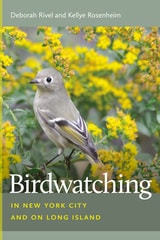
This easy-to-use guide gives seasonal information for both popular birding sites and those off the beaten path. Precise directions to the best viewing locations within the region’s diverse habitats enable birdwatchers to efficiently explore urban and wild birding hotspots. Over 500 species of birds can be seen in New York City’s five boroughs and on Long Island, one of the most densely populated and urbanized regions in North America, which also happens to be situated directly on the Atlantic Flyway. In this fragmented environment of scarce resources, birds concentrate on what’s available. This means that high numbers of birds are found in small spaces. In fact, Central Park alone attracts over 225 species of birds, which birders from around the world flock to see during spring and fall migration. Beyond Central Park, the five boroughs and Long Island have numerous wildlife refuges of extraordinary scenic beauty where resident and migratory birds inhabit forests, wetlands, grasslands, and beaches. These special places present an opportunity to see a wide array of songbirds, endangered nesting shorebirds, raptors, and an unprecedented number and variety of waterfowl. Including the latest information on the seasonal status and distribution of more than 400 species, with 39 maps and over 50 photographs, this full-color guide features information essential to planning a birding visit. It will become the go-to book for both the region’s longtime birders and those exploring the area for the first time.

Brown Threat
Identification in the Security StateKumarini Silva
University of Minnesota Press, 2016
What is “brown” in—and beyond—the context of American identity politics? How has the concept changed since 9/11? In the most sustained examination of these questions to date, Kumarini Silva argues that “brown” is no longer conceived of solely as a cultural, ethnic, or political identity. Instead, after 9/11, the Patriot Act, and the wars in Iran, Iraq, and Afghanistan, it has also become a concept and, indeed, a strategy of identification—one rooted in xenophobic, imperialistic, and racist ideologies to target those who do not neatly fit or subscribe to ideas of nationhood.
Interweaving personal narratives, ethnographic research, analyses of popular events like the Miss America pageant, and films and TV shows such as the Harold and Kumar franchise and Black-ish, Silva maps junctures where the ideological, political, and mediated terrain intersect, resulting in an appetite for all things “brown” (especially South Asian brown) by U.S. consumers, while political and nationalist discourses and legal structures (immigration, emigration, migration, outsourcing, incarceration) conspire to control brown bodies both within and outside the United States.
Silva explores this contradictory relationship between representation and reality, arguing that the representation mediates and manages the anxieties that come from contemporary global realities, in which brown spaces, like India, Pakistan, and the Middle East pose key economic, security, and political challenges to the United States. While racism is hardly new, what makes this iteration of brown new is that anyone or any group, at any time, can be branded as deviant, as a threat.
Butterflies of Alabama
Glimpses into Their LivesPaulette H. Ogard, Sara C. Bright
University of Alabama Press, 2010
Capture Every Stage of Alabama’s Butterfly Wonder.
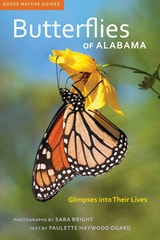
Butterflies of Alabama is a full-color, richly illustrated guide to the 84 known species of “true” butterflies (Papilionoidea) found within the state’s borders. For more than 14 years, the authors have made a close study of these showy, winged stars of the insect world, pursuing them in a great variety of habitats, rearing them, and photographing their remarkable life cycle stages—egg, larva (caterpillar), pupa (chrysalid or “cocoon”), and adult.
Each species account is accompanied by color photographs of live subjects in their natural habitats. Close-ups reveal fascinating details of camouflage, mimicry, coloration, and warning devices. The engaging text explains the highly evolved relationships between butterflies and the plants upon which they depend as well as the specialized adaptations that enable their survival within specific environmental niches. Included are range maps, flight times, caterpillar host plants, adult nectar sources, and identification tips—abundant information to tantalize budding as well as experienced butterfly watchers. In addition, pertinent conservation issues are addressed and appendices provide an annotated checklist of the state’s butterflies, a list of accidentals and strays, information on butterfly organizations, and recommended further reading.
With its non-technical language, simple format, and beautiful images, Butterflies of Alabama is accessible and appealing to anyone who appreciates Alabama’s amazing natural wealth.
Publication is supported in part by the Citizens of the City of Selma, Alabama's Butterfly Capital.
Butterflies of Houston and Southeast Texas
By John and Gloria Tveten
University of Texas Press, 1996
All across the country, butterflies are becoming as popular as birds and wildflowers, especially among people seeking to enjoy the rich natural resources that Texas possesses. John and Gloria Tveten have been studying butterflies in Southeast Texas for thirty-five years, and here they offer their considerable knowledge to everyone who shares their passion for butterflies.
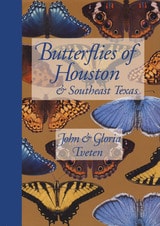
In this easy-to-use field guide, the Tvetens describe and illustrate more than 100 species of butterflies that live in Southeast Texas and can often be found across the state. Striking color photographs of living butterflies and caterpillars (a unique addition) show the key marks and characteristics necessary for field identification. The Tvetens' enjoyable and authoritative text describes each species' life history, habits, flight patterns, and characteristic markings.
An account of the different butterfly families, from swallowtails to longwings to skippers, precedes the descriptions of the species within each family. The Tvetens also include an interesting discussion of butterfly biology, a complete checklist of area butterflies, an index of butterfly-attracting plants, and pointers to other butterfly resources.
This field guide is the first to focus exclusively on Southeast Texas butterflies. It will be the essential reference for everyone seeking a reliable way to identify these butterflies, from field observers to apartment dwellers who wonder what is fluttering around the pot plants on the balcony.
Butterflies, Moths, and Other Invertebrates of Costa Rica
A Field GuideBy Carrol L. Henderson, with photographs by the author
University of Texas Press, 2010
At the biological crossroads of the Americas, Costa Rica hosts an astonishing array of plants and animals—over half a million species! Ecotourists, birders, and biologists come from around the world, drawn by the likelihood of seeing more than three or four hundred species of birds and other animals during even a short stay. To help all these visitors, as well as local residents, identify and enjoy the wildlife of Costa Rica, Carrol Henderson published Field Guide to the Wildlife of Costa Rica in 2002, and it instantly became the indispensable guide.
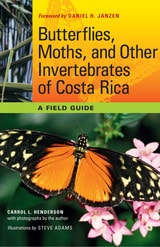
Now Henderson has created a dedicated field guide to more than one hundred tropical butterflies, moths, and other invertebrates that travelers are most likely to see while exploring the wild lands of Costa Rica. He includes fascinating information on their natural history, ecology, identification, and behavior gleaned from his forty years of travels and wildlife viewing, as well as details on where to see these remarkable and beautiful creatures. The butterflies, moths, and other invertebrates are illustrated by over 180 stunning and colorful photographs—most of which were taken in the wild by Henderson. A detailed and invaluable appendix that identifies many of Costa Rica's best wildlife-watching destinations, lodges, and contact information for trip-planning purposes completes the volume.