221 books match the query 'Imperialism' and 10 start with b
cover of Bankers and Empire: How Wall Street Colonized the Caribbean

Bankers and Empire

How Wall Street Colonized the Caribbean

Peter James Hudson

University of Chicago Press, 2017
From the end of the nineteenth century until the onset of the Great Depression, Wall Street embarked on a stunning, unprecedented, and often bloody period of international expansion in the Caribbean. A host of financial entities sought to control banking, trade, and finance in the region. In the process, they not only trampled local sovereignty, grappled with domestic banking regulation, and backed US imperialism—but they also set the model for bad behavior by banks, visible still today. In Bankers and Empire, Peter James Hudson tells the provocative story of this period, taking a close look at both the institutions and individuals who defined this era of American capitalism in the West Indies. Whether in Wall Street minstrel shows or in dubious practices across the Caribbean, the behavior of the banks was deeply conditioned by bankers’ racial views and prejudices. Drawing deeply on a broad range of sources, Hudson reveals that the banks’ experimental practices and projects in the Caribbean often led to embarrassing failure, and, eventually, literal erasure from the archives.
[more]
cover of Between Shadows and Noise: Sensation, Situatedness, and the Undisciplined

Between Shadows and Noise

Sensation, Situatedness, and the Undisciplined

Amber Jamilla Musser

Duke University Press, 2024
In Between Shadows and Noise Amber Jamilla Musser theorizes sensation as a Black feminist method for aesthetic interpretation and criticism that uses the knowledges held by the body to access the unrepresentable. Thinking through Blackness, empire, and colonialism, Musser examines artworks ranging from Ming Smith’s Flamingo Fandango, Jordan Peele’s Us, and Katherine Dunham’s Shango to Samita Sinha’s This ember state, Titus Kaphar’s A Pillow for Fragile Fictions, and Teresita Fernández’s Puerto Rico (Burned) 6. She engages with these works from an embodied situatedness to grapple with the questions and sensations of racialization and difference that the works produce. Throughout, Musser rethinks how we consider the relationships between race, representation, and politics by dwelling in those spaces and concepts that elude Western norms of representation, objectivity, and logic. In so doing, she explores ways of being and knowing that exceed overdetermined parameters while offering a blueprint for sensing, imagining, and living otherwise.
[more]
cover of Beyond Man: Race, Coloniality, and Philosophy of Religion

Beyond Man

Race, Coloniality, and Philosophy of Religion

Yountae An and Eleanor Craig, editors

Duke University Press, 2021

Beyond Man reimagines the meaning and potential of a philosophy of religion that better attends to the inextricable links among religion, racism, and colonialism. An Yountae, Eleanor Craig, and the contributors reckon with the colonial and racial implications of the field's history by staging a conversation with Black, Indigenous, and decolonial studies. In their introduction, An and Craig point out that European-descended Christianity has historically defined itself by its relation to the other while paradoxically claiming to represent and speak to humanity in its totality. The topics include secularism, the Eucharist's relation to Blackness, and sixteenth-century Brazilian cannibalism rituals as well as an analysis of how Mircea Eliade's conception of the sacred underwrites settler colonial projects and imaginaries. Throughout, the contributors also highlight the theorizing of Afro-Caribbean thinkers such as Sylvia Wynter, C. L. R. James, Frantz Fanon, and Aimé Césaire whose work disrupts the normative Western categories of religion and philosophy.

Contributors. An Yountae, Ellen Armour, J. Kameron Carter, Eleanor Craig, Amy Hollywood, Vincent Lloyd, Filipe Maia, Mayra Rivera, Devin Singh, Joseph R. Winters
[more]
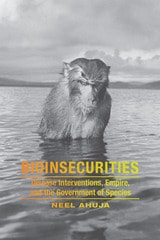
cover of Bioinsecurities: Disease Interventions, Empire, and the Government of Species

Bioinsecurities

Disease Interventions, Empire, and the Government of Species

Neel Ahuja

Duke University Press, 2016

In Bioinsecurities Neel Ahuja argues that U.S. imperial expansion has been shaped by the attempts of health and military officials to control the interactions of humans, animals, viruses, and bacteria at the borders of U.S. influence, a phenomenon called the government of species. The book explores efforts to control the spread of Hansen's disease, venereal disease, polio, smallpox, and HIV through interventions linking the continental United States to Hawai'i, Panamá, Puerto Rico, Cuba, Congo, Iraq, and India in the twentieth and twenty-first centuries. Ahuja argues that racial fears of contagion helped to produce public optimism concerning state uses of pharmaceuticals, medical experimentation, military intervention, and incarceration to regulate the immune capacities of the body. In the process, the security state made the biological structures of human and animal populations into sites of struggle in the politics of empire, unleashing new patient activisms and forms of resistance to medical and military authority across the increasingly global sphere of U.S. influence.
 

[more]
cover of Black People in the British Empire

Black People in the British Empire

Peter Fryer

Pluto Press, 2021

'Fantastic … the most important book on Black British history’ - Akala

Black People in the British Empire is a challenge to the official version of British history. It tells the story of Britain's exploitation and oppression of its subject peoples in its colonies, and in particular the people of Africa, Asia and Australasia

Peter Fryer reveals how the ideology of racism was used as justification for acquiring and expanding the Empire; how the British Industrial Revolution developed out of profits from the slave trade; and how the colonies were deliberately de-industrialised to create a market for British manufacturers.

In describing the frequency and the scale of revolts by subject peoples against slavery and foreign domination - and the brutality used in crushing them - Peter Fryer exposes the true history of colonialism, and restores to Black people their central role in Britain's past.
[more]
cover of Black People in the British Empire

Black People in the British Empire

Peter Fryer

Pluto Press, 2021

'Fantastic … the most important book on Black British history’ - Akala

Black People in the British Empire is a challenge to the official version of British history. It tells the story of Britain's exploitation and oppression of its subject peoples in its colonies, and in particular the people of Africa, Asia and Australasia

Peter Fryer reveals how the ideology of racism was used as justification for acquiring and expanding the Empire; how the British Industrial Revolution developed out of profits from the slave trade; and how the colonies were deliberately de-industrialised to create a market for British manufacturers.

In describing the frequency and the scale of revolts by subject peoples against slavery and foreign domination - and the brutality used in crushing them - Peter Fryer exposes the true history of colonialism, and restores to Black people their central role in Britain's past.
[more]
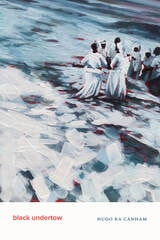
cover of Black Undertow

Black Undertow

Hugo ka Canham

Duke University Press, 2026

Meditative and theoretical, Black Undertow reorients the thinking of blackness away from the Atlantic to the African shorelines of the Indian Ocean, places where queerness and black life frequently brush up against one another. Hugo ka Canham listens for what he names the buzz of the undertow, the traces of African ancestors who linger in water, sand, coastal forts, corals, ritual practices, and unruly imaginations along the shore. In tracking these elusive figures, he develops an approach that honors a queer right to opacity. Canham reconstitutes the siloed disciplinarity that imagines African studies, Black studies, Queer African studies, and Queer studies as necessarily different. When read as coconstitutive instead, Canham demonstrates that they better allow for explicating local life, history, poetics, and theory. In so doing, he forges methods of studying black life that think beyond the limits of traditional, textual archives.
[more]
cover of Black and Green: The Fight For Civil Rights in Northern Ireland & Black America

Black and Green

The Fight For Civil Rights in Northern Ireland & Black America

Brian Dooley

Pluto Press, 1998

‘An excellent book.’ Irish Voice (New York)

'Focusing on the period from the 1960s onward, Brian Dooley suggests that the black rights struggle in the US had a formative influence on Northern Ireland's civil rights movement which adopted similar tactics of protest marches and sit-ins ... A well researched book, written from an unusual angle that illuminates this understudied international influence on the Ulster conflict' Political Studies

Ties between political activists in Black America and Ireland span several centuries, from the days of the slave trade to the close links between Frederick Douglass and Daniel O’Connell, and between Marcus Garvey and Eamon de Valera. This timely book traces those historic links and examines how the struggle for black civil rights in America in the 1960s helped shape the campaign against discrimination in Northern Ireland. The author includes interviews with key figures such as Angela Davis, Bernadette McAliskey and Eamonn McCann.
[more]
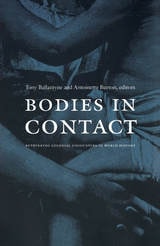
cover of Bodies in Contact: Rethinking Colonial Encounters in World History

Bodies in Contact

Rethinking Colonial Encounters in World History

Tony Ballantyne and Antoinette Burton, eds.

Duke University Press, 2005

From portrayals of African women’s bodies in early modern European travel accounts to the relation between celibacy and Indian nationalism to the fate of the Korean “comfort women” forced into prostitution by the occupying Japanese army during the Second World War, the essays collected in Bodies in Contact demonstrate how a focus on the body as a site of cultural encounter provides essential insights into world history. Together these essays reveal the “body as contact zone” as a powerful analytic rubric for interpreting the mechanisms and legacies of colonialism and illuminating how attention to gender alters understandings of world history. Rather than privileging the operations of the Foreign Office or gentlemanly capitalists, these historical studies render the home, the street, the school, the club, and the marketplace visible as sites of imperial ideologies.

Bodies in Contact brings together important scholarship on colonial gender studies gathered from journals around the world. Breaking with approaches to world history as the history of “the West and the rest,” the contributors offer a panoramic perspective. They examine aspects of imperial regimes including the Ottoman, Mughal, Soviet, British, Han, and Spanish, over a span of six hundred years—from the fifteenth century through the mid-twentieth. Discussing subjects as diverse as slavery and travel, ecclesiastical colonialism and military occupation, marriage and property, nationalism and football, immigration and temperance, Bodies in Contact puts women, gender, and sexuality at the center of the “master narratives” of imperialism and world history.

Contributors. Joseph S. Alter, Tony Ballantyne, Antoinette Burton, Elisa Camiscioli, Mary Ann Fay, Carter Vaughn Findley, Heidi Gengenbach, Shoshana Keller, Hyun Sook Kim, Mire Koikari, Siobhan Lambert-Hurley, Melani McAlister, Patrick McDevitt, Jennifer L. Morgan, Lucy Eldersveld Murphy, Rosalind O’Hanlon, Rebecca Overmyer-Velázquez, Fiona Paisley, Adele Perry, Sean Quinlan, Mrinalini Sinha, Emma Jinhua Teng, Julia C. Wells
[more]
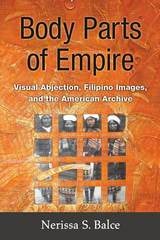
cover of Body Parts of Empire: Visual Abjection, Filipino Images, and the American Archive

Body Parts of Empire

Visual Abjection, Filipino Images, and the American Archive

Nerissa S. Balce

University of Michigan Press, 2016

Body Parts of Empire is a study of abjection in American visual culture and popular literature from the Philippine-American War (1899–1902). During this period, the American national territory expanded beyond its continental borders to islands in the Pacific and the Caribbean. Simultaneously, new technologies of vision emerged for imagining the human body, including the moving camera, stereoscopes, and more efficient print technologies for mass media.

Rather than focusing on canonical American authors who wrote at the time of U.S. imperialism, this book examines abject texts—images of naked savages, corpses, clothed native elites, and uniformed American soldiers—as well as bodies of writing that document the goodwill and violence of American expansion in the Philippine colony. Contributing to the fields of American studies, Asian American studies, and gender studies, the book analyzes the actual archive of the Philippine-American War and how the racialization and sexualization of the Filipino colonial native have always been part of the cultures of America and U.S. imperialism. By focusing on the Filipino native as an abject body of the American imperial imaginary, this study offers a historical materialist optic for reading the cultures of Filipino America.
 

[more]