Results by title
53 books match the query 'In art' and 2 start with b
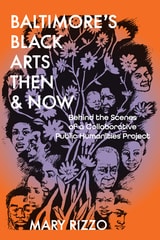
Baltimore's Black Arts Then & Now
Behind the Scenes of a Collaborative Public Humanities ProjectMary Rizzo
University of Iowa Press, 2026
Baltimore’s Black Arts Then & Now brings to life the Chicory Revitalization Project, a public humanities initiative that revives Baltimore’s historic Chicory magazine. From 1966 to 1983, Chicory served as a powerful voice for working-class Black communities, capturing their thoughts, struggles, and dreams through unedited poetry and street chatter. Dubbed “the most authentic microphone of black folks talking ever devised” by the Baltimore Afro-American newspaper, Chicory emerged from the liberalism of the War on Poverty and the militance of the Black Arts Movement.
Since 2017, a group of former Chicory editors, scholars, librarians, poets, teachers, and young writers have collaborated to use Chicory as a catalyst for intergenerational dialogue on social justice, race, and place. Baltimore’s Black Arts Then & Now documents this joint effort, offering valuable insights for public historians, educators, and humanists.
Since 2017, a group of former Chicory editors, scholars, librarians, poets, teachers, and young writers have collaborated to use Chicory as a catalyst for intergenerational dialogue on social justice, race, and place. Baltimore’s Black Arts Then & Now documents this joint effort, offering valuable insights for public historians, educators, and humanists.
[more]
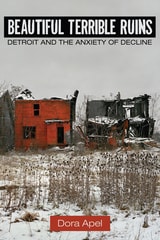
Beautiful Terrible Ruins
Detroit and the Anxiety of DeclineApel, Dora
Rutgers University Press, 2015
Once the manufacturing powerhouse of the nation, Detroit has become emblematic of failing cities everywhere—the paradigmatic city of ruins—and the epicenter of an explosive growth in images of urban decay. In Beautiful Terrible Ruins, art historian Dora Apel explores a wide array of these images, ranging from photography, advertising, and television, to documentaries, video games, and zombie and disaster films.
Apel shows how Detroit has become pivotal to an expanding network of ruin imagery, imagery ultimately driven by a pervasive and growing cultural pessimism, a loss of faith in progress, and a deepening fear that worse times are coming. The images of Detroit’s decay speak to the overarching anxieties of our era: increasing poverty, declining wages and social services, inadequate health care, unemployment, homelessness, and ecological disaster—in short, the failure of capitalism. Apel reveals how, through the aesthetic distancing of representation, the haunted beauty and fascination of ruin imagery, embodied by Detroit’s abandoned downtown skyscrapers, empty urban spaces, decaying factories, and derelict neighborhoods help us to cope with our fears. But Apel warns that these images, while pleasurable, have little explanatory power, lulling us into seeing Detroit’s deterioration as either inevitable or the city’s own fault, and absolving the real agents of decline—corporate disinvestment and globalization. Beautiful Terrible Ruins helps us understand the ways that the pleasure and the horror of urban decay hold us in thrall.
[more]