Results by title
84 books match the query 'In motion pictures' and 8 start with b
Becoming Palestine
Toward an Archival Imagination of the FutureGil Z. Hochberg
Duke University Press, 2021
Best Years
Going to the Movies, 1945-1946Charles Affron and Mirella Jona Affron
Rutgers University Press, 2009
Best Years is a panoramic study, shining light on this critical juncture in American historyand the history of American cinemaùthe end of World War II (1945) and a year of unprecedented success in Hollywood's "Golden Age" (1946). This unique time, the last year of war and the first full year of peace, provides a rich blend of cinema genres and typesùfrom the battlefront to the home front, the peace film to the woman's film, psychological drama, and the period's provocative new style, film noir.
Best Years focuses on films that were famous, infamous, forgotten, and unforgettable. Big budget A-films, road shows, and familiar series share the spotlight. From Bergman and Grant in Notorious to Abbott and Costello in Lost in a Harem, Charles Affron and Mirella Jona Affron examine why the bond between screen and viewer was perhaps never tighter. Paying special attention to the movie-going public in key cities--Atlanta, New York, Boston, Honolulu, and Chicago--this ambitious work takes us on a cinematic journey to recapture a magical time.
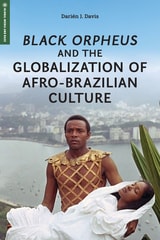
Black Orpheus and the Globalization of Afro-Brazilian Culture
Darién J. Davis
Rutgers University Press, 2026
“Black Orpheus” and the Globalization of Afro-Brazilian Culture is the first historical study in English to examine the development, production, and reception of the 1958 film Black Orpheus and its legacy in the 1960s and 1970s. It focuses on the making of the film and the trajectories of the major actors and musicians who helped construct an image of Black Brazil and provides an analysis of the globalization of Afro-Brazilian images and music in France and the United States in the wake of the movie’s success. Using archival sources, interviews, and the secondary literature from France, Brazil, and the United States, this book reveals information about the cultural histories of all three countries and gives readers new insight into the trajectories of diverse actors such as Breno Mello, Marpessa Dawn, and Léa Garcia and performers such as Agostinho dos Santos, Baden Powell, and Maria D’Apparecida.
Black Panther
Scott Bukatman
University of Texas Press, 2022
Black Panther was the first Black superhero in mainstream American comics. Black Panther was a cultural phenomenon that broke box office records. Yet it wasn’t just a movie led by and starring Black artists. It grappled with ideas and conflicts central to Black life in America and helped redress the racial dynamics of the Hollywood blockbuster.
Scott Bukatman, one of the foremost scholars of superheroes and cinematic spectacle, brings his impeccable pedigree to this lively and accessible study, finding in the utopianism of Black Panther a way of re-envisioning what a superhero movie can and should be while centering the Black creators, performers, and issues behind it. He considers the superheroic Black body; the Pan-African fantasy, feminism, and Afrofuturism of Wakanda; the African American relationship to Africa; the political influence of director Ryan Coogler’s earlier movies; and the entwined performances of Chadwick Boseman’s T’Challa and Michael B. Jordan’s Killmonger. Bukatman argues that Black Panther is escapism of the best kind, offering a fantasy of liberation and social justice while demonstrating the power of popular culture to articulate ideals and raise vital questions.
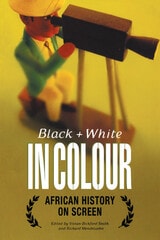
Black and White in Colour
African History on ScreenVivian Bickford-Smith
Ohio University Press, 2007
Black and White in Colour: African History on Screen considers how the African past has been represented in a wide range of historical films. Written by a team of eminent international scholars, the volume provides extensive coverage of both place and time and deals with major issues in the written history of Africa. Themes include the slave trade, imperialism and colonialism, racism, and anticolonial resistance. Many of the films will be familiar to readers: they include Out of Africa, Hotel Rwanda, Breaker Morant, Cry Freedom, The Battle of Algiers, and Chocolat.
This collection of essays is a highly original and useful contribution to African historiography, as well as a significant addition to the growing body of work within the emerging subdiscipline of “film and history.” It will appeal to those interested in African history and the ways in which films use the past to raise questions about the present.
Contributors: Mahir Saul, Ralph A. Austen, Robert Baum, Robert Harms, Nigel Worden, Carolyn Hamilton and Litheko Modisane, Richard Mendelsohn, Shamil Jeppie, Bill Nasson, Nigel Penn, Ruth Watson, Patrick Harries, David Moore, Teresa Barnes, Vivian Bickford-Smith, Mohamed Adhikari, and David Philips.
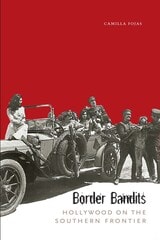
Border Bandits
Hollywood on the Southern FrontierBy Camilla Fojas
University of Texas Press, 2008
The southern frontier is one of the most emotionally charged zones in the United States, second only to its historical predecessor and partner, the western frontier. Though they span many genres, border films share common themes, trace the mood swings of public policy, and shape our cultural agenda.
In this examination, Camilla Fojas studies how major Hollywood films exploit the border between Mexico and the United States to tell a story about U.S. dominance in the American hemisphere. She charts the shift from the mythos of the open western frontier to that of the embattled southern frontier by offering in-depth analyses of particular border films, from post-World War II Westerns to drug-trafficking films to contemporary Latino/a cinema, within their historical and political contexts.
Fojas argues that Hollywood border films do important social work by offering a cinematic space through which viewers can manage traumatic and undesirable histories and ultimately reaffirm core "American" values. At the same time, these border narratives delineate opposing values and ideas.
Latino border films offer a critical vantage onto these topics; they challenge the presumptions of U.S. nationalism and subsequent cultural attitudes about immigrants and immigration, and often critically reconstruct their Hollywood kin.
By analyzing films such as Duel in the Sun, The Wild Bunch, El Norte, The Border, Traffic, and Brokeback Mountain, Fojas demands that we reexamine the powerful mythology of the Hollywood borderlands. This detailed scrutiny recognizes that these films are part of a national narrative comprised of many texts and symbols that create the myth of the United States as capital of the Americas.
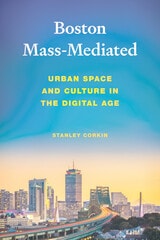
Boston Mass-Mediated
Urban Space and Culture in the Digital AgeStanley Corkin
University of Massachusetts Press, 2024
In the mid-nineteenth century, Boston fashioned itself as a global hub. By the early 1970s, it was barely a dot on the national picture. It had gained a reputation as a decaying city rife with crime and dysfunctional politics, as well as decidedly retrograde race relations, prominently exemplified by white resistance to school integration. Despite this historical ebb in its national and international presence, it still possessed the infrastructure—superb educational institutions such as Harvard and MIT, world-class sports teams like the Celtics and Red Sox, powerful media outlets like The Boston Globe, and extensive shipping capacity—required to eventually thrive in an age of global trade and mass communication.
In Boston Mass-Mediated, Stanley Corkin explores the power of mass media to define a place. He examines the tensions between the emergent and prosperous city of the late twentieth and early twenty-first centuries and its representation in a range of media genres such as news journalism, professional sports broadcasting, and popular films like Mystic River and The Departed. This mass media, with its ever-increasing digital reach, has emphasized a city restricted by tropes suggestive of an earlier Boston—racism, white ethnic crime, Catholicism, and a pre-modern insularity—even as it becomes increasingly international and multicultural. These tropes mediate our understanding and experience of the city. Using Boston as a case study, Corkin contends that our contemporary sense of place occurs through a media saturated world, a world created by the explosion of digital technology that is steeped in preconceptions.
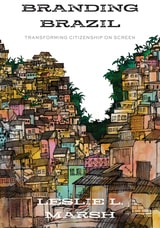
Branding Brazil
Transforming Citizenship on ScreenLeslie L. Marsh
Rutgers University Press, 2021