Results by title
14 books match the query 'Debates'

Contesting Clio's Craft
New Directions and Debates in Canadian HistoryEdited by Christopher Dummitt and Michael Dawson
University of London Press, 2009
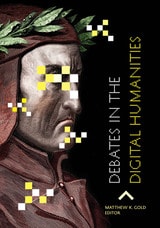
Debates in the Digital Humanities
Matthew K. Gold
University of Minnesota Press, 2012
Encompassing new technologies, research methods, and opportunities for collaborative scholarship and open-source peer review, as well as innovative ways of sharing knowledge and teaching, the digital humanities promises to transform the liberal arts—and perhaps the university itself. Indeed, at a time when many academic institutions are facing austerity budgets, digital humanities programs have been able to hire new faculty, establish new centers and initiatives, and attract multimillion-dollar grants.
Clearly the digital humanities has reached a significant moment in its brief history. But what sort of moment is it? Debates in the Digital Humanities brings together leading figures in the field to explore its theories, methods, and practices and to clarify its multiple possibilities and tensions. From defining what a digital humanist is and determining whether the field has (or needs) theoretical grounding, to discussions of coding as scholarship and trends in data-driven research, this cutting-edge volume delineates the current state of the digital humanities and envisions potential futures and challenges. At the same time, several essays aim pointed critiques at the field for its lack of attention to race, gender, class, and sexuality; the inadequate level of diversity among its practitioners; its absence of political commitment; and its preference for research over teaching.
Together, the essays in Debates in the Digital Humanities—which will be published both as a printed book and later as an ongoing, open-access website—suggest that the digital humanities is uniquely positioned to contribute to the revival of the humanities and academic life.
Contributors: Bryan Alexander, National Institute for Technology in Liberal Education; Rafael Alvarado, U of Virginia; Jamie “Skye” Bianco, U of Pittsburgh; Ian Bogost, Georgia Institute of Technology; Stephen Brier, CUNY Graduate Center; Daniel J. Cohen, George Mason U; Cathy N. Davidson, Duke U; Rebecca Frost Davis, National Institute for Technology in Liberal Education; Johanna Drucker, U of California, Los Angeles; Amy E. Earhart, Texas A&M U; Charlie Edwards; Kathleen Fitzpatrick, Pomona College; Julia Flanders, Brown U; Neil Fraistat, U of Maryland; Paul Fyfe, Florida State U; Michael Gavin, Rice U; David Greetham, CUNY Graduate Center; Jim Groom, U of Mary Washington; Gary Hall, Coventry U, UK; Mills Kelly, George Mason U; Matthew Kirschenbaum, U of Maryland; Alan Liu, U of California, Santa Barbara; Elizabeth Losh, U of California, San Diego; Lev Manovich, U of California, San Diego; Willard McCarty, King’s College London; Tara McPherson, U of Southern California; Bethany Nowviskie, U of Virginia; Trevor Owens, Library of Congress; William Pannapacker, Hope College; Dave Parry, U of Texas at Dallas; Stephen Ramsay, U of Nebraska, Lincoln; Alexander Reid, SUNY at Buffalo; Geoffrey Rockwell, Canadian Institute for Research Computing in the Arts; Mark L. Sample, George Mason U; Tom Scheinfeldt, George Mason U; Kathleen Marie Smith; Lisa Spiro, National Institute for Technology in Liberal Education; Patrik Svensson, Umeå U; Luke Waltzer, Baruch College; Matthew Wilkens, U of Notre Dame; George H. Williams, U of South Carolina Upstate; Michael Witmore, Folger Shakespeare Library.
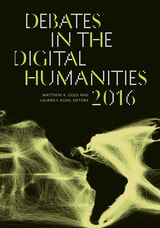
Debates in the Digital Humanities 2016
Matthew K. Gold
University of Minnesota Press, 2016
Pairing full-length scholarly essays with shorter pieces drawn from scholarly blogs and conference presentations, as well as commissioned interviews and position statements, Debates in the Digital Humanities 2016 reveals a dynamic view of a field in negotiation with its identity, methods, and reach. Pieces in the book explore how DH can and must change in response to social justice movements and events like #Ferguson; how DH alters and is altered by community college classrooms; and how scholars applying DH approaches to feminist studies, queer studies, and black studies might reframe the commitments of DH analysts. Numerous contributors examine the movement of interdisciplinary DH work into areas such as history, art history, and archaeology, and a special forum on large-scale text mining brings together position statements on a fast-growing area of DH research. In the multivalent aspects of its arguments, progressing across a range of platforms and environments, Debates in the Digital Humanities 2016 offers a vision of DH as an expanded field—new possibilities, differently structured.
Published simultaneously in print, e-book, and interactive webtext formats, each DH annual will be a book-length publication highlighting the particular debates that have shaped the discipline in a given year. By identifying key issues as they unfold, and by providing a hybrid model of open-access publication, these volumes and the Debates in the Digital Humanities series will articulate the present contours of the field and help forge its future.
Contributors: Moya Bailey, Northeastern U; Fiona Barnett; Matthew Battles, Harvard U; Jeffrey M. Binder; Zach Blas, U of London; Cameron Blevins, Rutgers U; Sheila A. Brennan, George Mason U; Timothy Burke, Swarthmore College; Rachel Sagner Buurma, Swarthmore College; Micha Cárdenas, U of Washington–Bothell; Wendy Hui Kyong Chun, Brown U; Tanya E. Clement, U of Texas–Austin; Anne Cong-Huyen, Whittier College; Ryan Cordell, Northeastern U; Tressie McMillan Cottom, Virginia Commonwealth U; Amy E. Earhart, Texas A&M U; Domenico Fiormonte, U of Roma Tre; Paul Fyfe, North Carolina State U; Jacob Gaboury, Stony Brook U; Kim Gallon, Purdue U; Alex Gil, Columbia U; Brian Greenspan, Carleton U; Richard Grusin, U of Wisconsin, Milwaukee; Michael Hancher, U of Minnesota; Molly O’Hagan Hardy; David L. Hoover, New York U; Wendy F. Hsu; Patrick Jagoda, U of Chicago; Jessica Marie Johnson, Michigan State U; Steven E. Jones, Loyola U; Margaret Linley, Simon Fraser U; Alan Liu, U of California, Santa Barbara; Elizabeth Losh, U of California, San Diego; Alexis Lothian, U of Maryland; Michael Maizels, Wellesley College; Mark C. Marino, U of Southern California; Anne B. McGrail, Lane Community College; Bethany Nowviskie, U of Virginia; Julianne Nyhan, U College London; Amanda Phillips, U of California, Davis; Miriam Posner, U of California, Los Angeles; Rita Raley, U of California, Santa Barbara; Stephen Ramsay, U of Nebraska–Lincoln; Margaret Rhee, U of Oregon; Lisa Marie Rhody, Graduate Center, CUNY; Roopika Risam, Salem State U; Stephen Robertson, George Mason U; Mark Sample, Davidson College; Jentery Sayers, U of Victoria; Benjamin M. Schmidt, Northeastern U; Scott Selisker, U of Arizona; Jonathan Senchyne, U of Wisconsin, Madison; Andrew Stauffer, U of Virginia; Joanna Swafford, SUNY New Paltz; Toniesha L. Taylor, Prairie View A&M U; Dennis Tenen; Melissa Terras, U College London; Anna Tione; Ted Underwood, U of Illinois, Urbana–Champaign; Ethan Watrall, Michigan State U; Jacqueline Wernimont, Arizona State U; Laura Wexler, Yale U; Hong-An Wu, U of Illinois, Urbana–Champaign.
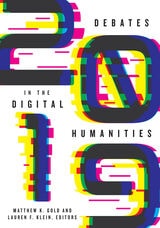
Debates in the Digital Humanities 2019
Matthew K. Gold
University of Minnesota Press, 2019
The latest installment of a digital humanities bellwether
Contending with recent developments like the shocking 2016 U.S. Presidential election, the radical transformation of the social web, and passionate debates about the future of data in higher education, Debates in the Digital Humanities 2019 brings together a broad array of important, thought-provoking perspectives on the field’s many sides. With a wide range of subjects including gender-based assumptions made by algorithms, the place of the digital humanities within art history, data-based methods for exhuming forgotten histories, video games, three-dimensional printing, and decolonial work, this book assembles a who’s who of the field in more than thirty impactful essays.
Contributors: Rafael Alvarado, U of Virginia; Taylor Arnold, U of Richmond; James Baker, U of Sussex; Kathi Inman Berens, Portland State U; David M. Berry, U of Sussex; Claire Bishop, The Graduate Center, CUNY; James Coltrain, U of Nebraska–Lincoln; Crunk Feminist Collective; Johanna Drucker, U of California–Los Angeles; Jennifer Edmond, Trinity College; Marta Effinger-Crichlow, New York City College of Technology–CUNY; M. Beatrice Fazi, U of Sussex; Kevin L. Ferguson, Queens College–CUNY; Curtis Fletcher, U of Southern California; Neil Fraistat, U of Maryland; Radhika Gajjala, Bowling Green State U; Michael Gavin, U of South Carolina; Andrew Goldstone, Rutgers U; Andrew Gomez, U of Puget Sound; Elyse Graham, Stony Brook U; Brian Greenspan, Carleton U; John Hunter, Bucknell U; Steven J. Jackson, Cornell U; Collin Jennings, Miami U; Lauren Kersey, Saint Louis U; Kari Kraus, U of Maryland; Seth Long, U of Nebraska, Kearney; Laura Mandell, Texas A&M U; Rachel Mann, U of South Carolina; Jason Mittell, Middlebury College; Lincoln A. Mullen, George Mason U; Trevor Muñoz, U of Maryland; Safiya Umoja Noble, U of Southern California; Jack Norton, Normandale Community College; Bethany Nowviskie, U of Virginia; Élika Ortega, Northeastern U; Marisa Parham, Amherst College; Jussi Parikka, U of Southampton; Kyle Parry, U of California, Santa Cruz; Brad Pasanek, U of Virginia; Stephen Ramsay, U of Nebraska–Lincoln; Matt Ratto, U of Toronto; Katie Rawson, U of Pennsylvania; Ben Roberts, U of Sussex; David S. Roh, U of Utah; Mark Sample, Davidson College; Moacir P. de Sá Pereira, New York U; Tim Sherratt, U of Canberra; Bobby L. Smiley, Vanderbilt U; Lauren Tilton, U of Richmond; Ted Underwood, U of Illinois, Urbana-Champaign; Megan Ward, Oregon State U; Claire Warwick, Durham U; Alban Webb, U of Sussex; Adrian S. Wisnicki, U of Nebraska–Lincoln.
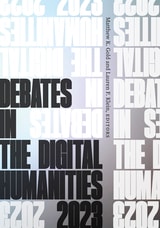
Debates in the Digital Humanities 2023
Matthew K. Gold
University of Minnesota Press, 2023
A cutting-edge view of the digital humanities at a time of global pandemic, catastrophe, and uncertainty
Where do the digital humanities stand in 2023? Debates in the Digital Humanities 2023 presents a state-of-the-field vision of digital humanities amid rising social, political, economic, and environmental crises; a global pandemic; and the deepening of austerity regimes in U.S. higher education. Providing a look not just at where DH stands but also where it is going, this fourth volume in the Debates in the Digital Humanities series features both established scholars and emerging voices pushing the field’s boundaries, asking thorny questions, and providing space for practitioners to bring to the fore their research and their hopes for future directions in the field. Carrying forward the themes of political and social engagement present in the series throughout, it includes crucial contributions to the field—from a vital forum centered on the voices of Black women scholars, manifestos from feminist and Latinx perspectives on data and DH, and a consideration of Indigenous data and artificial intelligence, to essays that range across topics such as the relation of DH to critical race theory, capital, and accessibility.
Contributors: Harmony Bench, Ohio State U; Christina Boyles, Michigan State U; Megan R. Brett, George Mason U; Michelle Lee Brown, Washington State U; Patrick J. Burns, New York U; Kent K. Chang, U of California, Berkeley; Rico Devara Chapman, Clark Atlanta U; Marika Cifor, U of Washington; María Eugenia Cotera, U of Texas; T. L. Cowan, U of Toronto; Marlene L. Daut, U of Virginia; Quinn Dombrowski, Stanford U; Kate Elswit, U of London; Nishani Frazier, U of Kansas; Kim Gallon, Brown U; Patricia Garcia, U of Michigan; Lorena Gauthereau, U of Houston; Masoud Ghorbaninejad, University of Victoria; Abraham Gibson, U of Texas at San Antonio; Nathan P. Gibson, Ludwig-Maximilians-Universität, Munich; Kaiama L. Glover, Barnard College; Hilary N. Green, Davidson College; Jo Guldi, Southern Methodist U; Matthew N. Hannah, Purdue U Libraries; Jeanelle Horcasitas, DigitalOcean; Christy Hyman, Mississippi State U; Arun Jacob, U of Toronto; Jessica Marie Johnson, Johns Hopkins U and Harvard U; Martha S. Jones, Johns Hopkins U; Annette K. Joseph-Gabriel, Duke U; Mills Kelly, George Mason U; Spencer D. C. Keralis, Digital Frontiers; Zoe LeBlanc, U of Illinois at Urbana-Champaign; Jason Edward Lewis, Concordia U; James Malazita, Rensselaer Polytechnic Institute; Alison Martin, Dartmouth College; Linda García Merchant, U of Houston Libraries; Rafia Mirza, Southern Methodist U; Mame-Fatou Niang, Carnegie Mellon U; Jessica Marie Otis, George Mason U; Marisa Parham, U of Maryland; Andrew Boyles Petersen, Michigan State U Libraries; Emily Pugh, Getty Research Institute; Olivia Quintanilla, UC Santa Barbara; Jasmine Rault, U of Toronto Scarborough; Anastasia Salter, U of Central Florida; Maura Seale, U of Michigan; Celeste Tường Vy Sharpe, Normandale Community College; Astrid J. Smith, Stanford U Libraries; Maboula Soumahoro, U of Tours; Mel Stanfill, U of Central Florida; Tonia Sutherland, U of Hawaiʻi at Mānoa; Gabriela Baeza Ventura, U of Houston; Carolina Villarroel, U of Houston; Melanie Walsh, U of Washington; Hēmi Whaanga, U of Waikato; Bridget Whearty, Binghamton U; Jeri Wieringa, U of Alabama; David Joseph Wrisley, NYU Abu Dhabi.
Cover alt text: A text-based cover with the main title repeating right-side up and upside down. The leftmost iteration appears in black ink; all others are white.
Feminism
A Brief Introduction to the Ideas, Debates, and Politics of the MovementDeborah Cameron
University of Chicago Press, 2019
In the era of #MeToo, Trump, and online harassment, innovative progressive feminist voices are more essential than ever. With her latest book, Deborah Cameron considers feminism from all sides—as an idea, as a theoretical approach, and as a political movement. Written in the succinct, sharp style that has made Cameron’s feminist linguistics blog so popular, this short book lays out past and present debates on seven key topics: domination, rights, work, femininity, sex, culture, and the future. Feminism emphasizes the diversity of feminist thought, including queer, women-of-color, and trans perspectives. Cameron’s clear and incisive account untangles the often confusing strands of one of history’s most important intellectual and political movements.
Broad in scope but refreshingly concise, this book is perfect for anyone who needs a straightforward primer on the complex history of feminism, a nuanced explanation of key issues and debates, or strategic thinking about the questions facing activists today.

Fights, Games, and Debates
Anatol Rapoport
University of Michigan Press, 1974
International Practices in Special Education
Debates and ChallengesMargret A. Winzer
Gallaudet University Press, 2011
Margret A. Winzer and Kas Mazurek combine two disciplines in this collection, comparative and international studies and special education, to explore the ways that diverse nations respond to persons who are exceptional. Their learned contributors also explore the changing parameters of special education, employing comparative studies theories and methods to document, explore, discuss, and analyze social and educational inclusion.
International Practices in Special Education: Debates and Challenges travels the world to examine the progress of special education, from inclusive reform in Canada, “education for all” in the United Kingdom, the reform-restructure-renew movement in Poland to the journey from awareness to action in the United States. Chapters describe the challenges and opportunities in the United Arab Emirates; conflicts regarding educational welfare in South Korea; new perspectives on special needs and inclusive education in Japan; facing inclusion in India; making the invisibles visible in Pakistan; problems and prospects in Nigeria; special needs education in Ethiopia; and the developments, prospects, and demands of special education in a rising China. “One step forward, two steps backward” describes Israel’s special education issues. Germany’s special education receives an international perspective; and education policy and pedagogy for students with disabilities in Australia, completes the analyses in this remarkable, comprehensive work of scholarship.
Notes of Debates in the Federal Convention of 1787
James Madison
Ohio University Press, 1987
James Madison’s record of the Constitutional Convention traces day by day the debates held from May to September 1787 and presents the only complete picture we have of the strategy, interests, and ideas of the Founders at the convention itself.
In this indispensable primary document, Madison not only provides detailed insights into one of the great events of US history, but clearly sets forth his own position on such issues as the balance of powers, the separation of functions, and the general role of the federal government. More than in Federalist, which shows the carefully formalized conclusions of his political thought, we see in Debates his philosophy in action, evolving in daily tension with the viewpoints of the other delegates. It is for this reason that Debates is invaluable for placing in perspective the incomplete records of such well-known figures as Rufus King and Alexander Hamilton, and the constitutional plans of such men as Edmund Randolph and Charles Pinckney.
Madison’s contemporaries regarded him as the chief statesmen at the Philadelphia convention; in addition to this, his record outranks in importance all the other writings of the founders of the American republic. He is thus identified, as no other man is, with the making of the Constitution and the correct interpretation of the intentions of its drafters.
New to this edition of Debates is a thorough, scholarly index of some two thousand entries.
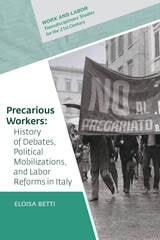
Precarious Workers
History of Debates, Political Mobilization, and Labor Reforms in ItalyEloisa Betti
Central European University Press, 2023
The recent vast upsurge in social science scholarship on job precarity has generally little to say about earlier forms of this phenomenon. Eloisa Betti’s monograph convincingly demonstrates on the example of Italy that even in the post-war phase of Keynesian stability and welfare state, precarious labor was an underlying feature of economic development. She examines how in this short period exceptional politics of labor stability prevailed. The volume then presents the processes whereby labor precarity regained momentum— under the name of flexibility— in the post-Fordist phase from the early 1980s, taking on new forms in the Craxi and Berlusconi eras.
Multiple actors are addressed in the analysis. The book gives voice to intellectuals, scholars, politicians and trade unionists as they have framed the concept and debates on precarious work from the 1950s onwards. Views of labor law experts, politicians and public servants are investigated in regard to labor regulations. Positions of the very precarians are explored, ranging from rural women, industrial homeworkers and blue-collar workers to physicians, university researchers and trainees, unveiling the emergence of anti-precarity social movements. The continuous role of women’s associations and feminist groups in opposing labor precarity since the 1950s is prominently exposed.
Public Lands, Public Debates
A Century of ControversyChar Miller, editor
Oregon State University Press, 2012
—Char Miller, from the introduction
Reshaping the World
Debates on Mesoamerican CosmologiesAna Díaz
University Press of Colorado, 2019
By reanalyzing and recontextualizing both indigenous and colonial texts and imagery in nine case studies examining Maya, Zapotec, Nahua, and Huichol cultures, the contributors discuss and challenge the commonly accepted notion that the cosmos was a static structure of superimposed levels unrelated to and unaffected by historical events and human actions. Instead, Mesoamerican cosmology consisted of a multitude of cosmographic repertoires that operated simultaneously as a result of historical circumstances and regional variations. These spaces were, and are, dynamic elements shaped, defined, and redefined throughout the course of human history. Indigenous cosmographies could be subdivided and organized in complex and diverse arrangements—as components in a dynamic interplay, which cannot be adequately understood if the cosmological discourse is reduced to a superposition of nine and thirteen levels.
Unlike previous studies, which focus on the reconstruction of a pan-Mesoamerican cosmological model, Reshaping the World shows how the movement of people, ideas, and objects in New Spain and neighboring regions produced a deep reconfiguration of Prehispanic cosmological and social structures, enriching them with new conceptions of space and time. The volume exposes the reciprocal influences of Mesoamerican and European theologies during the colonial era, offering expansive new ways of understanding Mesoamerican models of the cosmos.
Contributors:
Sergio Botta, Ana Díaz, Kerry Hull, Katarzyna Mikulska, Johannes Neurath, Jesper Nielsen, Toke Sellner Reunert†, David Tavárez, Alexander Tokovinine, Gabrielle Vail
The Evolution Wars
A Guide to the DebatesRuse, Michael
Rutgers University Press, 2001
The Evolution Wars draws on history, science, and philosophy to examine the development of evolutionary thought through the past two and a half centuries. It focuses on the debates that have engaged, divided, and ultimately provoked scientists to ponder the origins of organisms—including humankind—paying regard to the nineteenth-century clash over the nature of classification and debates about the fossil record, genetics, and human nature. Much attention is paid to external factors and the underlying motives of scientists.
In these pages you will meet Charles Darwin’s ebullient grandfather Erasmus, the contentious Frenchmen Georges Cuvier and Etienne Geoffroy Stain-Hillaire, new creationist Phillip Johnson, the brilliant J. B. S. Haldane, outspoken Richard Dawkins, and many other stars of the debates.
The Evolution Wars explores the ten greatest controversies surrounding evolution in world history, with emphasis on recent times, including the infamous Scopes trial of the 1920s: the search for human origins and speculation about the “missing link,” spurred by the discovery of “Lucy;” the debate surrounding the new theory of paleontology proposed by Stephen Jay Gould; and the rise of teaching “creation science” in public school as a subject on par with evolution.
Although the author takes a strong stand on the side of evolution, he also shows respect for dissenting viewpoints. Thus, the book is intellectually rewarding not only for evolutionists but also for opponents of evolution theory, especially those who want to see how one of the great ideas of Western civilization resonates through time, both within and beyond the scientific community.
The Michigan Constitutional Conventions of 1835-36
Debates and ProceedingsEdited by Harold M. Dorr
University of Michigan Press, 1940