Results by title
84 books match the query 'International cooperation' and 5 start with b
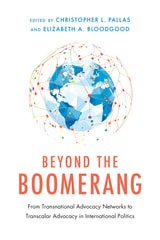
Beyond the Boomerang
From Transnational Advocacy Networks to Transcalar Advocacy in International PoliticsEdited by Christopher L. Pallas and Elizabeth A. Bloodgood
University of Alabama Press, 2022
From Networks to Scales: Rethinking Advocacy Power in Global Politics.
Margaret E. Keck and Kathryn Sikkink introduced the boomerang theory in their 1998 book, Activists beyond Borders: Advocacy Networks in International Politics. It remains one of the first broadly applicable theories for why groups of NGOs and interested individuals form transnational advocacy networks. Since its publication, however, the empirical conditions that prompted their theory have changed. The types of actors involved in transnational advocacy have diversified. Northern NGOs have lost power and influence and have been restricted in their access to southern states. Southern NGOs have developed the capacity to undertake advocacy on their own and often built closer relationships with their own governments. The architecture of global governance has likewise changed, providing new avenues of access and influence for southern voices.
In Beyond the Boomerang: From Transnational Advocacy Networks to Transcalar Advocacy in International Politics, editors Christopher L. Pallas and Elizabeth A. Bloodgood offer cutting-edge scholarship that synthesizes a new theoretical framework to develop a coherent, integrated picture of the current dynamics in global advocacy. This new theory of transcalar advocacy focuses on advocacy activities and policy impacts that transcend different levels or scales of political action. In transcalar advocacy, all NGOs–northern and southern–are treated as strategic actors, choosing the targets, scales of advocacy, and partnerships that best suit their capacities and goals. The case studies in the volume develop the empirical grounding of this theory using data from Latin America, Africa, Europe, and Asia, with several chapters featuring cross-national comparison. The chapters highlight the wide variety of actors involved in advocacy work, including NGOs, social movements, international institutions, governments, and businesses. Contributors use both qualitative and quantitative methodologies and bring to bear insights from political science, international relations, and sociology. The case studies also include diverse issue areas, from women’s rights to environmental protection, sustainable agriculture, health policy, and democracy promotion.
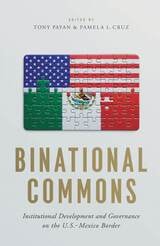
Binational Commons
Institutional Development and Governance on the U.S.-Mexico BorderEdited by Tony Payan and Pamela L. Cruz
University of Arizona Press, 2020
This volume addresses the most pertinent binational issues and how they are dealt with by both countries. In this important and timely volume, experts tackle the important problem of cross-border governance by an examination of formal and informal institutions, networks, processes, and mechanisms. Contributors also discuss various social, political, and economic actors and agencies that make up the increasingly complex governance space that is the U.S.-Mexico border.
Binational Commons focuses on whether the institutions that presently govern the U.S.-Mexico transborder space are effective in providing solutions to difficult binational problems as they manifest themselves in the borderlands. Critical for policy-making now and into the future, this volume addresses key binational issues. It explores where there are strong levels of institutional governance development, where it is failing, how governance mechanisms have evolved over time, and what can be done to improve it to meet the needs of the U.S.-Mexico borderlands in the next decades.
Contributors
Silvia M. Chavez-Baray
Kimberly Collins
Irasema Coronado
Guadalupe Correa-Cabrera
Pamela L. Cruz
Adrián Duhalt
James Gerber
Manuel A. Gutiérrez
Víctor Daniel Jurado Flores
Evan D. McCormick
Jorge Eduardo Mendoza Cota
Miriam S. Monroy
Eva M. Moya
Stephen Mumme
Tony Payan
Carla Pederzini Villarreal
Sergio Peña
Octavio Rodríguez Ferreira
Cecilia Sarabia Ríos
Kathleen Staudt
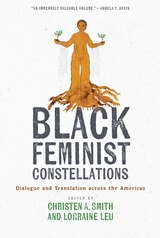
Black Feminist Constellations
Dialogue and Translation across the AmericasEdited by Christen A. Smith and Lorraine Leu
University of Texas Press, 2023
A collection of essays, interviews, and conversations by and between scholars, activists, and artists from Latin America and the Caribbean that paints a portrait of Black women's experiences across the region.
Black women in Latin America and the Caribbean suffer a triple erasure: as Black people, as women, and as non-English speakers in a global environment dominated by the Anglophone North. Black Feminist Constellations is a passionate and necessary corrective. Focused on and written by Black women of the southern Americas, the original works composing this volume make legible the epistemologies that sustain radical scholarship, art, and political organizing by Black women everywhere.
In essays, poems, and dialogues, the writers in Black Feminist Constellations reimagine liberation from the perspectives of radical South American and Caribbean Black women thinkers. The volume’s methodologically innovative approach reflects how Black women come together to theorize the world and challenges the notion that the university is the only site where knowledge can emerge. A major work of intellectual history, Black Feminist Constellations amplifies rarely heard voices, centers the uncanonized, and celebrates the overlooked work of Black women.

Breeding Bio Insecurity
How U.S. Biodefense Is Exporting Fear, Globalizing Risk, and Making Us All Less SecureLynn C. Klotz and Edward J. Sylvester
University of Chicago Press, 2009
In the years since the 9/11 attacks—and the subsequent lethal anthrax letters—the United States has spent billions of dollars on measures to defend the population against the threat of biological weapons. But as Lynn C. Klotz and Edward J. Sylvester argue forcefully in Breeding Bio Insecurity, all that money and effort hasn’t made us any safer—in fact, it has made us more vulnerable.
Breeding Bio Insecurity reveals the mistakes made to this point and lays out the necessary steps to set us on the path toward true biosecurity. The fundamental problem with the current approach, according to the authors, is the danger caused by the sheer size and secrecy of our biodefense effort. Thousands of scientists spread throughout hundreds of locations are now working with lethal bioweapons agents—but their inability to make their work public causes suspicion among our enemies and allies alike, even as the enormous number of laboratories greatly multiplies the inherent risk of deadly accidents or theft. Meanwhile, vital public health needs go unmet because of this new biodefense focus. True biosecurity, the authors argue, will require a multipronged effort based in an understanding of the complexity of the issue, guided by scientific ethics, and watched over by a vigilant citizenry attentive to the difference between fear mongering and true analysis of risk.
An impassioned warning that never loses sight of political and scientific reality, Breeding Bio Insecurity is a crucial first step toward meeting the evolving threats of the twenty-first century.

Bridging Worlds
Emerging Mode Ls And Practices OfRaymond Pun
Assoc of College & Research Libraries, 2016