167 books match the query 'Iowa' and 6 start with b

cover of Ball Hawks: The Arrival and Departure of the NBA in Iowa

Ball Hawks

The Arrival and Departure of the NBA in Iowa

Tim Harwood

University of Iowa Press, 2018

Believe it or not, Waterloo, Iowa, had an NBA team during the league’s first season, 1949 to 1950. Broadcaster and independent sports historian Tim Harwood uncovers the fascinating story of the Waterloo Hawks and the Midwest’s influence on professional basketball. Beginning with the professional leagues that led up to the creation of the National Basketball Association, Harwood recounts big games and dramatic buzzer-beaters, and the players who made them. 

The first season of the NBA was far from a success. Teams had a hard time attracting fans, with games often played in half-empty arenas. When Waterloo residents learned that the team was struggling financially, they rallied behind the Hawks and purchased shares of the team in a bid to keep it afloat. Unfortunately, that community-based effort was not enough; owners of teams in larger markets pressured the league to push Waterloo—and other smaller towns like Anderson, Indiana, and Sheboygan, Wisconsin—out of the league. 

Though the Hawks disappeared after their lone NBA campaign, Waterloo and other midwestern teams were nonetheless integral to getting the NBA off the ground, and their legacy continues today through some of the current franchises that relocated to larger markets. Combining newspaper accounts and personal interviews with surviving players, Harwood weaves a fascinating story of the underdog team, in the unlikeliest of places, that helped make professional basketball the worldwide success it is today. 

[more]
cover of Benjamin Shambaugh and the Intellectual Foundations of Public Hisory

Benjamin Shambaugh and the Intellectual Foundations of Public Hisory

Rebecca Conard

University of Iowa Press, 2001

"This is an important book that uses the long and distinguished historical career of Benjamin Shambaugh to place public or 'applied' history into a much-needed historical context. . . . Conard's narrative and analysis provide new insights into continuing debates about the proper role of federal and state governments in collecting and writing history. . . . an important contribution to American historiography in the twentieth century."--Barbara Franco, executive director, the Historical Society of Washington, D.C. "In Benjamin Shambaugh and the Intellectual Foundations of Public History, Rebecca Conard has written a useful and intriguing book. . . . The historical profession and the people of Iowa are indebted to Rebecca Conard for this book, which explores the impressive career of Benjamin Shambaugh and sheds new light on the fundamentals of the public history movement."--Annals of Iowa ". . . an unexpectedly engaging and useful examination and analysis of the ideologies, arguments, and politics surrounding the rise of history as a professional and academic discipline from the mid-nineteenth to the mid-twentieth centuries, especially as they were often rancorously expressed in disputes between the East and Midwest, state and national perspectives, and academic and professional practice."--The Journal of American History "Conard has provided the history profession with a layered narrative of its development and fragmentation or redevelopment over time, and has explored the meanings of its own histories."--Janelle Warren-Findley, The American Historical Review "Conard's biography is well written and interesting, and her strategies for engaging in dialog with a variety of texts produce a fresh method for defining and assessing public history."--The Journal of Heritage Stewardship Although his name is little known today outside Iowa, during the early part of the twentieth century Benjamin Shambaugh (1871 - 1940) was a key figure in the historical profession. Using his distinguished career as a lens, Conard's seminal work is the first book to consider public history as an integral part of the intellectual development of the historical profession as a whole in the United States. Conard draws upon an unpublished, mid-1940s biography by research historian Jacob Swisher to trace the forces that shaped Shambaugh's early years, his administration of the State Historical Society of Iowa, his development of applied history and commonwealth history in the 1910s and 1920s, and the transformations in his thinking and career during the 1930s. Framing this intriguingly interwoven narrative are chapters that contextualize Shambaugh's professional development within the development of the historical profession as a whole in the late nineteenth and early twentieth centuries and assess his career within the post-World War II emergence of the modern public history movement. Shambaugh's career speaks to those who believe in the power of history to engage and inspire local audiences as well as those who believe that historians should apply their knowledge and methods outside the academy in pursuit of the greater public good. Rebecca Conard, associate professor of history and codirector of the Public History Program at Middle Tennessee State University, is also the author of Places of Quiet Beauty: Parks, Preserves, and Environmentalism (Iowa, 1997), which won the Benjamin Shambaugh Award. "Rebecca Conard provides an elegant discussion of a complex topic: the emergence of public history in the twentieth century. . . . a sophisticated addition to public history historiography."--The Public Historian
[more]
cover of Between Gravity and What Cheer: Iowa Photographs

Between Gravity and What Cheer

Iowa Photographs

Barry Phipps

University of Iowa Press, 2018

When Barry Phipps relocated to Iowa City from Chicago in 2012, he knew nothing of Iowa. He began taking day trips across Iowa in the spirit of wonder and discovery. His marked-up road map soon became a work of art in and of itself, covered with spokes, lines, and places both seen and needing to be seen. Along the way he plied his trade, taking photographs. 

Inspired by such seminal work as Robert Frank’s The Americans, this is a unique vision of the Midwest and Iowa. Without condescending or overemphasizing the decline of small town America, Phipps documents rural communities as they are now, noting abstract shapes and colors as he photographs business districts with quirky and/or artful signs, streetscapes and landscapes, buildings with ghosts of paint from previous lives, and the occasional resident. 

In addition to their startling attention to color and geometry, Phipps’s photos delight because they suggest an author who isn’t on intimate terms with his subject matter, but very much wants to be. Though the photographs in this collection frequently maintain a cautious distance from the houses, water towers, and iconography he captures on film, the pictures feel, at once, eager and shy. 

Phipps admires his new home—from afar, by varying degrees—and excitedly introduces himself to it: the first steps of a journey toward claiming Iowa as his. 
[more]
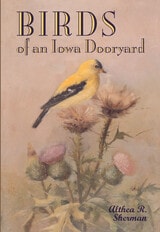
cover of Birds of an Iowa Dooryard

Birds of an Iowa Dooryard

Althea R. Sherman

University of Iowa Press, 1996

Now available in paperback with a new foreword by Marcia Myers Bonta, Birds of an Iowa Dooryard contains Althea Sherman's often caustic, always careful studies of the phoebes, wrens, cuckoos, rails, catbirds, owls, flickers, and many other species that inhabited her Acre of Birds in northern Iowa. Birds of an Iowa Dooryard, first published in 1952, is full of Sherman's meticulous observations of species both avian and human. Her paintings, her notebooks and publications, and her innovative chimney swift tower form a remarkably rich legacy to be valued by naturalists and researchers alike.

 
[more]
cover of Black Eagle Child: The Facepaint Narratives

Black Eagle Child

The Facepaint Narratives

Ray A. Young Bear

University of Iowa Press, 1992

A candid, poetic account of childhood and young manhood through the eyes of a Native American, this vivid narrative is destined to become a central moral text for our time. Through the persona of Edgar Bearchild—a member of the Black Eagle Child Settlement—Ray A. Young Bear takes readers on an unforgettable “journey of words” as he documents grief and anguish countered by an abundance of humor, pride, and insight.

[more]
cover of Buxton: A Black Utopia in the Heartland, An Expanded Edition

Buxton

A Black Utopia in the Heartland, An Expanded Edition

Dorothy Schwieder

University of Iowa Press, 2003

From 1900 until the early 1920s, an unusual community existed in America's heartland-Buxton, Iowa. Originally established by the Consolidation Coal Company, Buxton was the largest unincorporated coal mining community in Iowa. What made Buxton unique, however, is the fact that the majority of its 5,000 residents were African Americans—a highly unusual racial composition for a state which was over 90 percent white. At a time when both southern and northern blacks were disadvantaged and oppressed, blacks in Buxton enjoyed true racial integration—steady employment, above-average wages, decent housing, and minimal discrimination. For such reasons, Buxton was commonly known as “the black man's utopia in Iowa.”
Containing documentary evidence—including newspapers, census records, photographs, and state mining reports—along with interviews of 75 former residents, Buxton: Work and Racial Equality in a Coal Mining Community (originally published in 1987 and winner of the 1988 Benjamin Shambaugh Award) explored the Buxton experience from a variety of perspectives. The authors—an American historian, a family sociologist, and a race relations sociologist—provided a truly interdisciplinary history of one Iowa's most unique communities.
Now, eighty years after the town's demise and fifteen years after Buxton's original publication, the history of this Iowa town remains a compelling story that continues to capture people's imaginations. In Buxton: A Black Utopia in the Heartland, the authors offer further reflections upon their original study and the many former Buxton residents who shared their memories. In the new essay, “A Buxton Perspective,” issues such as social class and the town's continuing legacy are addressed. The voices captured inBuxton, although recorded over twenty years ago, still resonate with exuberance, affection, and poignancy; this expanded edition will bring their amazing stories back to the forefront of Iowa and American history. 
[more]