Results by title
87 books match the query 'Iraq' and 7 start with b
Babylonian Chronographic Texts from the Hellenistic Period
R. J. van der Spek
SBL Press, 2025
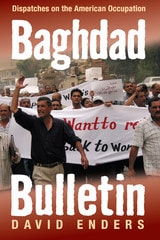
Baghdad Bulletin
Dispatches on the American OccupationDavid Enders
University of Michigan Press, 2009
-Joe Sacco, author of Safe Area Gorazde
"Baghdad Bulletin takes us where mainstream news accounts do not go. Disrupting the easy clichés that dominate U.S. journalism, Enders blows away the media fog of war. The result is a book that challenges Americans to see through double speak and reconsider the warfare being conducted in their names."
-Norman Solomon, author of War Made Easy: How Presidents and Pundits Keep Spinning Us to Death
"Journalism at its finest and on a shoestring to boot. David Enders shows that courage and honesty can outshine big-budget mainstream media. Wry but self-critical, Baghdad Bulletin tells a story that a few of us experienced but every journalist, nay every citizen, should read."
-Pratap Chatterjee, Managing Editor and Project Director, CorpWatch
"Young and tenacious, Dave Enders went, saw, and wrote it down. Here it is-a well-informed and detailed tale of Iraq's decline under American rule. Baghdad Bulletin offers tragic politics, wacky people, and keen insights about what really matters on the ground in Iraq."
-Christian Parenti
"I wrote my first piece for Baghdad Bulletin after visiting the mass graves at Al-Hilla in 2003. The Baghdad Bulletin was essential reading in the first few months after the end of the war. I handed that particular copy to Prime Minister Tony Blair. I am only sorry that I cannot read it anymore. David Enders and his team were brave, enterprising, and idealistic."
-Rt. Hon. Ann Clwyd, member of the British Parliament
Baghdad Bulletin is a street-level account of the war and turbulent postwar period as seen through the eyes of the young independent journalist David Enders. The book recounts Enders's story of his decision to go to Iraq, where he opened the only English-language newspaper completely written, printed, and distributed there during the war.
Young, courageous, and anti-authoritarian, Enders is the first reporter to cover the war as experienced by ordinary Iraqis. Deprived of the press credentials that gave his embedded colleagues access to press conferences and officially sanitized information, Enders tells the story of a different war, outside the Green Zone. It is a story in which the struggle of everyday life is interspersed with moments of sheer terror and bizarre absurdity: wired American troops train their guns on terrified civilians; Iraqi musicians prepare a recital for Coalition officials who never show; traveling clowns wreak havoc in a Baghdad police station.
Orphans and intellectuals, activists and insurgents: Baghdad Bulletin depicts the unseen complexity of Iraqi society and gives us a powerful glimpse of a new kind of warfare, one that coexists with-and sometimes tragically veers into-the everyday rhythms of life.
Baghdad Sketches
Freya Stark
Northwestern University Press, 1996
Baghdadi Judeo-Arabic
An Introductory TextAssaf Bar-Moshe
University College London, 2024
This textbook is dedicated to spoken Baghdadi Judeo-Arabic—the native tongue spoken by the Jews of Baghdad and other towns of Southern Iraq—and is designed to guide beginners to an advanced level of speaking. It focuses on common expressions, introduces Baghdad’s historic Jewish culture, and guides readers through sample texts, key vocabulary, grammar points, and exercises, as well as particular topics, such as greetings, family, shopping, and cuisine.
Being Human
Political Modernity and Hospitality in Kurdistan-IraqFazil Moradi
Rutgers University Press, 2024
Bordering on War
A Social and Political History of KhuzestanShaherzad Ahmadi
University of Texas Press, 2024
A study of transnational identity, migration, and state loyalties told through the social and political history of Iran’s Khuzestan province.
In 1980, Saddam Hussein’s Ba‘athist forces invaded Khuzestan, one of the oldest and richest provinces in Iran, triggering the Iran-Iraq War. Shaherzad Ahmadi’s Bordering on War examines the social history of Khuzestan and sheds light on how border dwellers, provincial leaders, and migrants in the region shaped Iran and Iraq's history before, during, and after the war.
Drawing from a rich collection of Persian- and Arabic-language archival sources—rarely used by western scholars due to restrictions in Iran—Ahmadi’s research focuses on Arab Iranians and argues that Iranian border dwellers and migrants formed local, non-national loyalties, thereby eschewing bureaucratic pressures to confine loyalties to a single nation-state. The transnational character and ethnically diverse composition of Khuzestan, especially in the oil-rich towns on the southwestern border, led many, including Iraq’s Ba‘ath Party, to question the national belonging of Arab Iranians. Bordering on War contributes to a wider discussion about the ability of individuals and communities to exert agency through migration, trade, education, and other activities.
Bullets in Envelopes
Iraqi Academics in ExileLouis Yako
Pluto Press, 2021