Results by title
16 books match the query 'Catalogue'
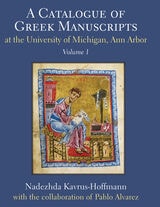
A Catalogue of Greek Manuscripts at the University of Michigan, Ann Arbor, Volume 1
Nadezhda Kavrus-Hoffmann with the collaboration of Pablo Alvarez
University of Michigan Press, 2021
A Catalogue of Greek Manuscripts at the University of Michigan, Ann Arbor is a comprehensive, fully illustrated catalogue of the largest collection of Greek manuscripts in America, including 110 codices and fragments ranging from the fourth to the nineteenth century. The collection, held in the Special Collections Research Center of the University of Michigan Library, contains many manuscripts from Epirus and the Meteora monasteries built on high pinnacles of rocks in Thessaly. Nadezhda Kavrus-Hoffmann has based the manuscript descriptions on the latest developments in the fields of paleography and codicology, including the newest recommendations of the Institute for Research and History of Texts in Paris. The catalogue includes high-resolution plates of all the manuscripts, allowing researchers to compare the entries with other Greek manuscripts around the world. This catalogue contains a trove of fascinating information related to Byzantine culture that will be available for the first time to scholars working on various disciplines of the humanities such as Classical and Byzantine Studies, Art History, Medieval Studies, Theology, and History.
This is the first volume of a projected two-volume set. Volume 2, also by Nadezhda Kavrus-Hoffmann, will contain descriptions of remaining Greek manuscripts in the Library’s collection, starting with Mich. Ms. 59 and ending with Mich. Ms. 238, for a total of 53 manuscripts and 8 fragments. Both volumes will have the same format – catalogue entries for each manuscript together with extensive illustrations. The publication date for Volume 2 has not been established.
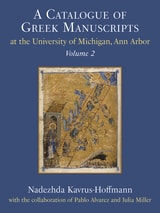
A Catalogue of Greek Manuscripts at the University of Michigan, Ann Arbor, Volume 2
Nadezhda Kavrus-Hoffmann with the collaboration of Pablo Alvarez and Julia Miller
University of Michigan Press, 2026
A Catalogue of Greek Manuscripts at the University of Michigan, Ann Arbor, Volume II unveils the rich diversity and enduring legacy of the Greek manuscript tradition preserved in one of North America's largest collections. Building on the acclaimed first volume, this second and concluding volume offers comprehensive illustrated descriptions of eighty-four manuscripts and fragments housed in the University of Michigan Library's Special Collections Research Center. The discovery of twenty-three previously unknown manuscripts and fragments significantly expands our understanding of Byzantine and post-Byzantine book culture, illuminating the remarkable continuity of Greek scholarly, liturgical, and artistic traditions from the ninth through the nineteenth centuries.
Each entry integrates codicological features, handwriting analysis, textual content, decoration, binding, provenance, and references to earlier scholarship as well as high-quality color plates to illustrate representative pages, script types, and illuminations. Among the exceptional highlights are a fragment of The Great Calculation According to the Indians by Maximos Planoudes, preserving portions of this rare mathematical treatise otherwise lost; an illuminated 1371 copy of The Heavenly Ladder by John Klimax, created by the renowned scribe Joasaph II of the Hodegon Monastery in Constantinople; and a newly identified manuscript containing rare patristic homilies linked to the sixteenth-century Choniates scriptorium in Venice.
A Catalogue of Greek Manuscripts from the Meerman Collection in the Bodleian Library
Annaclara Cataldi Palau
Bodleian Library Publishing, 2011
A Catalogue of Greek Manuscripts from the Meerman Collection in the Bodleian Library
Annaclara Cataldi Palau
Bodleian Library Publishing, 0

A Catalogue of the Everett D. Graff Collection of Western Americana
Compiled by Colton Storm
University of Chicago Press, 1968
Collectors, bibliographers, librarians, historians, and book dealers specializing in Americana will find the Graff Catalogue an interesting and essential tool. Detailed collations and binding descriptions are cited, and many of the more important works have been annotated by Mr. Graff and Mr. Storm. An extensive index of persons and subjects makes the book useful to the scholar as well as to the collector and dealer. The book is not a bibliography but rather a guide to rare or unique source materials now enriching The Newberry Library's outstanding holdings in American history.
A Catalogue of the Pre-1500 Western Manuscript Books at the Newberry Library
Paul Saenger
University of Chicago Press, 1989
Some of the books, such as those from the libraries of Philip the Good and Anne of Brittany, are beautifully illuminated. But the collection also includes an unusual array of "typical" medieval books, chosen not for their beauty but for their paleographical, codicological, and textual interest. Such codices include an eleventh-century Carthusian monk, and numerous books of hours adapted for feminine use. Paul Saenger has painstakingly identified the text, illumination, physical structure, and provenance for each of the more than 200 books in the collection to provide an exemplary guide to literate culture in the late Middle Ages.
This catalogue, carefully researched and handsomely illustrated, will be an invaluable resource for historians, art historians, paleographers, bibliographers, and collectors.
Catalogue of Books and Journals, 1891-1965
The University of Chicago Press
University of Chicago Press, 1967

Catalogue of Fungi of Colombia
Edited by Rafael F. De Almeida, Robert Lücking, Aída Vasco-Palacios, Ester Gaya, and Mauricio Diazgranados
Royal Botanic Gardens, Kew, 2022
Catalogue of Fungi of Colombia is the first comprehensive listing of the known Colombian fungi. It was compiled by a team of Colombian and international mycologists from the Royal Botanic Gardens, Kew, the Humboldt Institute, and other partner organizations. The catalog is accompanied by fifteen chapters written by specialists providing perspectives on the state of knowledge of the Colombian fungi covering a range of topics, from the diversity of the main groups of fungi and history of mycological studies in Colombia to aspects of the biogeography, ecology, biotechnology, conservation, and uses of Colombian fungi. The catalog is further enriched by supplementary material that allows readers to explore open questions, develop new ideas on the use of fungi and their conservation, and foster social and environmental awareness.
Catalogue of Useful Plants of Colombia
Edited by Raquel Negrão, Alexandre K. Monro, Carolina Castellanos-Castro, and Mauricio Diazgranados
Royal Botanic Gardens, Kew, 2022
The Catalogue of Useful Plants of Colombia is the most comprehensive listing of the known useful plants found in Colombia. It was compiled by a team of Colombian and international botanists from the Royal Botanic Gardens, Kew, the Humboldt Institute, and other partner organizations. The catalog is accompanied by eleven chapters written by specialists covering a range of topics, from taxonomic, geographic, and conservation aspects to the plants’ uses in sustainable value chains and contributions to the bioeconomy. Specific topics such as medicinal, edible, and insecticide plants and their representation in the Amazon region are also covered. The catalog includes supplementary material that allows readers to explore open questions and opportunities, develop new ideas on the use of plants and their conservation, and foster social and environmental awareness.
Catalogue of Watermarks in Italian Printed Maps, ca. 1540-1600
David Woodward
University of Chicago Press, 1996
Fifteen years in the making, this catalogue will be an essential reference for bibliographers and archivists dealing with rare books and maps of the period, for map collectors, map librarians, and scholars and librarians working with early printed items and manuscripts.
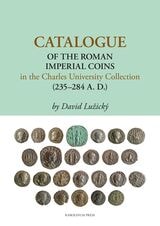
Catalogue of the Roman Imperial Coins in the Charles University Collection (235–284 A.D.)
David Lužický
Karolinum Press, 2026
Spotlights over five hundred Roman Imperial coins from Charles University's vast collection of ancient coins.
Charles University’s collection of ancient coins in its present state has existed since l945. Greek, Roman, and other ancient coins were entrusted to the care of the Seminar for Ancient History and compiled into a single collection along with antique coins from the original collection of the Czech University. The collection contains about 4,000 pieces altogether, mostly in silver and bronze.
This publication presents a catalogue of 564 Roman Imperial coins dating from 235 to 284 A. D. and is part of efforts to gradually catalogue the entirety of Charles University’s collection of ancient coins, stored in the depository of the CU Institute of Greek and Latin Studies. The book builds upon Václav Marek’s 1985 monograph, The Roman Republican Coins in the Collection of Charles University, and Federico Gambacorta’s 2013 continuation titled Catalogue of the Late Roman, Byzantine and Barbaric Coins in the Charles University Collection (364–1092 A. D.).
Catalogue of the Slavonic Cyrillic Manuscripts of the National Szechenyi Library
Ralph Cleminson
Central European University Press, 2007
Catalogue of the Stearns Collection of Musical Instruments
Albert A. Stanley
University of Michigan Press, 1918

Catalogue of the Stearns Collection of Musical Instruments
Albert A. Stanley
University of Michigan Press, 1921
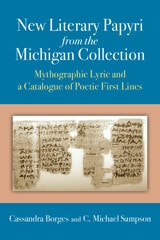
New Literary Papyri from the Michigan Collection
Mythographic Lyric and a Catalogue of Poetic First LinesCassandra Borges and C. Michael Sampson
University of Michigan Press, 2012
New texts from Greek antiquity continue to emerge on scraps of papyrus from the sands of Egypt, not only adding to the surviving corpus of classical and Hellenistic literature, but also occasionally offering a glimpse into how these poems were studied in antiquity. New Literary Papyri from the Michigan Collection: Mythographic Lyric and a Catalogue of Poetic First Lines presents three such new texts: an innovative lyric poem on the Trojan cycle, a scholarly anthology of lyric verses, and a brief but enigmatic third text. Cassandra Borges and C. Michael Sampson offer the original Greek text of these pieces, along with their scholarly commentary, analyzing their features in a variety of contexts—historical, cultural, poetic, mythological, religious, and scholarly.
The fragments collected here are of considerable antiquity (late third to second century BCE) a fact that is significant inasmuch as it places them among the oldest Greek papyri, but all the more so because in this period, a scholarly community was thriving in Ptolemaic Alexandria, the political and cultural capital of Hellenistic Egypt. The fragments bear witness to that scholarly activity: not only is their anthology of poetic verses consistent with other scholarly selections, but the very survival of these texts may well be at least partially indebted to the work of the Alexandrians in studying and propagating Greek literature in Egypt.
This edition supplements the 1970s work of Reinhold Merkelbach and Denys Page. Recent digitizing for the APIS project revealed a previously unsuspected join with other material, however, which alone warrants a new, comprehensive edition and analysis.
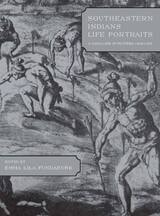
Southeastern Indians Life Portraits
A Catalogue of Pictures 1564-1860Emma Lila Fundaburk
University of Alabama Press, 1958
This pictorial classic is a valuable ethnological record of southeastern Indians that also showcases the work of early photographers and artists.
A collection of over 350 photographs, paintings, drawings,and woodcuts, Life Portraits offers us an important visual representation of southeastern Indians—at work, at play, in rituals, and in death—when they first encountered Europeans.
Studied by historians and archaeologists, as well as museum exhibit designers and costumers, these illustrations provide a wealth of information on native dress and jewelry, house construction, agricultural techniques, warfare, and other aspects of American Indian life. Among the tribes illustrated are Natchez, Choctaw, Creek, Chickasaw, Cherokee, Seminole, Chitimacha, Timucua, Powhatan, Tuscarora, Caddo, Yuchi, and Shawnee.
A special section of the book quotes historic narratives and comments on the life and work of the artists, lithographers, photographers, and engravers who made the originals. Included among these are Jacques le Moyne, John White, Theodore De Bry, Francis Parsons, Joshua Reynolds, John Trumball, George Catlin, John Mix Stanley, Thomas McKenney, and Samuel Waugh.
Life Portraits has been a classic title in southeastern archaeology and a staple of bookstores and museum shops around the country since its original publication in 1958. Because the carefully identified illustrations were secured from a wide variety of sources, including the British Museum, the Charleston Museum, the New York Public Library, and the Oklahoma Historical Society, this volume represents the most comprehensiveand widely available record of Indian images. Designed for Americana collections, it will appeal to general readers as well as professional historians and archaeologists.