412 books match the query 'Japan' and 14 start with b

cover of Babylon East: Performing Dancehall, Roots Reggae, and Rastafari in Japan

Babylon East

Performing Dancehall, Roots Reggae, and Rastafari in Japan

Marvin D. Sterling

Duke University Press, 2010

An important center of dancehall reggae performance, sound clashes are contests between rival sound systems: groups of emcees, tune selectors, and sound engineers. In World Clash 1999, held in Brooklyn, Mighty Crown, a Japanese sound system and the only non-Jamaican competitor, stunned the international dancehall community by winning the event. In 2002, the Japanese dancer Junko Kudo became the first non-Jamaican to win Jamaica’s National Dancehall Queen Contest. High-profile victories such as these affirmed and invigorated Japan’s enthusiasm for dancehall reggae. In Babylon East, the anthropologist Marvin D. Sterling traces the history of the Japanese embrace of dancehall reggae and other elements of Jamaican culture, including Rastafari, roots reggae, and dub music.

Sterling provides a nuanced ethnographic analysis of the ways that many Japanese involved in reggae as musicians and dancers, and those deeply engaged with Rastafari as a spiritual practice, seek to reimagine their lives through Jamaican culture. He considers Japanese performances and representations of Jamaican culture in clubs, competitions, and festivals; on websites; and in song lyrics, music videos, reggae magazines, travel writing, and fiction. He illuminates issues of race, ethnicity, gender, sexuality, and class as he discusses topics ranging from the cultural capital that Japanese dancehall artists amass by immersing themselves in dancehall culture in Jamaica, New York, and England, to the use of Rastafari as a means of critiquing class difference, consumerism, and the colonial pasts of the West and Japan. Encompassing the reactions of Jamaica’s artists to Japanese appropriations of Jamaican culture, as well as the relative positions of Jamaica and Japan in the world economy, Babylon East is a rare ethnographic account of Afro-Asian cultural exchange and global discourses of blackness beyond the African diaspora.

[more]
cover of Bad Water: Nature, Pollution, and Politics in Japan, 1870-1950

Bad Water

Nature, Pollution, and Politics in Japan, 1870-1950

Robert Stolz

Duke University Press, 2014

Bad Water is a sophisticated theoretical analysis of Japanese thinkers and activists' efforts to reintegrate the natural environment into Japan's social and political thought in the late nineteenth century and early twentieth. The need to incorporate nature into politics was revealed by a series of large-scale industrial disasters in the 1890s. The Ashio Copper Mine unleashed massive amounts of copper, arsenic, mercury, and other pollutants into surrounding watersheds. Robert Stolz argues that by forcefully demonstrating the mutual penetration of humans and nature, industrial pollution biologically and politically compromised the autonomous liberal subject underlying the political philosophy of the modernizing Meiji state. In the following decades, socialism, anarchism, fascism, and Confucian benevolence and moral economy were marshaled in the search for new theories of a modern political subject and a social organization adequate to the environmental crisis. With detailed considerations of several key environmental activists, including Tanaka Shōzō, Bad Water is a nuanced account of Japan's environmental turn, a historical moment when, for the first time, Japanese thinkers and activists experienced nature as alienated from themselves and were forced to rebuild the connections.
[more]
cover of Banking on Stability: Japan and the Cross-Pacific Dynamics of International Financial Crisis Management

Banking on Stability

Japan and the Cross-Pacific Dynamics of International Financial Crisis Management

Saori N. Katada

University of Michigan Press, 2001

Saori N. Katada examines international financial stability in the aftermath of financial crises--and how such stability is maintained through collective action among major financial powers across the Pacific, the United States, and Japan. She explores the important role that financial support by the Japanese government played in solving the Latin American debt crisis in the 1980s, as well as its lack of support for the Mexican rescue in 1994--95 and its inconsistency during the recent Asian financial crisis.
Banking on Stability looks at Japan's willingness to cooperate financially with the United States--its most important trade partner--in cases where such compliance yields an improvement in relations. Katada argues that the Japanese government carefully weighs the benefits arising in international and domestic realms when taking on the role of collective crisis manager and concludes that Japan is no exception in having private gain as a central motivation during international financial crises.
Saori Katada is Assistant Professor, School of International Relations, University of Southern California.

[more]
cover of Beautiful Fighting Girl

Beautiful Fighting Girl

Saito Tamaki

University of Minnesota Press, 2010

From Cutie Honey and Sailor Moon to Nausicaä of the Valley of the Wind, the worlds of Japanese anime and manga teem with prepubescent girls toting deadly weapons. Sometimes overtly sexual, always intensely cute, the beautiful fighting girl has been both hailed as a feminist icon and condemned as a symptom of the objectification of young women in Japanese society.

In Beautiful Fighting Girl, Saito Tamaki offers a far more sophisticated and convincing interpretation of this alluring and capable figure. For Saito, the beautiful fighting girl is a complex sexual fantasy that paradoxically lends reality to the fictional spaces she inhabits. As an object of desire for male otaku (obsessive fans of anime and manga), she saturates these worlds with meaning even as her fictional status demands her ceaseless proliferation and reproduction. Rejecting simplistic moralizing, Saito understands the otaku’s ability to eroticize and even fall in love with the beautiful fighting girl not as a sign of immaturity or maladaptation but as a result of a heightened sensitivity to the multiple layers of mediation and fictional context that constitute life in our hypermediated world—a logical outcome of the media they consume.

Featuring extensive interviews with Japanese and American otaku, a comprehensive genealogy of the beautiful fighting girl, and an analysis of the American outsider artist Henry Darger, whose baroque imagination Saito sees as an important antecedent of otaku culture, Beautiful Fighting Girl was hugely influential when first published in Japan, and it remains a key text in the study of manga, anime, and otaku culture. Now available in English for the first time, this book will spark new debates about the role played by desire in the production and consumption of popular culture.
[more]
cover of Before the Nation: Kokugaku and the Imagining of Community in Early Modern Japan

Before the Nation

Kokugaku and the Imagining of Community in Early Modern Japan

Susan L. Burns

Duke University Press, 2003

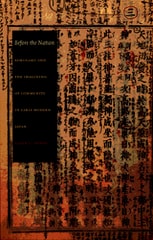
Exploring the emergence and evolution of theories of nationhood that continue to be evoked in present-day Japan, Susan L. Burns provides a close examination ofthe late-eighteenth-century intellectual movement kokugaku, which means "the study of our country.” Departing from earlier studies of kokugaku that focused on intellectuals whose work has been valorized by modern scholars, Burns seeks to recover the multiple ways "Japan" as social and cultural identity began to be imagined before modernity.

Central to Burns's analysis is Motoori Norinaga’s Kojikiden, arguably the most important intellectual work of Japan's early modern period. Burns situates the Kojikiden as one in a series of attempts to analyze and interpret the mythohistories dating from the early eighth century, the Kojiki and Nihon shoki. Norinaga saw these texts as keys to an original, authentic, and idyllic Japan that existed before being tainted by "flawed" foreign influences, notably Confucianism and Buddhism. Hailed in the nineteenth century as the begetter of a new national consciousness, Norinaga's Kojikiden was later condemned by some as a source of Japan's twentieth-century descent into militarism, war, and defeat. Burns looks in depth at three kokugaku writers—Ueda Akinari, Fujitani Mitsue, and Tachibana Moribe—who contested Norinaga's interpretations and produced competing readings of the mythohistories that offered new theories of community as the basis for Japanese social and cultural identity. Though relegated to the footnotes by a later generation of scholars, these writers were quite influential in their day, and by recovering their arguments, Burns reveals kokugaku as a complex debate—involving history, language, and subjectivity—with repercussions extending well into the modern era.

[more]
cover of Being Dead Otherwise

Being Dead Otherwise

Anne Allison

Duke University Press, 2023

With an aging population, declining marriage and childbirth rates, and a rise in single households, more Japanese are living and dying alone. Many dead are no longer buried in traditional ancestral graves where descendants would tend their spirits, and individuals are increasingly taking on mortuary preparation for themselves. In Being Dead Otherwise Anne Allison examines the emergence of new death practices in Japan as the old customs of mortuary care are coming undone. She outlines the proliferation of new industries, services, initiatives, and businesses that offer alternative means---ranging from automated graves, collective grave sites, and crematoria to one-stop mortuary complexes and robotic priests---for tending to the dead. These new burial and ritual practices provide alternatives to long-standing traditions of burial and commemoration of the dead. In charting this shifting ecology of death, Allison outlines the potential of these solutions to radically reorient sociality in Japan in ways that will impact how we think about the end of life, identity, tradition, and culture in Japan and beyond.
[more]
cover of Between the Eagle and the Sun: Traces of Japan

Between the Eagle and the Sun

Traces of Japan

Ihab Hassan

University of Alabama Press, 1996

A fascinating memoir by Egypt-born American literary theorist and writer Ihab Hassan about his life in Japan. Part recollection, part cultural perception, Between the Eagle and the Sun records his journey, living and seeing himself sometimes as another, assaying always to read the hieroglyphs of his past in the scripts of Japan. As lucid as it is intensely felt, at once lyrical and critical, the work offers a beguiling vision of Japan and, by tacit contrast, of America. For writing, the author says, is more than praise or blame, it is also knowledge, empathy, and delight. These attributes are evident in Hassan's treatment of Japanese culture, its people and scenes. Indeed, the people, rendered in vibrant portraits throughout the book, abide when all the shadows of romance and exasperation have fled.

True to its moment, the work also reinvests the forms of memoir, travel, and quest. Cultural essays, travel anecdotes, autobiographical meditations, portraits of Japanese friends, a section titled "Entries, A to Z," fit into a tight frame, with clear transitions from one section to another. The style, however, alters subtly to suit topic, occasion, and mood.

Japan may not hold the key to this planet's future; no single nation does. Yet the continuing interest in its history, society, and people and the incresed awareness of its recent trends and growing global impact engage an expanding audience. Avoiding cliches, sympathetic to its subject yet analytical, unflinching in judgment, and withal highly personal, Between the Eagle and the Sun offers a unique image of its subject by a distinguished and well-traveled critic, at home in several cultures.
[more]
cover of Beyond the Gender Gap in Japan

Beyond the Gender Gap in Japan

Gill Steel, Editor

University of Michigan Press, 2019
Why do Japanese women enjoy a high sense of well-being in a context of high inequality? Beyond the Gender Gap in Japan brings together researchers from across the social sciences to investigate this question. The authors analyze women’s values and the lived experiences at home, in the family, at work, in their leisure time, as volunteers, and in politics and policy-making. Their research shows that the state and firms have blurred “the public” and “the private” in postwar Japan, constraining individuals’ lives, and reveals the uneven pace of change in women’s representation in politics. Yet, despite these constraints, the increasing diversification in how people live and how they manage their lives demonstrates that some people are crafting a variety of individual solutions to structural problems. Covering a significant breadth of material, the book presents comprehensive findings that use a variety of research methods—public opinion surveys, in-depth interviews, a life history, and participant observation—and, in doing so, look beyond Japan’s perennially low rankings in gender equality indices to demonstrate the diversity underneath, questioning some of the stereotypical assumptions about women in Japan.
[more]
cover of Black Wave: How Networks and Governance Shaped Japan’s 3/11 Disasters

Black Wave

How Networks and Governance Shaped Japan’s 3/11 Disasters

Daniel P. Aldrich

University of Chicago Press, 2019

Despite the devastation caused by the magnitude 9.0 earthquake and 60-foot tsunami that struck Japan in 2011, some 96% of those living and working in the most disaster-stricken region of Tōhoku made it through. Smaller earthquakes and tsunamis have killed far more people in nearby China and India. What accounts for the exceptionally high survival rate? And why is it that some towns and cities in the Tōhoku region have built back more quickly than others?
           
Black Wave illuminates two critical factors that had a direct influence on why survival rates varied so much across the Tōhoku region following the 3/11 disasters and why the rebuilding process has also not moved in lockstep across the region. Individuals and communities with stronger networks and better governance, Daniel P. Aldrich shows, had higher survival rates and accelerated recoveries. Less-connected communities with fewer such ties faced harder recovery processes and lower survival rates. Beyond the individual and neighborhood levels of survival and recovery, the rebuilding process has varied greatly, as some towns and cities have sought to work independently on rebuilding plans, ignoring recommendations from the national government and moving quickly to institute their own visions, while others have followed the guidelines offered by Tokyo-based bureaucrats for economic development and rebuilding.
 
[more]
cover of Blind in Early Modern Japan: Disability, Medicine, and Identity

Blind in Early Modern Japan

Disability, Medicine, and Identity

Wei Yu Wayne Tan

University of Michigan Press, 2022

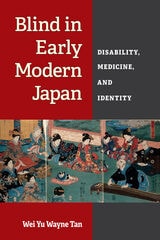
While the loss of sight—whether in early modern Japan or now—may be understood as a disability, blind people in the Tokugawa period (1600–1868) could thrive because of disability. The blind of the era were prominent across a wide range of professions, and through a strong guild structure were able to exert contractual monopolies over certain trades. Blind in Early Modern Japan illustrates the breadth and depth of those occupations, the power and respect that accrued to the guild members, and the lasting legacy of the Tokugawa guilds into the current moment.The book illustrates why disability must be assessed within a particular society’s social, political, and medical context, and also the importance of bringing medical history into conversation with cultural history. A Euro-American-centric disability studies perspective that focuses on disability and oppression, the author contends, risks overlooking the unique situation in a non-Western society like Japan in which disability was constructed to enhance blind people’s power. He explores what it meant to be blind in Japan at that time, and what it says about current frameworks for understanding disability.
[more]
cover of Blue Nippon: Authenticating Jazz in Japan

Blue Nippon

Authenticating Jazz in Japan

E. Taylor Atkins

Duke University Press, 2001

Japan’s jazz community—both musicians and audience—has been begrudgingly recognized in the United States for its talent, knowledge, and level of appreciation. Underpinning this tentative admiration, however, has been a tacit agreement that, for cultural reasons, Japanese jazz “can’t swing.” In Blue Nippon E. Taylor Atkins shows how, strangely, Japan’s own attitude toward jazz is founded on this same ambivalence about its authenticity.
Engagingly told through the voices of many musicians, Blue Nippon explores the true and legitimate nature of Japanese jazz. Atkins peers into 1920s dancehalls to examine the Japanese Jazz Age and reveal the origins of urban modernism with its new set of social mores, gender relations, and consumer practices. He shows how the interwar jazz period then became a troubling symbol of Japan’s intimacy with the West—but how, even during the Pacific war, the roots of jazz had taken hold too deeply for the “total jazz ban” that some nationalists desired. While the allied occupation was a setback in the search for an indigenous jazz sound, Japanese musicians again sought American validation. Atkins closes out his cultural history with an examination of the contemporary jazz scene that rose up out of Japan’s spectacular economic prominence in the 1960s and 1970s but then leveled off by the 1990s, as tensions over authenticity and identity persisted.
With its depiction of jazz as a transforming global phenomenon, Blue Nippon will make enjoyable reading not only for jazz fans worldwide but also for ethnomusicologists, and students of cultural studies, Asian studies, and modernism.

[more]
cover of Bonds of the Dead: Temples, Burial, and the Transformation of Contemporary Japanese Buddhism

Bonds of the Dead

Temples, Burial, and the Transformation of Contemporary Japanese Buddhism

Mark Michael Rowe

University of Chicago Press, 2011

Despite popular images of priests seeking enlightenment in snow-covered mountain temples, the central concern of Japanese Buddhism is death. For that reason, Japanese Buddhism’s social and economic base has long been in mortuary services—a base now threatened by public debate over the status, treatment, and location of the dead. Bonds of the Dead explores the crisis brought on by this debate and investigates what changing burial forms reveal about the ways temple Buddhism is perceived and propagated in contemporary Japan.
Mark Rowe offers a crucial account of how religious, political, social, and economic forces in the twentieth century led to the emergence of new funerary practices in Japan and how, as a result, the care of the dead has become the most fundamental challenge to the continued existence of Japanese temple Buddhism. Far from marking the death of Buddhism in Japan, Rowe argues, funerary Buddhism reveals the tradition at its most vibrant. Combining ethnographic research with doctrinal considerations, this is a fascinating book for anyone interested in Japanese society and religion.
[more]
cover of Borders of Chinese Civilization: Geography and History at Empire's End

Borders of Chinese Civilization

Geography and History at Empire's End

D. R. Howland

Duke University Press, 1996

D. R. Howland explores China’s representations of Japan in the changing world of the late nineteenth century and, in so doing, examines the cultural and social borders between the two neighbors. Looking at Chinese accounts of Japan written during the 1870s and 1880s, he undertakes an unprecedented analysis of the main genres the Chinese used to portray Japan—the travel diary, poetry, and the geographical treatise. In his discussion of the practice of “brushtalk,” in which Chinese scholars communicated with the Japanese by exchanging ideographs, Howland further shows how the Chinese viewed the communication of their language and its dominant modes—history and poetry—as the textual and cultural basis of a shared civilization between the two societies.

With Japan’s decision in the 1870s to modernize and westernize, China’s relationship with Japan underwent a crucial change—one that resulted in its decisive separation from Chinese civilization and, according to Howland, a destabilization of China’s worldview. His examination of the ways in which Chinese perceptions of Japan altered in the 1880s reveals the crucial choice faced by the Chinese of whether to interact with Japan as “kin,” based on geographical proximity and the existence of common cultural threads, or as a “barbarian,” an alien force molded by European influence.

By probing China’s poetic and expository modes of portraying Japan, Borders of Chinese Civilization exposes the changing world of the nineteenth century and China’s comprehension of it. This broadly appealing work will engage scholars in the fields of Asian studies, Chinese literature, history, and geography, as well as those interested in theoretical reflections on travel or modernism.


[more]
cover of Butoh: Metamorphic Dance and Global Alchemy

Butoh

Metamorphic Dance and Global Alchemy

Sondra Fraleigh

University of Illinois Press, 2010

Both a refraction of the bombings of Hiroshima and Nagasaki and a protest against Western values, butoh is a form of Japanese dance theater that emerged in the aftermath of World War II. Sondra Fraleigh chronicles the growth of this provocative art form from its mid-century founding under a sign of darkness to its assimilation in the twenty-first century as a poignant performance medium with philosophical and political implications.
 
Through highly descriptive, thoughtful, and emotional prose, Fraleigh traces the transformative alchemy of this metaphoric dance form by studying the international movement inspired by its aesthetic mixtures. While butoh has retained a special identity related to its Japanese background, it also has blossomed into a borderless art with a tolerant and inclusive morphology gaining prominence in a borderless century.
 
Employing intellectual and aesthetic perspectives to reveal the origins, major figures, and international development of the dance, Fraleigh documents the range and variety of butoh artists around the world with first-hand knowledge of butoh performances from 1973 to 2008. Her definitions of butoh's morphology, alchemy, and philosophy set a theoretical framework for poetic and engaging articulations of twenty butoh performances in Japan, Europe, India, and the West. With a blend of scholarly research and direct experience, she also signifies the unfinished nature of butoh and emphasizes its capacity to effect spiritual transformation and bridge cultural differences.
[more]