Results by title
403 books match the query 'Journalism' and 21 start with b
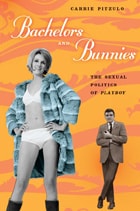
Bachelors and Bunnies
The Sexual Politics of PlayboyCarrie Pitzulo
University of Chicago Press, 2011
For a lot of people, thoughts about the sexual politics of Playboy run along the lines of what Gloria Steinem reportedly once told Hugh Hefner: “A woman reading Playboy feels a little like a Jew reading a Nazi manual.” Hefner’s magazine celebrates men as swinging bachelors and women as objects of desire; ergo, it’s sexist.
Not so fast, says Carrie Pitzulo. With Bachelors and Bunnies, she delves into the history of the magazine to reveal its surprisingly strong record of support for women’s rights and the modernization of sexual and gender roles. Taking readers behind the scenes of Playboy’s heyday, Pitzulo shows how Hefner’s own complicated but thoughtful perspective on modern manhood, sexual liberation, and feminism played into debates—both in the editorial offices and on the magazine’s pages—about how Playboy’s trademark “girl next door” appeal could accommodate, acknowledge, and even honor the changing roles and new aspirations of women in postwar America. Revealing interviews with Hugh Hefner and his daughter (and later Playboy CEO) Christie Hefner, as well as with a number of editors and even Playmates, show that even as the magazine continued to present a romanticized notion of gender difference, it again and again demonstrated a commitment to equality and expanded opportunities for women.
Offering a surprising new take on a twentieth-century icon, Bachelors and Bunnies goes beyond the smoking jacket and the centerfold to uncover an unlikely ally for the feminist cause.
Bad News Travels Fast
The Telegraph, Libel, and Press Freedom in the Progressive EraPatrick C. File
University of Massachusetts Press, 2019
This largely forgotten era in the development of American libel law provides crucial historical context for contemporary debates about the news media, public discourse, and the role of a free press. File argues that the legal thinking surrounding these cases laid the groundwork for the more friendly libel standards the press now enjoys and helped to establish today's regulations of press freedom amid the promise and peril of high-speed communication technology.
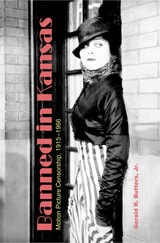
Banned in Kansas
Motion Picture Censorship, 1915-1966Gerald R. Butters, Jr.
University of Missouri Press, 2016
In 1915, Kansas became one of only a handful of states to establish its own film censorship board. The Kansas board controlled screen content in the state for more than fifty years, yet little is known about its activities. This first book-length study of state film censorship examines the unique political, social, and economic factors that led to its implementation in Kansas, examining why censorship legislation was enacted, what the attitudes of Kansans were toward censorship, and why it lasted for half a century.
Cinema historian Gerald Butters places the Kansas Board of Review’s attempts to control screen content in the context of nationwide censorship efforts during the early part of the twentieth century. He tells how factors such as Progressivism, concern over child rearing, and a supportive press contributed to censorship, and he traces the board’s history from the problems posed by the emergence of “talkies” through changing sexual mores in the 1920s to challenges to its power in the 1950s.
In addition to revealing the fine points of film content deemed too sensitive for screening, Butters describes the daily operations of the board, illustrating the difficulties it encountered as it wrestled not only with constantly shifting definitions of morality but also with the vagaries of the political and legal systems. Stills from motion pictures illustrate the type of screen content the board attempted to censor.
As Kansas faced the march of modernity, even state politicians began to criticize film censorship, and Butters tells how by the 1960s the board was fighting to remain relevant as film companies increasingly challenged its attempts to control screen content. Banned in Kansas weaves a fascinating tale of the enforcement of public morality, making it a definitive study for cinema scholars and an entertaining read for film buffs.
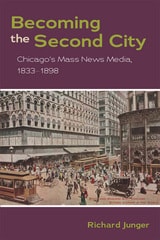
Becoming the Second City
Chicago's Mass News Media, 1833-1898Richard Junger
University of Illinois Press, 2010
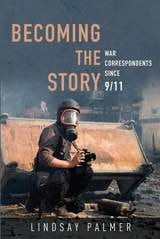
Becoming the Story
War Correspondents since 9/11Lindsay Palmer
University of Illinois Press, 2018
Becoming the Story examines the transformation of war reporting in the decade after 9/11. Lindsay Palmer delves into times when print or television correspondents themselves received intense public scrutiny because of an incident associated with the work of war reporting. Such instances include Daniel Pearl’s kidnapping and murder; Bob Woodruff’s near-fatal injury in Iraq; the expulsions of Maziar Bahari and Nazila Fathi from Iran in 2009; the sexual assault of Lara Logan; and Marie Colvin’s 2012 death in Syria. Merging analysis with in-depth interviews of Woodruff and others, Palmer shows what these events say about how post-9/11 conflicts transformed the day-to-day labor of reporting. But they also illuminate how journalists’ work became entangled with issues ranging from digitization processes to unprecedented hostility from all sides to the political logic of the War on Terror.
Before Journalism Schools
How Gilded Age Reporters Learned the RulesRandall S. Sumpter
University of Missouri Press, 2018
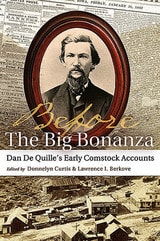
Before THE BIG BONANZA
Dan De Quille's Early Comstock AccountsEdited by Donnelyn Curtis and Lawrence I. Berkove
University of Missouri Press, 2015

Behind the Times
Inside the New New York TimesEdwin Diamond
University of Chicago Press, 1995
"Edwin Diamond's Behind the Times sets the Paper of Record straight—a fascinating look at the people and policies, the dissension and debate behind the seemingly serene masthead of the New York Times. No newsroom is a Garden of Eden, and only the rare reporter wears a halo: the Times, not surprisingly, is an imperfect place. But Edwin Diamond is careful to note the triumph as well as the turmoil at this great American newspaper. The result is a window on the changing world of journalism today."—Dan Rather
Best AltWeekly Writing 2009 & 2010
Association of Alternative Newsweeklies
Northwestern University Press, 2011
Best AltWeekly Writing 2009 & 2010 showcases articles that won the Association of Alternative Newsweeklies’s AltWeekly Awards in 2009 and 2010. These pieces embody the in-depth investigative journalism, narrative style, and defiant viewpoints that define alternative weeklies. Interviews with the authors illuminate the methods and personalities behind the stories. Articles feature music criticism from the Village Voice and election coverage from City Pages and the Texas Observer, as well as pieces from Westword, LA Weekly, San Francisco Weekly, and LEO Weekly. Interviews include journalists Anne Schindler, Sarah Fenske, Joel Warner, Jonathan Gold, John Dickerson, Jeffrey C. Billman, Erik Wemple, David Koon and Rob Harvilla.
Between Watergate and the Gulag
The French Press and Politics, 1970–1985Charles R. Eisendrath
Michigan Publishing Services, 2022
Also introduced: “surplus freedom” a novel approach for gauging self-censorship by comparing the degree of free expression a legal system permits to what publications actually exercise.
Beyond The Barricades
Nicaragua and the Struggle for the Sandinista Press, 1979–1998Adam Jones
Ohio University Press, 2002
Throughout the 1980s, Barricada, the official daily newspaper of the ruling Sandinista Front, played the standard role of a party organ, seeking the mobilize the Nicaraguan public to support the revolutionary agenda. Beyond the Barricades, however, reveals a story that is both more intriguing and much more complex. Even during this period of sweeping transformation and outside military siege, another, more professional agenda also motivated Barricada’s journalists and editors.
When the Sandinistas unexpectedly fell from power in the 1990 elections, Barricada gained a substantial degree of autonomy that allowed it to explore a more balanced and nuanced journalism “in the national interest.” This new orientation, however, ran afoul of more orthodox party leaders, who gradually gained the upper hand in the bitter internal struggle that wracked the Sandinista Front in the early 1990s. The paper closed its doors in January 1998.
Adam Jones’s outstanding study offers an unprecedented behin-the-scenes looks at Barricada’s two decades of evolution and dissolution. It also presents an intimate portrait of a key revolutionary institution and the memorable individuals who were a part of it.
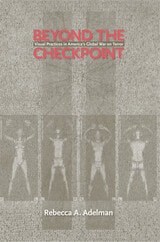
Beyond the Checkpoint
Visual Practices in America's Global War on TerrorRebecca A. Adelman
University of Massachusetts Press, 2014
Tracing the connections between citizenship and spectatorship, and moving beyond the close reading of visual representations, this book focuses on the institutions and actors that create, monitor, and regulate the visual landscape of the GWOT. Adelman looks around and through common images to follow the complex patterns of practice by which institutions and audiences engage them in various contexts. In the process, she proposes a new methodology for studying visual cultures of conflict, and related phenomena like violence, terror, and suffering that are notoriously difficult to represent.
Attending to previously unanalyzed dimensions of this conflict, this book illustrates the complexity of GWOT visual culture and the variegated experiences of citizenship that result as Americans navigate this terrain.
Bigger, Brighter, Louder
150 Years of Chicago Theater as Seen by "Chicago Tribune" CriticsChris Jones
University of Chicago Press, 2013
The Chicago of today, on the other hand, is regarded as one of the world’s premier cities for theater, and no one has had a more consistent front-row seat to its ascendance than the Chicago Tribune theater critics. Bigger, Brighter, Louder weaves together more than 150 years of Tribune reviews into a compelling narrative, pairing full reviews with commentary and history. With a sharp eye for telling details and a keen sense of historical context, Jones, longtime chief Tribune theater critic, takes readers through decades of highs and lows, successes and failures.
The book showcases fascinating early reviews of actors and shows that would go on to achieve phenomenal success, including a tryout of A Raisin in the Sun with newcomer Sidney Poitier and the first major review of The Producers. It also delves into the rare and the unusual, such as a previously unpublished Tennessee Williams interview and a long conversation with Edward Albee’s mother. With reviews from Claudia Cassidy, Peregine Pickle, William Leonard, and more, many never collected before, Bigger, Brighter, Louder offers a unique lasting record of an ephemeral art and a riveting look at the history behind Chicago’s rise to theatrical greatness.
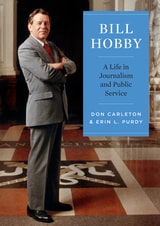
Bill Hobby
A Life in Journalism and Public ServiceDon Carleton and Erin L. Purdy
University of Texas Press, 2024
A comprehensive biography of a legendary lieutenant governor.
During his five terms as lieutenant governor of Texas, Bill Hobby became one of the most powerful political figures in the state’s history. He was first elected lieutenant governor of Texas in 1972 and served until 1990. Thanks to his brilliance as a political tactician and his personal integrity, Hobby was able to set the Senate’s agenda and garner respect from legislators on both sides of the aisle.
In Bill Hobby: A Life in Journalism and Public Service, Don Carleton and Erin Purdy document Hobby’s significant contributions to Texas as a journalist, politician, and philanthropist. Born into a prominent Texas family with a rich legacy of public service, he was the son of Houston newspaper publisher and former Texas governor William P. Hobby Sr., and Oveta Culp Hobby, who led the Women’s Army Corps during World War II and served in Eisenhower’s cabinet. After more than a decade as a journalist for the Houston Post, Hobby forged his own political path while also playing a prominent role in his family’s newspaper and television business.
Hobby was never shy about using his power to serve the people of Texas. Even after he left office, he continued to make a difference as a strong advocate for public education, including a term as chancellor of the University of Houston.
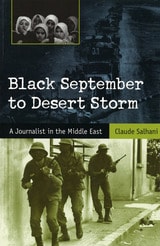
Black September to Desert Storm
A Journalist in the Middle EastClaude Salhani
University of Missouri Press, 1998
For more than twenty years, Claude Salhani traveled throughout the volatile Middle East as a photojournalist and reporter in search of the region's biggest stories. Wars, terrorist acts, demonstrations by religious extremists, and the flight of refugees were among the events he witnessed. "I have seen much through my lens . . . the most terrible cruelties, the most horrible suffering—and the most improbable and moving acts of love and generosity. I have been warmly received by kings, prime ministers, and secretaries of state. I have been shot at, kidnapped, and rifle-butted," writes Salhani in the prologue of this fascinating account.
From exclusive travels with former U.S. Secretary of State Henry Kissinger to intimate moments with combatants in the battle for Beirut to the forbidden world of drug smugglers in Lebanon, to the Iranian Revolution, and finally to the rise of Desert Storm, Salhani transports readers behind the scenes of many groundbreaking news stories. He proves that behind the front-page story we see, an equally intriguing tale is often hidden—that of the difficult, bizarre, even comical circumstances in which news is obtained.
Offering insight into the potent mixture of journalism and warfare, Black September to Desert Storm shares with readers an extraordinary journey into the headline-grabbing sagas that have plagued the Middle East in the last three decades. Salhani's "behind-the-lens" perspective will appeal to students of journalism and the Middle East, as well as anyone simply fascinated by the trials that many journalists undergo to capture "The Story."

Blaming the Victim
How Global Journalism Fails Those in PovertyJairo Lugo-Ocando
Pluto Press, 2014
The books asks many biting questions. When - and how - does poverty become newsworthy? How does ideology come into play when determining the ways in which 'poverty' is constructed in newsrooms - and how do the resulting narratives frame the issue? And why do so many journalists and news editors tend to obscure the structural causes of poverty?
In analysing the processes of news production and presentation around the world, Lugo-Ocando reveals that the news-makers' agendas are often as problematic as the geopolitics they seek to represent. This groundbreaking study reframes the ways in which we can think and write about the enduring global injustice of poverty.
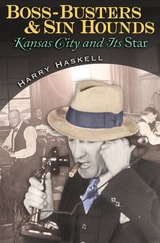
Boss-Busters and Sin Hounds
Kansas City and Its StarHarry Haskell
University of Missouri Press, 2007
At the turn of the twentieth century, the Kansas City Star was a trust-busting newspaper acclaimed for its crusading progressive spirit; fifty years later it was a busted trust, targeted in the most important antitrust action ever brought against an American daily. Now Harry Haskell tells the tale of the Star’s rise and decline against the richly textured backdrop of Kansas City—the story of how a newspaper and a city grew together and ultimately grew apart.
Boss-Busters and Sin Hounds takes readers into the city room and executive offices of one of the most respected American newspapers, whose influence extended beyond its own community to international affairs. Re-creating life at the Star from the inside, the book traces the shifting fortunes of a great newspaper and the compelling “power of purpose” it exerted from the birth of the progressive movement in the 1880s to the 1950s.
This fascinating tale—with underlying themes of sin and redemption, high-minded ideals and gutter politics—is populated by a cast of larger-than-life characters, ranging from power brokers to presidents and including such Kansas City notables as Tom Pendergast, J. C. Nichols, and Frank Walsh. But at heart this is the story of three men with contrasting personalities and agendas who shaped the newspaper over more than three-quarters of a century: William Rockhill Nelson, among the last of the great “personal” editors from journalism’s golden age; the scholarly Henry J. Haskell, who led the Star to its peak of influence in the 1930s and ’40s; and Roy A. Roberts, who went on to combine the roles of newspaper publisher and political kingmaker.
Along the way, Haskell recounts such milestones as the Star’s role in the City Beautiful movement that helped transform America’s urban centers; the nation’s entry into two global wars; a bold but ill-starred experiment in employee ownership; and the paper’s on-again, off-again battle with Boss Pendergast’s legendary political machine. And he brings into focus issues that remain timely today, from social and political reform to the very role of newspapers in a democracy, while also drawing parallels with recent American history—disillusionment with liberalism, the hijacking of the GOP by the far right, America’s go-it-alone attitude—that are as alarming as they are instructive.
As Haskell shows, the evolution of American journalism from crusading newspapers to pawns of corporate culture was already under way in the early 1900s and was substantially complete by midcentury. Boss-Busters and Sin Hounds chronicles the glory days of an illustrious newspaper as it opens new windows on a city’s history.
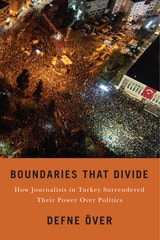
Boundaries That Divide
How Journalists in Turkey Surrendered Their Power over PoliticsDefne Över
Rutgers University Press, 2026
Turkey presents a striking example of the most recent wave of global authoritarian turns. The two-decade-long transition in the country’s political system also transformed its media environment. As mainstream journalists gradually yielded their places to sycophants, much more willing to praise the government in their news, the mainstream media that once oversaw—however imperfectly—political decisions started devoting its full service to cheerleading the government. Simultaneously, a new sphere of critical journalism began to emerge, with mainstream media journalists joining their fellows in the peripheries of the media. Considering the transformation of Turkey’s news media as the decay of a democratic institution, this book asks, How does the media break down under the rule of an elected government?
Drawing on fieldwork and in-depth interviews, the book traces the ruling AKP’s manipulation of social divides to consolidate power and journalists’ navigation of the resulting climate of fear, hope, doubt, and anger. The book shows how Turkey’s news media surrendered its power over politics as some journalists embraced disinformation as a path to heightened status, others turned to self-censorship for protection, and still others resisted capture through continuous but fragmented efforts.
The book portrays journalists as central actors in media decay, while also revealing that resilience to decay emerges where rising demand for “news” meets the contentious mobilization of journalists. Although focused on Turkey, the book’s insights extend far beyond, offering urgent lessons about the future of journalism in an age of populism, polarization, and institutional erosion.
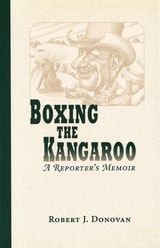
Boxing the Kangaroo
A Reporter's MemoirRobert J. Donovan
University of Missouri Press, 2000
"The host had brought out a pair of boxing gloves and asked the president if any of his friends would like to indulge in the Australian sport of boxing kangaroos. Once the president of the United States had selected me, there was almost no way out, unless I ran home to tell my mother."
In Boxing the Kangaroo: A Reporter's Memoir, Robert J. Donovan shares many exciting events that highlighted his stellar journalistic career. As an investigative reporter during five presidential administrations, Donovan has had many "insider" experiences. His memoir delightfully humanizes each of the five presidents he reported on: Truman, Eisenhower, Kennedy, Johnson, and Nixon.
Donovan began his career working as a night copyboy for the Buffalo Courier-Express, earning seven dollars a week. In 1937, he got a job as a reporter for the New York Herald Tribune, where he worked for many years. By 1942 the Herald Tribune had assigned Donovan to cover City Hall and the lively activities of Fiorello La Guardia. After his service in World War II he returned to the Herald Tribune to cover the man from Missouri who followed FDR. Ultimately, Donovan served as chief of the New York Herald Tribune Washington bureau and the Los Angeles Times Washington bureau.
Donovan traveled across the country with Harry S. Truman during his "Give 'Em Hell, Harry" campaign. He covered Dwight D. Eisenhower's election, about which he says there was never a doubt--Ike, the war hero, mesmerized the country. He was a personal friend of John F. Kennedy, having written about the President's PT-109 heroics in World War II, and was on the scene the day Kennedy was assassinated: "The drama in the second press bus, in which I rode in the presidential motorcade in Dallas, is unforgettable. `Why has the motorcade stopped?' a reporter asked as we drew near the Texas School Book Depository. . . . `I heard a shot,' another said. A voice in the rear contradicted him. `That was a motorcycle backfiring.'" Donovan would find out shortly before the rest of the world that, in fact, it was not a motorcycle backfiring, but the firing of an assassin's bullet that killed the nation's thirty-fifth president.
Boxing the Kangaroo is one of the best "I was there" accounts of American history. This fascinating book will appeal to journalists, American history buffs, and the general reader alike.
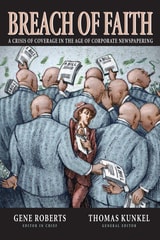
Breach of Faith
A Crisis of Coverage in the Age of Corporate NewspaperingGene Roberts
University of Arkansas Press, 2005
For more than two years, legendary editor Gene Roberts led a group of journalists in an unprecedented study of the newspaper industry for the American Journalism Review. This is the second volume of their findings. The first, Leaving Readers Behind: The Age of Corporate Newspapering, documented the storm of buying, selling, and consolidation that is transforming the American press. This second volume explores the consequences of these changes for ordinary communities and for the nation, arguing that they place democracy itself in peril.
Contributors include Peter Arnett, Mary Walton, Charles Layton, John Herbers, James McCartney, Carl Sessions Stepp, Lewis M. Simons, Chip Brown and Winnie Hu.
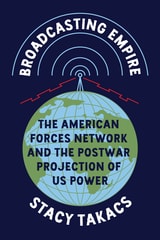
Broadcasting Empire
The American Forces Network and the Postwar Projection of US PowerStacy Takacs
University of Illinois Press, 2026
Stacy Takacs traces the AFN’s role in the worldwide expansion of American-style broadcasting and illuminates its impact on how foreign audiences viewed the United States. The AFN’s transformation emerged from collaborations between military leaders, foreign governments, commercial media companies, and local communities and turned the sprawling archipelago of US military bases into a potent instrument of soft power. Yet at times shifting alliances, practical problems, and the everyday routines of military life led to problems that complicated its mission
Knowledgeable and multidimensional, Broadcasting Empire combines big-picture analysis with case studies and oral history to reveal an important but overlooked tool of American influence.