Results by title
622 books match the query 'Language Study' and 33 start with b
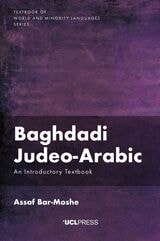
Baghdadi Judeo-Arabic
An Introductory TextAssaf Bar-Moshe
University College London, 2024
This textbook is dedicated to spoken Baghdadi Judeo-Arabic—the native tongue spoken by the Jews of Baghdad and other towns of Southern Iraq—and is designed to guide beginners to an advanced level of speaking. It focuses on common expressions, introduces Baghdad’s historic Jewish culture, and guides readers through sample texts, key vocabulary, grammar points, and exercises, as well as particular topics, such as greetings, family, shopping, and cuisine.
Bantu Historical Linguistics
Theoretical and Empirical PerspectivesEdited by Jean-Marie Hombert and Larry M. Hyman
CSLI, 1999
Basic Czech I
Third Revised and Updated EditionAna Adamovicova and Darina Ivanovova
Karolinum Press, 2009
Basic Czech II
Third Revised and Updated EditionAna Adamovicova and Darina Ivanovova, and Milan Hrdlicka
Karolinum Press, 2014
Basic Czech III
Ana Adamovicová and Milan Hrdlicka
Karolinum Press, 2016
The grammatical and lexical topics covered in this volume exceed the level we commonly call basic. Nevertheless to preserve the formal continuity of all three volumes, we have kept the title "Basic Czech." Grammar and vocabulary covered corresponds with level B1-B2 of the Common European Framework of Reference for Languages.

Basic Technical Japanese
Edward E. Daub
University of Wisconsin Press, 2011
Even if you have had no Japanese-language training, you can learn how to translate technical manuals, research publications, and reference works. Basic Technical Japanese takes you step by step from an introduction to the Japanese writing system through a mastery of grammar and scientific vocabulary to reading actual texts in Japanese. You can use the book to study independently or in formal classes.
This book places special emphasis on the kanji (characters) that occur most often in technical writing. There are special chapters on the language of mathematics and chemistry, and vocabulary building and reading exercises in physics, chemistry, biology, and biochemistry. With extensive character charts and vocabulary lists, Basic Technical Japanese is entirely self-contained; no dictionaries or other reference works are needed.
Basics of Language for Language Learners, 2nd Edition
Peter W. Culicover and Elizabeth V. Hume
The Ohio State University Press, 2017
Learning a language involves so much more than just rote memorization of rules. Basics of Language for Language Learners, 2nd edition, by Peter W. Culicover and Elizabeth V. Hume, systematically explores all the aspects of language central to second language learning: the sounds of language, the different grammatical structures, the social functions of communication, and the psychology of language learning and use.
Unlike books specific to one single language, Basics of Language will help students of all languages. Readers will gain insight into the structure and use of their own language and will therefore see more clearly how the language they are learning differs from their first language. Language instructors will find the approach provocative, and the book will stimulate many new and effective ideas for teaching. Both a textbook and a reference work, Basics of Language will enhance the learning experience for anyone taking a foreign language course as well as the do-it-yourself learner.
A new section, “Tools and Strategies for Language Learning,” has been added to this second edition. It comprises three chapters that focus on brain training, memory and using a dictionary. In addition, the section “Thinking Like a Native Speaker” has been substantially updated to include more discussion of errors made by language learners.
Basque-English Dictionary
Gorka Aulestia
University of Nevada Press, 1989
Basque-English, English-Basque Dictionary
Gorka Aulestia
University of Nevada Press, 1992
Becoming a Bilingual Family
Help Your Kids Learn Spanish (and Learn Spanish Yourself in the Process)By Stephen Marks and Jeffrey Marks
University of Texas Press, 2013
Would you like your children to grow up bilingual, even if you aren’t yet? Then speak to your kids in Spanish as you learn the language along with them. Becoming a Bilingual Family gives English-speaking parents the tools to start speaking Spanish with their kids in their earliest years, when children are most receptive to learning languages. It teaches the vocabulary and idioms for speaking to children in Spanish and offers practical, proven ways to create a language-learning environment at home.
The first part of the book introduces parents to many resources—books, audio books, music, television, computer programs, childcare workers, school, and friends—that can help you establish a home environment conducive to the acquisition of Spanish. The second part is a Spanish phrasebook that takes you through all the typical activities that parents and children share, from getting up in the morning to going to bed at night. Few, if any, other Spanish study aids provide this much vocabulary and guidance for talking to small children about common daily activities. The authors also include a quick course in Spanish pronunciation and enough grammar to get a parent started. Spanish-language resources, kids’ names in Spanish, and an easy-to-use index and glossary complete the book.
Take the Markses’ advice and start talking to your kids in Spanish, even if it’s not perfect. You’ll learn the language together and share the excitement of discovering the peoples and cultures that make up the Spanish-speaking world.
Before the Dissertation
A Textual Mentor for Doctoral Students at Early Stages of a Research ProjectChristine Pearson Casanave
University of Michigan Press, 2014
“This very readable book is what every graduate student needs as they start a program. I wish my own MA and PhD students, during my 40 years of supervising, could have been demystified by having Casanave's ‘textual mentor' as a companion."
--Merrill Swain, Professor Emerita, OISE, University of Toronto
“Before the Dissertation is an insightful, relevant, and accessible resource for doctoral students at any stage. Full of reflections and advice not found in other books, it serves as an indispensable guide for students and their supervisors. And the dispelling of myths is a superb idea!”
--Robert Kohls, PhD candidate, University of Toronto
Before the Dissertation speaks to an audience in the social sciences, but in particular to doctoral students who have experience with and interest in international, multilingual, as well as native English speaking students and settings and who wish to investigate topics in (second) language and multicultural-transcultural education. Athough appropriate for use in English-dominant doctoral programs throughout the world, the book will relate more closely to students in the North American educational system than to ones, for example, in the British system. The main audience for this book is thus doctoral students who are first or second/additional users of English, who are interested in pursuing topics in one of the social sciences, including education and multilingual inquiry, and who may just be finishing course work in an English-dominant university and are wondering what might happen next.
Beyond Babel
A Handbook for Biblical Hebrew and Related LanguagesJohn Kaltner
SBL Press, 2002
Beyond Babel provides a general introduction to and overview of the languages that are significant for the study of the Hebrew Bible and ancient Israel. Included are essays on biblical and inscriptional Hebrew, Akkadian, Northwest Semitic dialects (Ammonite, Edomite, and Moabite), Arabic, Aramaic, Egyptian, Hittite, Phoenician, postbiblical Hebrew, and Ugaritic.
Each chapter in the volume shares a common format, including an overview of the language, a discussion of its significance for the Hebrew Bible, and a list of ancient sources and modern resources for further study of the language. A general introduction by John Huehnergard discusses the importance of the study of Near Eastern languages for biblical scholarship, helping to make the volume an ideal resource for persons beginning an in-depth study of the Hebrew Bible.
Beyond Convention
Genre Innovation in Academic WritingChristine M. Tardy
University of Michigan Press, 2016
---Foreword by Dana R. Ferris, author of Treatment of Error and Teaching College Writing to Diverse Student Populations
This book attempts to engage directly with the complexities and tensions in genre from both theoretical and pedagogical perspectives. While struggling with questions of why, when, and how different writers can manipulate conventions, Tardy became interested in related research into voice and identity in academic writing and then began to consider the ways that genre can be a valuable tool that allows writing students and teachers to explore expected conventions and transformative innovations. For Tardy, genres aren’t “fixed,” and she argues also that neither genre constraints nor innovations are objective—that they can be accepted or rejected depending on the context.
Beyond Convention considers a range of learning and teaching settings, including first-year undergraduate writing, undergraduate writing in the disciplines, and the advanced academic writing of graduate students and professionals. It is intended for those interested in the complexities of written communication, whether their interests are grounded in genre theory, academic discourse, discourse analysis, or writing instruction. With its attentiveness to context, discipline, and community, it offers a resource for those interested in English for Academic Purposes, English for Specific Purposes, and Writing in the Disciplines. At its heart, this is a book for teachers and teacher educators.
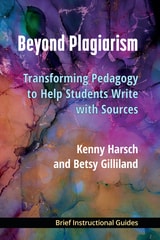
Beyond Plagiarism
Transforming Pedagogy to Help Students Write with SourcesKenny Harsch and Betsy Gilliland
University of Michigan Press, 2025
Starting with an overview of the complexities underlying plagiarism and source use, the book offers practical tools that teachers can integrate in their classes. These tools include examples of modifications to syllabi; integrating processes into assignment design, classroom support, and feedback and grading; meta-texts to guide student reflection on their use of sources; explanations of why source use is important in academic writing; guiding students through learning how to read for writing, analyze genres to better understand expectations, and practice paraphrasing, summarizing, and quoting in their own assignments; approaching AI tools strategically; and modeling successful strategies for each step of the scholarly process. By taking a pedagogical approach, expert members of the academic community can help students understand how academic writing builds on and incorporates sources, provide support for students to learn to do these things through a process approach, and respond to situations of plagiarism with nuance, compassion, and a growth mindset.
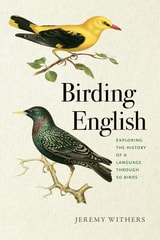
Birding English
Exploring the History of a Language Through 50 BirdsJeremy Withers
University of Iowa Press, 2026
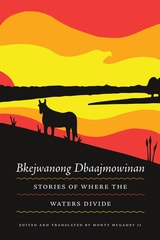
Bkejwanong Dbaajmowinan/Stories of Where the Waters Divide
McGahey, Monty
Michigan State University Press, 2021
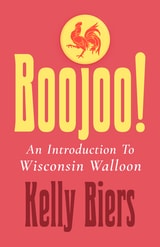
Boojoo!
An Introduction to Wisconsin WalloonKelly Biers
University of Wisconsin Press, 2026
Walloon is a language still spoken by a minority population in its home country of Belgium. It can also still be found among a few sparse communities descended from Belgian immigrants in northeastern Wisconsin. Although spoken by a small number of people, the language plays a vital role in the ethnic heritage of the state and is audible in local words like “booyah” and “trippe.”
This book is the first to introduce the language without recourse to French, of which Walloon is sometimes mistakenly described as a variant or dialect. With this text, English-language speakers will need nothing more than interest to pick up basic conversational Walloon, thanks to Kelly Biers’s clear guidance for pronunciation, vocabulary, and grammar. Additionally, readers will learn about how this minority language arrived in the Upper Midwest, the history of Belgian American immigration and settlement, and the language’s linguistic features.
Boojoo and welcome to Wisconsin Walloon!
Bookmarks
A Companion Text for KindredJanet Giannotti
University of Michigan Press, 1999
The textbook is designed to be used along with Kindred, a novel by Octavia Butler (published by Beacon Press), which tells the story of a young black woman who disappears from her home in 1970s California to save the life of her white slave-owner ancestor in the early nineteenth century. Through the novel and textbook, students learn about nineteenth-century American life, the origins of slavery in America, the conditions under which slaves lived, the Underground Railroad, important historical figures (like Harriet Tubman and Frederick Douglass), and the civil rights movement of the twentieth century.
Each of the six units begins with a preview of the reading and free writing topics, followed by exercises that improve comprehension and vocabulary building. Students use response journals to think about their personal connection with the novel. They are encouraged to discuss different topics and then write about what they've discussed. The Beyond the Novel section in each unit introduces factual background information in which students learn about slavery and other material mentioned in the novel. Puzzles and out-of-class activities are also included at the end of each unit.
Bookmarks
A Companion Text for Like Water for ChocolateJanet Giannotti
University of Michigan Press, 1999
A Companion TextforLike Water for Chocolate is made up of six units, each covering two chapters in the novel. Every unit contains a preview section, free writing exercises, a short glossary (to help with Spanish words), comprehension quizzes, vocabulary exercises and summarizing exercises, a section devoted to response journals, and topics for discussion. The "Beyond the Novel" section includes facts about U.S. and Mexican history and folk tales. Illustrations throughout the book help to engage students and offer visual support for reading comprehension.
Bosnian, Croatian, Serbian, a Grammar
With Sociolinguistic CommentaryRonelle Alexander
University of Wisconsin Press, 2006
Bosnian, Croatian, Serbian, a Grammar analyzes and clarifies the complex, dynamic language situation in the former Yugoslavia. Addressing squarely the issues connected with the splintering of Serbo-Croatian into component languages, this volume provides teachers and learners with practical solutions and highlights the differences among the languages as well as the communicative core that they all share. The first book to cover all three components of the post-Yugoslav linguistic environment, this reference manual features:
· Thorough presentation of the grammar common to Bosnian, Croatian, and Serbian, with explication of all the major differences
· Examples from a broad range of spoken language and literature
· New approaches to accent and clitic ordering, two of the most difficult points in BCS grammar
· Order of grammar presentation in chapters 1–16 keyed to corresponding lessons in Bosnian, Croatian, Serbian, a Textbook
· "Sociolinguistic commentary" explicating the cultural and political context within which Bosnian, Croatian, and Serbian function and have been defined
· Separate indexes of the grammar and sociolinguistic commentary, and of all words discussed in both

Bosnian, Croatian, Serbian, a Textbook
With Exercises and Basic GrammarRonelle Alexander and Ellen Elias-Bursac
University of Wisconsin Press, 2006
•Classroom exercises designed for both small-group and full-class work, allowing for maximum oral participation
•Reading selections written by Bosnian, Croatian, and Serbian authors especially for this book
•Vocabulary lists for each individual section and full glossaries at the end of the book
•A short animated film, on an accompanying DVD, for use with chapter 15
•Brief grammar explanations after each dialogue, with cross-reference to more detailed grammar chapters in Bosnian, Croatian, Serbian, a Grammar
Available separately, the audio supplement (ISBN 0-299-22110-5) offers audio recordings of all dialogues in Bosnian, Croatian, and Serbian, a Textbook.
Bosnian, Croatian, Serbian, a Textbook
With Exercises and Basic GrammarRonelle Alexander
University of Wisconsin Press, 2010
• All dialogues, exercises, and homework assignments available in Bosnian, Croatian, and Serbian
• Classroom exercises designed for both small-group and full-class work, allowing for maximum oral participation
• Reading selections written by Bosnian, Croatian, and Serbian authors especially for this book
• Vocabulary lists for each individual section and full glossaries at the end of the book
• A short animated film, on an accompanying DVD, for use with chapter 15
• Brief grammar explanations after each dialogue, with a cross-reference to more detailed grammar chapters in the companion book, Bosnian, Croatian, Serbian, a Grammar.
Brandeis Modern Hebrew
Vardit Ringvald, Bonit Porath, Yaron Peleg, Esther Shorr, and Sara Hascal
Brandeis University Press, 2015
Brandeis Modern Hebrew, Intermediate to Advanced
Pilot EditionVardit Ringvald, Bonit Porath, Yaron Peleg, and Esther Shorr
Brandeis University Press, 2013
Breaking New Ground for SLIFE
The Mutually Adaptive Learning ParadigmAndrea DeCapua and Helaine W. Marshall
University of Michigan Press, 2023
In its second edition, Breaking New Ground for SLIFE builds on its model for supporting students who are new to English and may have experienced a disruption in their schooling. The practices presented in this book emerge from the belief that education for students with limited or interrupted formal education, also known as SLIFE, should not be remedial but should build on the students’ prior learning experiences and existing areas of knowledge. This second edition has been significantly updated, informed by recent research in the field, feedback from teachers, and new scholarly treatments of the topic. Breaking New Ground for SLIFE, second edition, explores the MALP approach, highlights how technology can be incorporated into classroom activities, and includes actual MALP projects implemented by MALP-trained teachers of both young and adolescent learners. In addition, the authors provide a newly revised MALP Teacher Planning Checklist.
By reading Breaking New Ground for SLIFE, educators will:
- Learn about the Mutually Adaptive Learning Paradigm (MALP) and how to integrate it into their classrooms
- Discover and learn about the MALP instructional approach and how to use it to develop a project-based curriculum using examples from teachers in the field
Breaking Out of Beginner's Spanish
By Joseph J. Keenan
University of Texas Press, 2014
Many language books are boring—this one is not. Written by a native English speaker who learned Spanish the hard way—by trying to talk to Spanish-speaking people—it offers English speakers who have a basic knowledge of Spanish hundreds of tips for using the language more fluently and colloquially, with fewer obvious “gringo” errors.
Writing with humor, common sense, and a minimum of jargon, Joseph J. Keenan covers everything from pronunciation, verb usage, and common grammatical mistakes to the subtleties of addressing other people, “trickster” words that look alike in both languages, inadvertent obscenities, and intentional swearing. He guides readers through the set phrases and idiomatic expressions that pepper the native speaker’s conversation and provides a valuable introduction to the most widely used Spanish slang.
With this book, both students in school and adult learners who never want to see another classroom can rapidly improve their speaking ability. Breaking Out of Beginner’s Spanish will be an essential aid in passing the supreme language test—communicating fluently with native speakers.
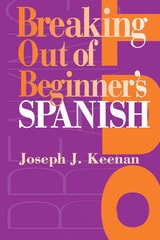
Breaking Out of Beginner's Spanish
By Joseph J. Keenan
University of Texas Press, 1994
Many language books are boring—this one is not. Written by a native English speaker who learned Spanish the hard way—by trying to talk to Spanish-speaking people—it offers English speakers with a basic knowledge of Spanish hundreds of tips for using the language more fluently and colloquially, with fewer obvious "gringo" errors.
Writing with humor, common sense, and a minimum of jargon, Joseph Keenan covers everything from pronunciation, verb usage, and common grammatical mistakes to the subtleties of addressing other people, "trickster" words that look alike in both languages, inadvertent obscenities, and intentional swearing. He guides readers through the set phrases and idiomatic expressions that pepper the native speaker's conversation and provides a valuable introduction to the most widely used Spanish slang.
With this book, both students in school and adult learners who never want to see another classroom can rapidly improve their speaking ability. Breaking Out of Beginner's Spanish will be an essential aid in passing the supreme language test-communicating fluently with native speakers.
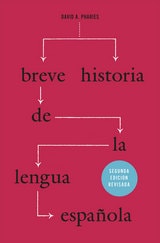
Breve historia de la lengua española
Segunda edición revisadaDavid A. Pharies
University of Chicago Press, 2015
La Breve historia de la lengua española se concentra en los cambios más importantes de la evolución de la lengua, evitando la jerga académica ininteligible y favoreciendo la claridad en las explicaciones. Por el camino, intenta dar respuesta a muchas de las preguntas que con frecuencia desconciertan a los hablantes nativos y no nativos: ¿Por qué se utiliza tú en algunos lugares y vos en otros? ¿Cómo surgió la pronunciación como fricativa interdental de la zeta castellana? ¿Por qué se dice la mesa pero el agua con un artículo que parece masculino?
David A. Pharies es un experto en el estudio de la historia y evolución del español, que goza de un reconocido prestigio en la escena internacional. Para actualizar esta segunda edición ha revisado en profundidad todos los aspectos de la evolución del español, incluido su desarrollo demográfico. El libro va dirigido a quienes tienen un conocimiento básico del español y desean aprender más sobre sus orígenes. También constituye una base ideal para emprender el estudio de cualquier aspecto de la lingüística histórica española y de la literatura medieval. Entretenida y accesible, la Breve historia de la lengua española es un gran viaje de descubrimiento en una presentación amena y sucinta.
Since its publication in 2007, A Brief History of the Spanish Language has become the leading introduction to the history of one of the world’s most widely spoken languages. Moving from the language’s Latin roots to its present-day forms, this concise book offers readers insights into the origin and evolution of Spanish, the historical and cultural changes that shaped it, and its spread around the world.
A Brief History of the Spanish Language focuses on the most important aspects of the development of the Spanish language, eschewing technical jargon in favor of straightforward explanations. Along the way, it answers many of the common questions that puzzle native and nonnative speakers alike, such as: Why do some regions use tú while others use vos? How did the th sound develop in Castilian? And why is it la mesa but el agua?
David A. Pharies, an internationally recognized expert on the history and development of Spanish, has updated this edition with new research on all aspects of the evolution of Spanish while adding current demographic information as well. This book is perfect for anyone with a basic understanding of Spanish and a desire to further explore its roots. It also provides an ideal foundation for further study in any area of historical Spanish linguistics and early Spanish literature. Both absorbing and accessible, A Brief History of the Spanish Language is a grand journey of discovery in a beautifully compact format.
Building Internationalized Spaces
Second Language Perspectives on Developing Language and Cultural Exchange Programs in Higher EducationEdited by Matthew Allen, Estela Ene, and Kyle McIntosh
University of Michigan Press, 2022
This volume contributes to emerging interdisciplinary conversations in higher education about how to refine internationalization in terms of praxis and how to coordinate curricular and pedagogical efforts to achieve meaningful learning outcomes for all students. The chapters provide suggestions for how L2 specialists can reframe their work in their individual programs to help internationalize the entire university in ways that lead to improved learning outcomes for students at different points in their degree programs, including:
- Orientation programs (early arrival on campus, before classes start)
- Language Center contexts (support during studies)
- Volunteer programs for International Teaching Assistants (ITA) and undergraduate students
- Graduate-level writing support structures
- Instructional design (virtual learning spaces)
- Virtual Partner programs (co-curricular)
- Intercultural composition (placement, interdisciplinary collaborations)
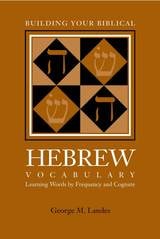
Building Your Biblical Hebrew Vocabulary
Learning Words by Frequency and CognateGeorge M. Landes
SBL Press, 2001
A classic resource for beginning Hebrew students
First published over thirty years ago under the title A Student's Vocabulary of Biblical Hebrew, this classic work has been completely revised, updated, and expanded by the author to assist a new generation of students in naturally developing a basic Biblical Hebrew vocabulary. Designed to help beginning Hebrew readers acquire vocabulary quickly, this valuable teaching tool focuses on words that occur most frequently in the Hebrew Bible, while arranging them by roots and cognates allowing students to naturally expand their working vocabulary. Vocabulary lists have been kept to a manageable size; extensive cross-references document when words appear frequently with different meanings, and an index allows rapid location of every word encountered. As a result, students who master this volume will remember words more easily, consult a lexicon less frequently but more intelligently, and translate the Hebrew Bible at sight more readily and enjoyably.
Features
- Vocabulary groupings based on frequency, roots, and cognates
- Separate listing for nouns without verbal roots in the Hebrew Bible
- Appendices including proper names and the forms and meanings of pronominal suffixes
Building Your New Testament Greek Vocabulary, Third Edition
Robert E. Van Voorst
SBL Press, 2022
Business Arabic, Advanced Level
Authentic Texts and Audiovisual MaterialsRaji M. Rammuny
University of Michigan Press, 2000
Business Arabic, Intermediate Level
Language, Culture and CommunicationRaji M. Rammuny
University of Michigan Press, 2000
The volume expects students to have control of basic vocabulary and grammatical structures that are typically covered in the first two years of Arabic instruction. Grammatical notes are given for review purposes, where necessary.