Results by title
791 books match the query 'Levels' and 43 start with b

Back in School
How Student Parents Are Transforming College and FamilyA. Fiona Pearson
Rutgers University Press, 2019
Bad Guys Don't Have Birthdays
Fantasy Play at FourVivian Gussin Paley
University of Chicago Press, 1991
Their play is filled with warnings. They invent chaos in order to show that everything is under control. They portray fear to prove that it can be conquered. No theme is too large or too small for their intense scrutiny. Fantasy play is their ever dependable pathway to knowledge and certainty.
" It . . . takes a special teacher to value the young child's communications sufficiently, enter into a meaningful dialogue with the youngster, and thereby stimulate more productivity without overwhelming the child with her own ideas. Vivian Paley is such a teacher."—Maria W. Piers, in the American Journal of Education
"[Mrs. Paley's books] should be required reading wherever children are growing. Mrs. Paley does not presume to understand preschool children, or to theorize. Her strength lies equally in knowing that she does not know and in trying to learn. When she cannot help children—because she can neither anticipate nor follow their thinking—she strives not to hinder them. She avoids the arrogance of adult to small child; of teacher to student; or writer to reader."—Penelope Leach, author of Your Baby & Child in the New York Times Book Review
"[Paley's] stories and interpretation argue for a new type of early childhood education . . . a form of teaching that builds upon the considerable knowledge children already have and grapple with daily in fantasy play."—Alex Raskin, Los Angeles Times Book Review
"Through the 'intuitive language' of fantasy play, Paley believes, children express their deepest concerns. They act out different roles and invent imaginative scenarios to better understand the real world. Fantasy play helps them cope with uncomfortable feelings. . . . In fantasy, any device may be used to draw safe boundaries."—Ruth J. Moss, Psychology Today

Bankers in the Ivory Tower
The Troubling Rise of Financiers in US Higher EducationCharlie Eaton
University of Chicago Press, 2022
Exposes the intimate relationship between big finance and higher education inequality in America.
Elite colleges have long played a crucial role in maintaining social and class status in America, while public universities have offered a major stepping stone to new economic opportunities. However, as Charlie Eaton reveals in Bankers in the Ivory Tower, finance has played a central role in the widening inequality in recent decades, both in American higher education and in American society at large.
With federal and state funding falling short, the US higher education system has become increasingly dependent on financial markets and the financiers that mediate them. Beginning in the 1980s, the government, colleges, students, and their families took on multiple new roles as financial investors, borrowers, and brokers. The turn to finance, however, has yielded wildly unequal results. At the top, ties to Wall Street help the most elite private schools achieve the greatest endowment growth through hedge fund investments and the support of wealthy donors. At the bottom, takeovers by private equity transform for-profit colleges into predatory organizations that leave disadvantaged students with massive loan debt and few educational benefits. And in the middle, public universities are squeezed between incentives to increase tuition and pressures to maintain access and affordability. Eaton chronicles these transformations, making clear for the first time just how tight the links are between powerful financiers and America’s unequal system of higher education.
Basic Principles of Curriculum and Instruction
Ralph W. Tyler
University of Chicago Press, 2013
Basic Principles of Curriculum and Instruction has been the standard in the field for decades, and it continues to be the leading guide to curriculum development today. Ralph W. Tyler presents here the concept that curriculum should be dynamic, a program under constant evaluation and revision. Before the publication of this book, curriculum had generally been thought of as a static, set program, and in an era preoccupied with student testing, he offered the innovative idea that teachers and administrators should spend as much time evaluating their plans as they do assessing their students.
Although not a strict how-to guide, the book shows how educators can critically approach curriculum planning, studying progress and retooling when needed. Its four sections focus on setting objectives, selecting learning experiences, organizing instruction, and evaluating progress. Readers will come away with a firm understanding of how to formulate educational objectives and how to analyze and adjust their plans so that students meet the objectives. Tyler also explains that curriculum planning is a continuous, cyclical process, an instrument of education that needs to be fine-tuned.
This emphasis on thoughtful evaluation has kept Basic Principles of Curriculum and Instruction a relevant, trusted companion for decades. Even as the educational landscape changes and teachers and administrators have to adjust to new developments in testing, student engagement, regulation, and more, the core principles animating this book remain as valid and effective as ever. And with school districts across the nation working to align their curriculum with Common Core standards, Tyler's straightforward recommendations are sound and effective tools for educators working to create a curriculum that integrates national objectives with their students' needs.
Basic Principles of Curriculum and Instruction
Ralph W. Tyler
University of Chicago Press, 2013
In 1949, a small book had a big impact on education. In just over one hundred pages, Ralph W. Tyler presented the concept that curriculum should be dynamic, a program under constant evaluation and revision. Curriculum had always been thought of as a static, set program, and in an era preoccupied with student testing, he offered the innovative idea that teachers and administrators should spend as much time evaluating their plans as they do assessing their students.
Since then, Basic Principles of Curriculum and Instruction has been a standard reference for anyone working with curriculum development. Although not a strict how-to guide, the book shows how educators can critically approach curriculum planning, studying progress and retooling when needed. Its four sections focus on setting objectives, selecting learning experiences, organizing instruction, and evaluating progress. Readers will come away with a firm understanding of how to formulate educational objectives and how to analyze and adjust their plans so that students meet the objectives. Tyler also explains that curriculum planning is a continuous, cyclical process, an instrument of education that needs to be fine-tuned.
This emphasis on thoughtful evaluation has kept Basic Principles of Curriculum and Instruction a relevant, trusted companion for over sixty years. And with school districts across the nation working feverishly to align their curriculum with Common Core standards, Tyler's straightforward recommendations are sound and effective tools for educators working to create a curriculum that integrates national objectives with their students' needs.
Becoming Historians
Edited by James M. Banner, Jr. and John R. Gillis
University of Chicago Press, 2009
In this unique collection, the memoirs of eleven historians provide a fascinating portrait of a formative generation of scholars. Born around the time of World War II, these influential historians came of age just before the upheavals of the 1960s and ’70s and helped to transform both their discipline and the broader world of American higher education. The self-inventions they thoughtfully chronicle led, in many cases, to the invention of new fields—including women’s and gender history, social history, and public history—that cleared paths in the academy and made the study of the past more capacious and broadly relevant. In these stories—skillfully compiled and introduced by James Banner and John Gillis—aspiring historians will find inspiration and guidance, experienced scholars will see reflections of their own dilemmas and struggles, and all readers will discover a rare account of how today’s seasoned historians embarked on their intellectual journeys.
Becoming Mead
The Social Process of Academic KnowledgeDaniel R. Huebner
University of Chicago Press, 2014
In Becoming Mead, Daniel R. Huebner traces the ways in which knowledge has been produced by and about the famed American philosopher. Instead of treating Mead’s problematic reputation as a separate topic of study from his intellectual biography, Huebner considers both biography and reputation as social processes of knowledge production. He uses Mead as a case study and provides fresh new answers to critical questions in the social sciences, such as how authors come to be considered canonical in particular disciplines, how academics understand and use others’ works in their research, and how claims to authority and knowledge are made in scholarship. Becoming Mead provides a novel take on the history of sociology, placing it in critical dialogue with cultural sociology and the sociology of knowledge and intellectuals.
Becoming a Scholar
Cross-Cultural Reflections on Identity and Agency in an Education DoctorateEdited by Maria Savva and Lynn P. Nygaard
University College London, 2021
This book provides a window into the lives of nine non-traditional doctoral students. As mature, part-time, international students enrolled in a professional doctorate program, the students reflect on the transformation process of becoming scholars, as their narratives provide breadth and depth to themes that represent a diverse cross-section of cultures, identities, and communities. The volume brings the “human face” behind the doctoral journey to the forefront, as the narratives draw much-needed attention to the personal journey that inevitably parallels and intersects with the academic journey. Although the narratives are drawn from a professional doctor-in-education program based in the United Kingdom, the struggles will resonate with a much wider range of doctoral students and academics, sparking lively discussion, debate, and reflection. A must-read for students preparing to embark on the doctoral journey, this book will be essential reading for leaders of doctoral programs who wish to equip students with important knowledge about the challenges ahead.
Before March Madness
The Wars for the Soul of College BasketballKurt Edward Kemper
University of Illinois Press, 2020
Kurt Edward Kemper tells the dramatic story of the clashes that shook college basketball at mid-century—and how the repercussions continue to influence college sports to the present day. Taking readers inside the competing factions, he details why historically black colleges and regional schools came to embrace commercialization. As he shows, the NCAA's strategy of co-opting its opponents gave each group just enough just enough to play along—while the victory of the big-time athletics model handed the organization the power to seize control of college sports.
An innovative history of an overlooked era, Before March Madness looks at how promises, power, and money laid the groundwork for an American sports institution.
Before the Dissertation
A Textual Mentor for Doctoral Students at Early Stages of a Research ProjectChristine Pearson Casanave
University of Michigan Press, 2014
“This very readable book is what every graduate student needs as they start a program. I wish my own MA and PhD students, during my 40 years of supervising, could have been demystified by having Casanave's ‘textual mentor' as a companion."
--Merrill Swain, Professor Emerita, OISE, University of Toronto
“Before the Dissertation is an insightful, relevant, and accessible resource for doctoral students at any stage. Full of reflections and advice not found in other books, it serves as an indispensable guide for students and their supervisors. And the dispelling of myths is a superb idea!”
--Robert Kohls, PhD candidate, University of Toronto
Before the Dissertation speaks to an audience in the social sciences, but in particular to doctoral students who have experience with and interest in international, multilingual, as well as native English speaking students and settings and who wish to investigate topics in (second) language and multicultural-transcultural education. Athough appropriate for use in English-dominant doctoral programs throughout the world, the book will relate more closely to students in the North American educational system than to ones, for example, in the British system. The main audience for this book is thus doctoral students who are first or second/additional users of English, who are interested in pursuing topics in one of the social sciences, including education and multilingual inquiry, and who may just be finishing course work in an English-dominant university and are wondering what might happen next.
Behind the Academic Curtain
How to Find Success and Happiness with a PhDFrank F. Furstenberg
University of Chicago Press, 2013
While the greatest anxieties for PhD candidates and postgrads are often centered on getting that tenure-track dream job, each stage of an academic career poses a series of distinctive problems. Furstenberg divides these stages into five chapters that cover the entire trajectory of an academic life, including how to make use of a PhD outside of academia. From finding the right job to earning tenure, from managing teaching loads to conducting research, from working on committees to easing into retirement, he illuminates all the challenges and opportunities an academic can expect to encounter. Each chapter is designed for easy consultation, with copious signposts, helpful suggestions, and a bevy of questions that all academics should ask themselves throughout their career, whether at a major university, junior college, or a nonacademic organization. An honest and up-to-date portrayal of how this life really works, Behind the Academic Curtain is an essential companion for any scholar, at any stage of his or her career.
Being a Presence for Students
Teaching as a Lived Defense of Liberal EducationJeff Frank
Lever Press, 2019
Belonging and Identity in STEM Higher Education
Edited by Camille Kandiko Howson and Martyn Kingsbury
University College London, 2024
In Belonging and Identity in STEM Higher Education, Camille Kandiko Howson and Martyn Kingsbury examine the role of science, technology, engineering, and mathematics (STEM) pedagogies in facilitating belonging, variable impacts across student characteristics, and the experiences of STEM students in higher education. Through case study contributions, the book analyzes the unique educational environments for STEM staff and students throughout Europe and Asia, challenging the assumptions that STEM fields are inherently unemotional and impersonal disciplines.
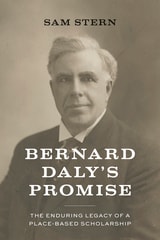
Bernard Daly's Promise
The Enduring Legacy of a Place-based ScholarshipSam Stern
Oregon State University Press, 2022
Bernard Daly escaped the Irish Famine and with his family emigrated to America, where he became the town doctor in Lakeview, Oregon, and then a state legislator, Oregon Agricultural College regent, county judge, rancher, and banker. When he died in 1920, his estate, valued at about a million dollars, established a college scholarship for the youth of Lake County, ensuring that most of them could attend college.
It’s hard to imagine a place more distant from higher education than Lake County in south central Oregon, a county about the size of New Jersey with a population under eight thousand. When the Bernard Daly scholarship was first awarded in 1922, less than two percent of America’s youth went to college, and the percentage was even lower in Lake County.
Today, Lake County students are much more likely to go to college, graduate in four years without debt, go on to graduate school, have successful careers, and contribute to the larger community—all because of a scholarship established a hundred years ago by an immigrant who sought a better life, not only for himself but also for others.
Drawing on more than a hundred personal interviews, an extensive web-based survey, and archival materials, Bernard Daly’s Promise offers unique insights into the benefits of higher education and how it might best be supported—questions that we are struggling with today.
Betrayal U
The Politics of Belonging in Higher EducationEdited by Rebecca G. Martínez and Monica J. Casper
University of Arizona Press, 2025
Betrayal U intervenes in this context with a diverse, rich collection of essays, art, poetry, and research that explores these inequities through the lens of institutional betrayal, theorized by psychologist Jennifer Freyd. Edited by Rebecca G. Martínez and Monica J. Casper, this collection brings together thirty-six contributors who share personal experiences covering a range of topics in higher education. The work spans five thematic sections that examine the complexities of belonging and exclusion in academic settings.
The contributors share their lived experiences of academic life from diverse vantage points, showing the ways minoritized groups are made to feel unwelcome, further marginalized, and often positioned as the problem. Exhibiting courage, compassion, and a commitment to better futures, the voices in this collection offer both a searing indictment of higher education and pathways to alternative practices and structures. They shine a spotlight on academia today, including the promise of inclusion and the perils of exclusion.
Contributors
Celeste Atkins
Jasmine Banks
Krista L. Benson
Jessica Bishop-Royse
Samit Dipon Bordoloi
Monica J. Casper
Aparajita De
Kathy Diehl
Taylor Marie Doherty
Reshmi Dutt-Ballerstadt
Alma Flores
Alanna Gillis
C. Goldberg
Jennifer M. Gómez
Kristina Gupta
Jasmine L. Harris
Susan Hillock
Doreen Hsu
Jennifer Lai
Amy Andrea Martinez
Rebecca G. Martínez
Shantel Martinez
Sara A. Mata
Rachael McCollum
Wang Ping
Emily Rosser
Angélica Ruvalcaba
Brandy L. Simula
Rashna Batliwala Singh
Cierra Raine Sorin
Connor Spencer
Chantelle Spicer
James M. Thomas
Mercedes Valadez
Meg A. Warren
Matthew Wills

Between / Beyond / Hybrid
New Essays on TransdisciplinarityEdited by Hartmut von Sass
Diaphanes, 2019
Between Talk And Teaching
Reconsidering the Writing ConferenceLaurel Johnson Black
Utah State University Press, 1998
The teacher-student conference is standard in the repertoire of teachers at all levels. Because it's a one-to-one encounter, teachers work hard to make it comfortable; but because it's a pedagogical moment, they hope that learning occurs in the encounter, too. The literature in this area often suggests that a conference is a conversation, but this doesn't account for a teacher's need to use it pedagogically. Laurel Johnson Black's new book explores the conflicting meanings and relations embedded in conferencing and offers a new theoretical understanding of the conference along with practical approaches to conferencing more effectively with students.
Analyzing taped conferences of several different teachers and students, Black considers the influence that power, gender, and culture can have on a conference. She draws on sociolinguistic theory, as well as critical theory in composition and rhetoric, to build an understanding of the writing conference as an encounter somewhere between conversation and the classroom. She finds neither the conversation model nor versions of the master-apprentice model satisfactory. Her approach is humane, student-centered, and progressive, but it does not ignore the valid pedagogical purposes a teacher might have in conferencing. Between Talk and Teaching will be a valuable addition to the professional library of writing teachers and writing program administrators.
Beyond College For All
Career Paths for the Forgotten HalfJames E. Rosenbaum
Russell Sage Foundation, 2001
Beyond Education
Radical Studying for Another WorldEli Meyerhoff
University of Minnesota Press, 2019
A bold call to deromanticize education and reframe universities as terrains of struggle between alternative modes of studying and world-making
Higher education is at an impasse. Black Lives Matter and #MeToo show that racism and sexism remain pervasive on campus, while student and faculty movements fight to reverse increased tuition, student debt, corporatization, and adjunctification. Commentators typically frame these issues as crises for an otherwise optimal mode of intellectual and professional development. In Beyond Education, Eli Meyerhoff instead sees this impasse as inherent to universities, as sites of intersecting political struggles over resources for studying.
Meyerhoff argues that the predominant mode of study, education, is only one among many alternatives and that it must be deromanticized in order to recognize it as a colonial-capitalist institution. He traces how key elements of education—the vertical trajectory of individualized development, its role in preparing people to participate in governance through a pedagogical mode of accounting, and dichotomous figures of educational waste (the “dropout”) and value (the “graduate”)—emerged from histories of struggles in opposition to alternative modes of study bound up with different modes of world-making.
Through interviews with participants in contemporary university struggles and embedded research with an anarchist free university, Beyond Education paves new avenues for achieving the aims of an “alter-university” movement to put novel modes of study into practice. Taking inspiration from Black Lives Matter, Occupy Wall Street, and Indigenous resurgence projects, it charts a new course for movements within, against, and beyond the university as we know it.
Beyond Productivity
Embodied, Situated, and (Un)Balanced Faculty Writing ProcessesKim Hensley Owens
Utah State University Press, 2023
This collection positions scholarly writers' ways of writing as a form of flexible, evolving knowledge. By exhibiting what is lost and gained through successive rounds of transformation and adaptation over time, the contributors offer a sustainable understanding and practice of process—one that looks beyond productivity as the primary measure of success. Each presents a fluid understanding of the writing process, illustrating its deeply personal nature and revealing how fragmented and disjointed methods and experiences can highlight what is precious about writing.
Beyond Productivity determines anew the use and value of scholarly writing and the processes that produce it, both within and beyond the context of the losses, constraints, and adaptations associated with the COVID-19 pandemic.
Beyond Winning
National Scholarship Competitions and the Student ExperienceSuzanne McCray
University of Arkansas Press, 2005
Black Space
Negotiating Race, Diversity, and Belonging in the Ivory TowerSherry L. Deckman
Rutgers University Press, 2022
Black Students in the Ivory Tower
African American Student Activism at the University of Pennsylvania, 1967-1990Wayne C. Glasker
University of Massachusetts Press, 2002
Glasker begins his study in the late 1960s, when the university's expansion into a predominantly black Philadelphia neighborhood precipitated a massive sit-in and protest. In response, Penn accelerated the process of admitting more black students, doubling the number of black matriculants by September 1969. Many came from inner city public high schools with backgrounds, ideas, and interests far different from those of the affluent middle- and upper-class white students who constituted the majority of the undergraduate population. As a result, the next decade was marked by recurrent tension and conflict, as black students at Penn rejected assimilation and agitated successfully for the creation of a variety of institutions that recognized their needs. These included an Afro-American studies program, a residence for students interested in black culture, and a Black Student League. Following a 1978 sit-in, they won a demand for an Inter-cultural Center and formed the United Minorities Council, and in 1986 they joined with white activists to press the university to divest its holdings from companies doing business in South Africa.
Throughout the book Glasker interweaves two parallel stories: that of an Ivy League university wrestling with questions of diversity, compensatory education, and the meaning of merit and qualification; and that of black students grappling with issues of assimilation, separatism, and cultural pluralism. In the end, he argues, the students sought to preserve their own distinctive ethnic culture, identity, and heritage while pursuing economic upward mobility. Rather than separatism, they aspired to a form of biculturalism that involved economic empowerment without cultural assimilation.
Black and Smart
How Black High-Achieving Women Experience CollegeAdrianne Musu Davis
Rutgers University Press, 2023
Blacked Out
Dilemmas of Race, Identity, and Success at Capital HighSignithia Fordham
University of Chicago Press, 1996
Blaming Teachers
Professionalization Policies and the Failure of Reform in American HistoryDiana D'Amico Pawlewicz
Rutgers University Press, 2020
Historically, Americans of all stripes have concurred that teachers were essential to the success of the public schools and nation. However, they have also concurred that public school teachers were to blame for the failures of the schools and identified professionalization as a panacea.
In Blaming Teachers, Diana D'Amico Pawlewicz reveals that historical professionalization reforms subverted public school teachers’ professional legitimacy. Superficially, professionalism connotes authority, expertise, and status. Professionalization for teachers never unfolded this way; rather, it was a policy process fueled by blame where others identified teachers’ shortcomings. Policymakers, school leaders, and others understood professionalization measures for teachers as efficient ways to bolster the growing bureaucratic order of the public schools through regulation and standardization. Beginning in the mid-nineteenth century with the rise of municipal public school systems and reaching into the 1980s, Blaming Teachers traces the history of professionalization policies and the discourses of blame that sustained them.
Blow Up the Humanities
Toby Miller
Temple University Press, 2012
A short, sharp, and provocative book, Blow Up the Humanities has esteemed scholar Toby Miller declaring that there are two humanities in the United States. One is the venerable, powerful humanities of private universities; the other is the humanities of state schools, which focus mainly on job prospects. There is a class division between the two—both in terms of faculty research and student background—and it must end.
Miller critically lays waste to the system. He examines scholarly publishing as well as media and cultural studies to show how to restructure the humanities by studying popular cultural phenomena, like video games. Miller ultimately insists that these two humanities must merge in order to survive and succeed in producing an aware and concerned citizenry.
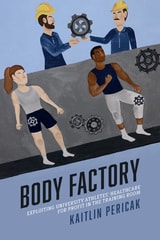
Body Factory
Exploiting University Athletes' Healthcare for Profit in the Training RoomKaitlin Pericak
Temple University Press, 2025
Body Factory enters an NCAA Division I athletic training room to examine the disconnect between what the NCAA states as its goal of athlete healthcare and what is actually happening. Kaitlin Pericak conducts observations in this space and interviews injured athletes and sports medicine staff members to show how institutional control over “best interests” often ends up exploiting the individual athlete. The influences at work are part of a neoliberal paradigm that explains why interest in an athlete’s care is greatly diminished once they are injured and can no longer play.
Body Factory considers how race, gender, and health before and after injury are deciding factors in these university training centers. The bureaucratic organization has a goal of maintaining power to generate profit, and Pericak shows this is almost always at the expense of the athlete.
Boo-Tickle Tales
Not-So-Scary Stories for Ages 4-9Lynette Ford & Sherry Norfolk
Parkhurst Brothers, Inc., 2016
The attraction of scary stories begins very early in childhood, but the fortitude to be truly scared comes later. So where are the scary stories for young children? Educators and storytellers, Ford and Norfolk deliver a silly and gently spooky collection of jumps, laughs, interactive moments, and mostly happy endings to satisfy the curious-for-creepy Pre-K through Grade 4 set. Their weirdly funny and gently scary collection of adapted folktales, original stories, and verses will delight those who enjoy being surprised more than being scared.
This book is for:
Parents, grandparents, and other mentors who work with children developmentally aged 4 to 9
Educators, librarians and others serving young listeners, who like silly and creepy stories, but may not like very scary material
Audiences ages 4-9, who like creepy but not-too-scary stories.
Twelve pen-and-ink drawings based on folktale motifs complement the fanciful tone of the book.
Boys and Girls
Superheroes in the Doll CornerVivian Gussin Paley
University of Chicago Press, 1984
"I will admit my biases up front: having a three-year old daughter of my own made it impossible for this book to be anything but fun to read. I dare anyone who enjoys children not to enjoy this story about stories, this narrative about narratives."—Jerry Powell, Winterthur Portfolio
Boys and Girls
Superheroes in the Doll CornerVivian Gussin Paley
University of Chicago Press, 2014
For more than forty years, Boys and Girls has a classic account of the little-known world that young children create together when they play. Vivian Gussin Paley takes readers inside a kindergarten classroom to show them in detail how boys and girls play—and how, by playing and fantasizing in different ways, they work through complicated notions of gender roles and identity. The children’s own conversations, stories, playacting, and scuffles are interwoven with Paley’s observations and accounts of her vain attempts to alter their stereotyped play. In the decades since the book's original publication, play in kindergarten and early years of school has lost ground to structured teaching and even testing, which makes Paley's book, updated for a new era, more important than ever. To teach kids successfully, we must make space for play.
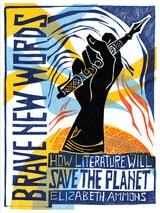
Brave New Words
How Literature Will Save the PlanetAmmons, Elizabeth
University of Iowa Press, 2010
The activist tradition in American literature has long testified to the power of words to change people and the power of people to change the world, yet in recent years many professional humanists have chosen to distract themselves with a postmodern fundamentalism of indeterminacy and instability rather than engage with social and political issues. Throughout her bold and provocative call to action, Elizabeth Ammons argues that the responsibility now facing humanists is urgent: inside and outside academic settings, they need to revive the liberal arts as a progressive cultural force that offers workable ideas and inspiration in the real-world struggle to achieve social and environmental justice.
Brave New Words challenges present and future literary scholars and teachers to look beyond mere literary critique toward the concrete issue of social change and how to achieve it. Calling for a profound realignment of thought and spirit in the service of positive social change, Ammons argues for the continued importance of multiculturalism in the twenty-first century despite attacks on the concept from both right and left. Concentrating on activist U.S. writers—from ecocritics to feminists to those dedicated to exposing race and class biases, from Jim Wallis and Cornel West to Winona LaDuke and Paula Moya and many others—she calls for all humanists to link their work to the progressive literature of the last half century, to insist on activism in the service of positive change as part of their mission, and to teach the power of hope and action to their students.
As Ammons clearly demonstrates, much of American literature was written to expose injustice and motivate readers to work for social transformation. She challenges today’s academic humanists to address the issues of hope and purpose by creating a practical activist pedagogy that gives students the knowledge to connect their theoretical learning to the outside world. By relying on the transformative power of literature and replacing nihilism and powerlessness with conviction and faith, the liberal arts can offer practical, useful inspiration to everyone seeking to create a better world.

Breast Cancer in the Academy
Solidarity in the Fight for Our LivesWendy K.Z. Anderson
Rutgers University Press, 2027
This edited collection is an interdisciplinary dialogue about how breast cancer diagnosis, treatment, and healing is experienced by academic women. The contributors fostered dialogue rooted in critical, qualitative, and autoethnographic traditions about how breast cancer diagnosis, treatment, and healing was experienced by a group with academic privileges, such as the ability to research and advocate for themselves. The book takes on a global perspective, incorporating pieces from medical doctors who became patients, BIPOC women, as well as scholars who identify as LBGTQIA, as they faced decisions about issues such as flat closures, fertility treatments, and being one-sided. These seventeen academic women navigated and resisted healthcare systems to develop a theory of coalitional survivorship.
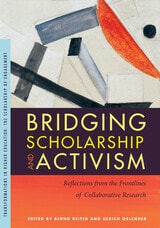
Bridging Scholarship and Activism
Reflections from the Frontlines of Collaborative ResearchBernd Reiter
Michigan State University Press, 2015
CONTENTS:
Introduction, Ulrich Oslender and Bernd Reiter
Part One. The Promises and Pitfalls of Collaborative Research
- Of Academic Embeddedness: Communities of Choice and How to Make Sense of Activism and Research Abroad, Bernd Reiter
- New Shapes of Revolution, Gustavo Esteva
- The Accidental Activist Scholar: A Memoir on Reactive Boundary and Identity Work for Social Change within the Academy, Rob Benford
- Leaving the Field: How to Write about Disappointment and Frustration in Collaborative Research, Ulrich Oslender
- Invisible Heroes, Eshe Lewis
- El Muntuen America, Manuel Zapata Olivella
- Activism as History Making: The Collective and the Personal in Collaborative Research with the Process of Black Communities in Colombia, Arturo Escobar
- Out of Bounds: Negotiating Researcher Positionality in Brazil, Elizabeth Hordge-Freeman
- Between Soapboxes and Shadows: Activism, Theory, and the Politics of Life and Death in Salvador, Bahia, Brazil, Christen A. Smith
- State Violence and the Ethnographic Encounter: Feminist Research and Racial Embodiment, Keisha-Khan Y. Perry
- The Challenges Resulting from Combining Scientific Production and Social-Political Activism in the Brazilian Academy, Fernando Conceição
- The Challenge of Doing Applied/Activist Anti-Racist Anthropology in Revolutionary Cuba, Gayle L. McGarrity
- Conclusion, Ulrich Oslender and Bernd Reiter
- About the Authors
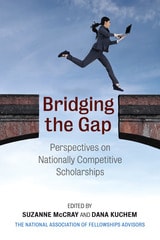
Bridging the Gap
Perspectives on Nationally Competitive ScholarshipsSuzanne McCray
University of Arkansas Press, 2019
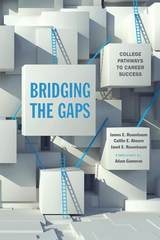
Bridging the Gaps
College Pathways to Career SuccessJames E. Rosenbaum
Russell Sage Foundation, 2017
The authors find that sub-baccalaureate credentials—associate degrees and college certificates—can improve employment outcomes. Young adults who complete these credentials have higher employment rates, earnings, autonomy, career opportunities, and job satisfaction than those who enroll but do not complete credentials. Sub-BA credentials can be completed at community college in less time than bachelor’s degrees, making them an affordable option for many low-income students.
Bridging the Gaps shows that when community colleges overemphasize bachelor’s degrees, they tend to funnel resources into remedial programs, and try to get low-performing students on track for a BA. Yet, remedial programs have inconsistent success rates and can create unrealistic expectations, leading struggling students to drop out before completing any degree. The authors show that colleges can devise procedures that reduce remedial placements and help students discover unseen abilities, attain valued credentials, get good jobs, and progress on degree ladders to higher credentials.
To turn college-for-all into a reality, community college students must be aware of their multiple credential and career options. Bridging the Gaps shows how colleges can create new pathways for non-traditional students to achieve success in their schooling and careers.

Bright College Years
Inside the American College TodayAnne Matthews
University of Chicago Press, 1998
"Matthews writes with sympathy and substantial understanding of the dilemmas colleges face these days."—Tara Fitzpatrick, Chicago Tribune
"A wide-ranging, well-written and lively account of contemporary academia."—Christian Wiman, Dallas Morning News
"Notable Book of the Year." New York Times
"An eye-opening, startling exposé;. . . . Matthews' energetic and well-written report provides a dismal yet concise insider portrait of college life."—Booklist
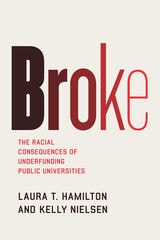
Broke
The Racial Consequences of Underfunding Public UniversitiesLaura T. Hamilton and Kelly Nielsen
University of Chicago Press, 2021
In Broke, Laura T. Hamilton and Kelly Nielsen examine virtually all aspects of campus life to show how the new economic order in public universities, particularly at two campuses in the renowned University of California system, affects students. For most of the twentieth century, they show, less affluent families of color paid with their taxes for wealthy white students to attend universities where their own offspring were not welcome. That changed as a subset of public research universities, some quite old, opted for a “new” approach, making racially and economically marginalized youth the lifeblood of the university. These new universities, however, have been particularly hard hit by austerity. To survive, they’ve had to adapt, finding new ways to secure funding and trim costs—but ultimately it’s their students who pay the price, in decreased services and inadequate infrastructure.
The rise of new universities is a reminder that a world-class education for all is possible. Broke shows us how far we are from that ideal and sets out a path for how we could get there.
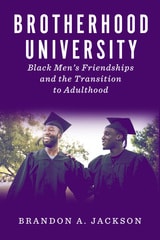
Brotherhood University
Black Men's Friendships and the Transition to AdulthoodBrandon A. Jackson
Rutgers University Press, 2024
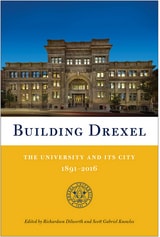
Building Drexel
The University and Its City 1891-2016Richardson Dilworth
Temple University Press, 2016
Published in conjunction with Drexel University’s 125th anniversary, Building Drexel chronicles the founding of the university by Anthony J. Drexel through to the present day. The editors and contributors create a prismatic discussion of the university and its evolution.
Richly illustrated chapters cover the architectural history of notable Drexel buildings; the role of Drexel in Philadelphia’s modern history; its Greek life; sports—particularly Drexel’s history in the Big 5; and each of the university’s schools and colleges. There is a history of the medical college and law school, plus the creation of new schools such as those of biomedical engineering, science and health systems.
Building Drexel also documents the civil rights history of Drexel and its urban planning history in relation to the racially diverse Powelton Village and Mantua neighborhoods it borders. This commemorative volume shows the development of the university both in the city and in the world.
Contributors include: Lloyd Ackert, Cordelia Frances Biddle, Paula Marantz Cohen, Donna Marie De Carolis, Roger Dennis, Gloria Donnelly, Kevin D. Egan, Alissa Falcone, David Fenske, John A. Fry, Stephen F. Gambescia, Marla J. Gold, Charles Haas, Kathy Harvatt, Daniel Johnson, Jeannine Keefer, Larry Keiser, Michael Kelley, Jason Ludwig, Jonson Miller, Julie Mostov, Danuta A. Nitecki, Anthony M. Noce, Steven J. Peitzman, David Raizman, Tiago Saraiva, Amy E. Slaton, Nathaniel Stanton, Virginia Theerman, Laura Valenti, James Wolfinger, Eric A. Zillmer, and the editors.
Building Internationalized Spaces
Second Language Perspectives on Developing Language and Cultural Exchange Programs in Higher EducationEdited by Matthew Allen, Estela Ene, and Kyle McIntosh
University of Michigan Press, 2022
This volume contributes to emerging interdisciplinary conversations in higher education about how to refine internationalization in terms of praxis and how to coordinate curricular and pedagogical efforts to achieve meaningful learning outcomes for all students. The chapters provide suggestions for how L2 specialists can reframe their work in their individual programs to help internationalize the entire university in ways that lead to improved learning outcomes for students at different points in their degree programs, including:
- Orientation programs (early arrival on campus, before classes start)
- Language Center contexts (support during studies)
- Volunteer programs for International Teaching Assistants (ITA) and undergraduate students
- Graduate-level writing support structures
- Instructional design (virtual learning spaces)
- Virtual Partner programs (co-curricular)
- Intercultural composition (placement, interdisciplinary collaborations)
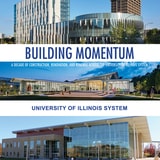
Building Momentum
A Decade of Construction, Renovation, and Renewal across the University of Illinois SystemUniversity of Illinois. Foreword by Timothy L. Killeen
University of Illinois Press, 2023
The University of Illinois System’s universities have undergone a dramatic transformation. This lavishly illustrated volume showcases the major capital projects and renovations dedicated to keeping facilities on the cutting edge while at the same time preserving history at the universities in Urbana-Champaign, Chicago, and Springfield. Fueled by an ambitious capital initiative launched in 2018, these essential and forward-looking changes include more than 500 projects valued at $4 billion over 10 years. The initiative harnesses a mix of innovative funding programs like public-private partnerships, thoughtful use of capital reserves and bonding authority, and generous state funding.
Covering completed and ongoing projects, Building Momentum offers a one- or two-page feature on each undertaking that covers its history and purpose while providing specific details about its unit, campus, architect, square footage or renovation size, budget, and LEED or other certifications. More than 100 architectural drawings and commissioned and historical photographs round out the descriptions.

Building a Curriculum for General Education
A Description of the General College ProgramIvol Spafford
University of Minnesota Press, 1943
Building a Curriculum for General Education was first published in 1943. Minnesota Archive Editions uses digital technology to make long-unavailable books once again accessible, and are published unaltered from the original University of Minnesota Press editions.