Results by title
121 books match the query 'Literacy' and 4 start with b

Baby Storytime Magic
Active Early Literacy through Bounces, Rhymes, Tickles, and MoreKathy MacMillan
American Library Association, 2014
Beyond the Lettered City
Indigenous Literacies in the AndesJoanne Rappaport and Tom Cummins
Duke University Press, 2012
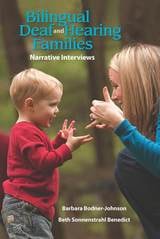
Bilingual Deaf and Hearing Families
Narrative InterviewsBarbara Bodner-Johnson
Gallaudet University Press, 2012
This study emphasizes the importance of family support for deaf members, particularly through the use of both American Sign Language (ASL) and spoken and/or written English. Research has shown how these factors influence such areas as a child’s development, performance in school, and relationships with brothers and sisters. In this volume, authors Barbara Bodner-Johnson and Beth S. Benedict concentrate on the vital, positive effects of bilingualism and how families that share their experiences with other families can enhance all of their children’s achievement and enrichment.
Bilingual Deaf and Hearing Families: Narrative Interviews describes the experiences of ten families who have at least one deaf family member. In five of the families, the parents are hearing and they have a deaf child; two of the children in these families have cochlear implants. In three families, both the parents and children are deaf. In one family, the parents are deaf and their daughter is hearing; and in one family, the parents and one child are deaf and they all have cochlear implants, and the deaf child’s twin is hearing.
The interviews were conducted in the families’ homes using set topics and questions. The family discussions cover a wide range of subjects: cochlear implants, where they live, their thoughts about family relationships, how they participate in the Deaf community, how they arrive at certain decisions, their children’s friendships, and the goals and resiliencies they have as a family.
By Touch Alone
Blindness and Reading in Nineteenth-Century CultureVanessa Warne
University of Michigan Press, 2025
While By Touch Alone features the writing and ideas of an understudied community of nineteenth-century blind authors, innovators, and activists, it also engages the work of sighted authors such as George Eliot and Rudyard Kipling to explore the culture-wide effects of reading by touch. The emergence of a new category of readers who did not rely on sight to read prompted sighted people to reimagine blindness and adopt more progressive attitudes toward blind people. In our own era, one characterized by the increasing digitization of our reading lives, Vanessa Warne’s exploration positions scholars and blind readers to navigate present-day developments and shape the future of their reading lives. A carefully contextualized study of how reading by touch shaped Victorian culture, By Touch Alone adds new chapters to the history of disability and reading.