Results by title
99 books match the query 'Local' and 7 start with b
Back of the Yards
The Making of a Local DemocracyRobert A. Slayton
University of Chicago Press, 1986
Beast
Benjamin B. Lindsey
University Press of Colorado, 2009

Big Bill Thompson, Chicago, and the Politics of Image
Douglas Bukowski
University of Illinois Press, 1998
A brilliant chameleon of a politician, Thompson could move from pro- to anti-prohibition, from opposing the Chicago Teachers Federation to opposing a superintendent hostile to it, from being anti-Catholic to winning, in huge numbers, the Catholic vote. Shape-shifter extraordinaire, Thompson stayed in power by repeatedly altering his political image. In Big Bill Thompson, Chicago, and the Politics of Image, Douglas Bukowski captures the essence of this wily urban politico as no other biographer or historian has. Using materials accessible only thanks to the Freedom of Information Act, Bukowski has fashioned an unforgettable story of a volatile Chicago leader and his era. And he does it with such grace and in such an irresistible style that readers will yearn to visit the local speakeasy and lift a glass to colorful politicians gone by.
Bitter Fruit
Black Politics and the Chicago Machine, 1931-1991William J. Grimshaw
University of Chicago Press, 1992
Boss Cox’s Cincinnati
Urban Politics in the Progressive EraZane L. Miller
The Ohio State University Press, 2000
In documenting the changes Cincinnati experienced during the Progressive Era, Zane L. Miller provides a clear perspective on the processes of urbanization that transformed the American city. His focus is political because politics provided continuity amid the diversity of city life. The most important aspect of political continuity in Cincinnati and in other cities was "bossism," often depicted as an example of corruption, but which was in many cities part of the quest for a new urban order. In Cincinnati, Boss George B. Cox's machine was a response to the disorder of the times; interestingly, the machine actually helped to control disorder, paving the way for later reforms. Miller carefully explores both the nature and the significance of bossism, showing how it and municipal reform were both essential components of the modern urban political system.
Originally published in 1968, Boss Cox's Cincinnati is considered a classic in the field of urban studies.
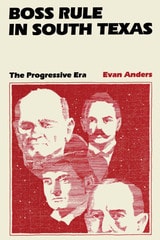
Boss Rule in South Texas
The Progressive EraBy Evan Anders
University of Texas Press, 1982
Four men played leading roles in the political drama that unfolded in South Texas during the first decades of this century:
- James B. Wells, who ruled as boss of Cameron County and served as leading conservative spokesman of the Democratic Party in Texas;
- Archer (Archie) Parr, whose ruthless tactics and misuse of public funds in Duval County established him as one of the most notoriously corrupt politicians in Texas history;
- Manuel Guerra, Mexican American rancher and merchant whose domination of Starr County mirrored the rule of his Anglo counterparts in the border region;
- John Nance Garner, who served the interests of these bosses of South Texas as he set forth on the road that would lead him to the United States vice-presidency.
Evan Anders's Boss Rule in South Texas tells the story of these men and the county rings they shaped in South Texas during the Progressive Era.
Power was the byword of the bosses of the Lower Rio Grande Valley, and Anders explores the sources of that power. These politicos did not shirk from using corrupt and even violent means to attain their goals, but Anders demonstrates that their keen sensitivity to the needs of their diverse constituency was key to their long-term success. Patronage and other political services were their lifeblood, and the allies gained by these ranged from developers and businessmen to ranchers and Mexican Americans, wealthy and poor.
Besides examining the workings of the Democratic machines of four South Texas counties, Anders explores the role of the Hispanic populace in shaping the politics of the border region, the economic development of the Lower Rio Grande Valley and its political repercussions, the emergence and nature of progressive movements at both local and state levels, and the part played by the Texas Rangers in supporting bossism in South Texas.
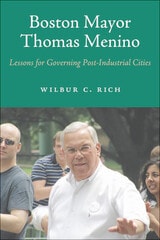
Boston Mayor Thomas Menino
Lessons for Governing Post-Industrial CitiesWilbur C. Rich
University of Massachusetts Press, 2023
Hailed as one of Boston’s most beloved mayors and its longest serving, Thomas Menino (1942–2014) deftly managed the city’s finances and transformed Boston into the hub of innovation that it is today. During his time in office, Boston embraced modern industrial growth and moved forward with noteworthy developments that altered neighborhoods, while also facing ongoing racial strife, challenges of unaffordable housing, and significant public union negotiations.
Mayors in modern American cities occupy unique positions as government leaders who need to remain active parts of their communities in addition to being tasked with fixing neighborhood issues, managing crises, and keeping schools and public infrastructure on course. Situating news coverage alongside interviews with the mayor and his administration, political scientist Wilbur C. Rich chronicles Menino’s time in office while also considering his personal and professional background, his larger-than-life personality, and his ambitions. Menino’s approach to these challenges and opportunities offers enduring lessons to anyone interested in urban government and political leadership.