79 books match the query 'Media & Communications' and 4 start with b

cover of Bad News for Refugees

Bad News for Refugees

Greg Philo, Emma Briant, and Pauline Donald

Pluto Press, 2013

Bad News for Refugees analyses the political, economic and environmental contexts of migration and looks specifically at how refugees and asylum seekers have been stigmatised in political rhetoric and in media coverage.

Through forensic research it shows how hysterical and inaccurate media accounts act to legitimise political action which can have terrible consequences both on the lives of refugees and also on established migrant communities.

Based on new research by the renowned Glasgow Media Group, Bad News for Refugees is essential reading for those concerned with the negative effects of media on public understanding and for the safety of vulnerable groups and communities in our society.
[more]
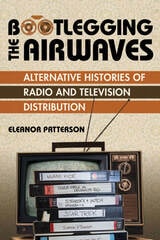
cover of Bootlegging the Airwaves: Alternative Histories of Radio and Television Distribution

Bootlegging the Airwaves

Alternative Histories of Radio and Television Distribution

Eleanor Patterson

University of Illinois Press, 2024

How fan passion and technology merged into a new subculture

Long before internet archives and the anytime, anywhere convenience of streaming, people collected, traded, and shared radio and television content via informal networks that crisscrossed transnational boundaries.

Eleanor Patterson’s fascinating cultural history explores the distribution of radio and TV tapes from the 1960s through the 1980s. Looking at bootlegging against the backdrop of mass media’s formative years, Patterson delves into some of the major subcultures of the era. Old-time radio aficionados felt the impact of inexpensive audio recording equipment and the controversies surrounding programs like Amos ‘n’ Andy. Bootlegging communities devoted to buddy cop TV shows like Starsky and Hutch allowed women to articulate female pleasure and sexuality while Star Trek videos in Australia inspired a grassroots subculture built around community viewings of episodes. Tape trading also had a profound influence on creating an intellectual pro wrestling fandom that aided wrestling’s growth into an international sports entertainment industry.

[more]
cover of Branding Brazil: Transforming Citizenship on Screen

Branding Brazil

Transforming Citizenship on Screen

Leslie L. Marsh

Rutgers University Press, 2021
Branding Brazil examines a panorama of contemporary cultural productions including film, television, photography, and alternative media to explore the transformation of citizenship in Brazil from 2003 to 2014. A utopian impulse drove the reproduction of Brazilian cultural identity for local and global consumption; cultural production sought social and economic profits, especially greater inclusion of previously marginalized people and places. Marsh asserts that three communicative strategies from branding–promising progress, cultivating buy-in, and resolving contradictions–are the most salient and recurrent practices of nation branding during this historic period. More recent political crises can be understood partly in terms of backlash against marked social and political changes introduced during the branding period. Branding Brazil takes a multi-faceted approach, weaving media studies with politics and cinema studies to reveal that more than a marketing term or project emanating from the state, branding was a cultural phenomenon.
[more]
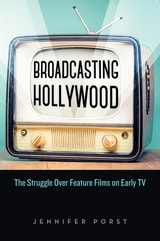
cover of Broadcasting Hollywood: The Struggle over Feature Films on Early TV

Broadcasting Hollywood

The Struggle over Feature Films on Early TV

Jennifer Porst

Rutgers University Press, 2021

Broadcasting Hollywood: The Struggle Over Feature Films on Early Television uses extensive archival research into the files of studios, networks, advertising agencies, unions and guilds, theatre associations, the FCC, and key legal cases to analyze the tensions and synergies between the film and television industries in the early years of television. This analysis of the case study of the struggle over Hollywood’s feature films appearing on television in the 1940s and 1950s illustrates that the notion of an industry misunderstands the complex array of stakeholders who work in and profit from a media sector, and models a variegated examination of the history of media industries. Ultimately, it draws a parallel to the contemporary period and the introduction of digital media to highlight the fact that history repeats itself and can therefore play a key role in helping media industry scholars and practitioners to understand and navigate contemporary industrial phenomena.
[more]