Results by title
237 books match the query 'Medicine' and 9 start with b
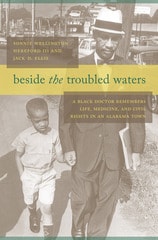
Beside the Troubled Waters
A Black Doctor Remembers Life, Medicine, and Civil Rights in an Alabama TownSonnie Wellington Hereford III and Jack D. Ellis
University of Alabama Press, 2011
A memoir by an African American physician in Alabama whose story in many ways typifies the lives and careers of black doctors in the south during the segregationist era
Beside the Troubled Waters is a memoir by an African American physician in Alabama whose story in many ways typifies the lives and careers of black doctors in the south during the segregationist era while also illustrating the diversity of the black experience in the medical profession. Based on interviews conducted with Hereford over ten years, the account includes his childhood and youth as the son of a black sharecropper and Primitive Baptist minister in Madison County, Alabama, during the Depression; his education at Huntsville’s all-black CouncillSchool and medical training at MeharryMedicalCollege in Nashville; his medical practice in Huntsville’s black community beginning in 1956; his efforts to overcome the racism he met in the white medical community; his participation in the civil rights movement in Huntsville; and his later problems with the Medicaid program and state medical authorities, which eventually led to the loss of his license.

Beyond the Body
The Boundaries of Medicine and English Renaissance DramaWilliam Kerwin
University of Massachusetts Press, 2005
Drawing on research in the social history of medicine as well as a wide-ranging collection of primary narratives of medical encounters, Kerwin pursues the stories of several medical groups. Specifically, he examines women healers in terms of the changing place of women in the public sphere; the connections between drug sellers—apothecaries and alchemists—and an emerging modern economy; the role barbers and surgeons played in early modern concerns for protecting a new sense of privacy and interiority; the ways physicians defined their professional primacy through the language of theaters and actors; and the ways individual patients employed rhetorics of diagnosis as a way of participating in sectarian religious battles. The study moves from the dynamics of medical politics to the work drama does in exposing those dynamics. In addition to offering astute readings of works by Shakespeare and Ben Jonson, the book pays substantial attention to plays by Samuel Daniel, John Fletcher, John Ford, Thomas Heywood, John Lyly, Philip Massinger, and John Webster.
Beyond the Body complements the wealth of recent critical attention given to the body. Kerwin attends to a different sort of material politics; as the book's title suggests, he asks a reader interested in the politics of medicine to look not at the practitioner treating the body but at the social forces influencing the practitioner. Beyond the Body works to erode a widespread cultural bias toward giving medicine deference as a self-defining profession.
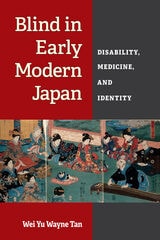
Blind in Early Modern Japan
Disability, Medicine, and IdentityWei Yu Wayne Tan
University of Michigan Press, 2022
Blood and Bone
Poems by PhysiciansAngela Belli
University of Iowa Press, 1998
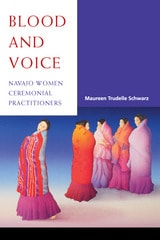
Blood and Voice
Navajo Women Ceremonial PractitionersMaureen Trudelle Schwarz
University of Arizona Press, 2003
The maintenance of the latter tradition has long been held to be the function of the Navajo singer, a role usually viewed as male. But despite this longstanding assumption, women can and do fill this role. Drawing on interviews with seventeen Navajo women practitioners and five apprentices, Maureen Trudelle Schwarz explicates women's role as ceremonial practitioners and shows that it is more complex than has previously been thought. She examines gender differences dictated by the Navajo origin story, details how women came to be practitioners, and reveals their experiences and the strategies they use to negotiate being both woman and singer.
Women who choose careers as singers face complex challenges, since some rules prohibit menstruating women from conducting ceremonies and others regarding sexual continence can strain marital relationships. Additionally, oral history places men in charge of all ceremonial matters. Schwarz focuses on how the reproductive life courses of Navajo women influence their apprenticeships and practices to demonstrate how they navigate these issues to preserve time-honored traditions. Through the words of actual practitioners, she shows how each woman brings her own unique life experience to the role. While differing among individuals, these experiences represent a commitment to shared cultural symbols and result in a consensus that sustains social cohesion.
By showing the differences and similarities between the apprenticeship, initiation, and practice of men and women singers, Blood and Voice offers a better understanding of the role of Navajo women in a profession usually viewed as a male activity—and of the symbolic construction of the self in Navajo culture. It also addresses classic questions concerning the sexual division of labor, menstrual taboos, gender stereotypes, and the tension between tradition and change that will enlighten students of other cultures.
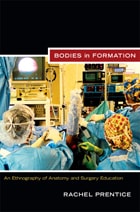
Bodies in Formation
An Ethnography of Anatomy and Surgery EducationRachel Prentice
Duke University Press, 2012
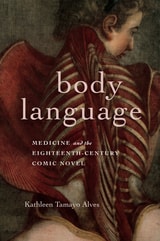
Body Language
Medicine and the Eighteenth-Century Comic NovelKathleen Tamayo Alves
Bucknell University Press, 2026
Body Language examines the complex intersections of British eighteenth-century comic fiction and medical discourse. By engaging medical writings of renowned and widely-read physicians of the Enlightenment such as John Freind, Thomas Sydenham, Albrecht von Haller, John Whytt, and William Cullen, with novels of humor by Henry Fielding, Tobias Smollett, Laurence Sterne, and Charlotte Lennox, Alves explains how medicine shaped comic language by dramatizing female-specific phenomena like menstruation, hysteria, nervous disorders, and pregnancy. In these novels, the medical belief that women are incapable of bodily self-regulation becomes an imperative for policing women’s bodies and highlights the enduring shortcomings of patriarchal systems. Ultimately, these comic representations offer a counternarrative of women’s bodies, agency, and selfhood, exposing masculine anxieties about the effectiveness of marriage to regulate women’s sexuality.
Published by Bucknell University Press. Distributed worldwide by Rutgers University Press.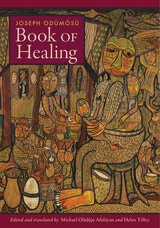
Book of Healing
Joseph Odùmósù
University of Wisconsin Press, 2026
While the existence of Odùmósù’s massive work is well-known in southwestern Nigeria, it has not previously been available in English. Michael Ọládẹ̀jọ Afọláyan and Helen Tilley have translated the volume in its entirety, and here use it as an entrée into greater understandings of Yorùbá medicine, spirituality, and print culture during a time of rapid change under British colonialism and the spread of Christianity.
Bounding Biomedicine
Evidence and Rhetoric in the New Science of Alternative MedicineColleen Derkatch
University of Chicago Press, 2016
Bounding Biomedicine centers on this boundary-changing era, looking at how consumer demand shook the health care hierarchy. Drawing on scholarship in rhetoric and science and technology studies, the book examines how the medical profession scrambled to maintain its position of privilege and prestige, even as its foothold appeared to be crumbling. Colleen Derkatch analyzes CAM-themed medical journals and related discourse to illustrate how members of the medical establishment applied Western standards of evaluation and peer review to test health practices that did not fit easily (or at all) within standard frameworks of medical research. And she shows that, despite many practitioners’ efforts to eliminate the boundaries between “regular” and “alternative,” this research on CAM and the forms of communication that surrounded it ultimately ended up creating an even greater division between what counts as safe, effective health care and what does not.
At a time when debates over treatment choices have flared up again, Bounding Biomedicine gives us a possible blueprint for understanding how the medical establishment will react to this new era of therapeutic change.