Results by title
153 books match the query 'Metaphysics' and 7 start with b
Beauty and the Good
Recovering the Classical Tradition from Plato to Duns ScotusAlice M. Ramos
Catholic University of America Press, 2021

Being after Rousseau
Philosophy and Culture in QuestionRichard L. Velkley
University of Chicago Press, 2002
The Rousseauian tradition begins, for Velkley, with Rousseau's criticism of modern political philosophy. Although the German Idealists such as Schelling accepted much of Rousseau's critique, they believed, unlike Rousseau, that human wholeness could be attained at the level of society and history. Heidegger and Nietzsche questioned this claim, but followed both Rousseau and the Idealists in their vision of the philosopher-poet striving to recover an original wholeness that the history of reason has distorted.
Being and the Cosmos
Robert E. Wood
Catholic University of America Press, 2018
In Being and the Cosmos<\i>, the tack against both is to make explicit the character of the mind that sees and thinks, that actively takes up commitment to the truth available in the disciplines involved. The basic ground of this position rests upon the functioning of the notion of Being that opens up the question of the character of the Whole and the human being’s place in it. Thus position the treatment of the notion of Being as foundation and as orientation toward the Whole between the attack on reductionism and on deconstruction and anti-foundationalism. Wood concludes with a multidimensional sketch of an evolutionary view of the cosmos whose initial phases contain the potentialities for life, sensibility, and intellect as cosmic telos. The holism of contemporary physics has to be reconfigured in terms of this observation. Both reductionists and dualists should know that matter itself has to be re-minded and that mind itself matters.
Being is Better Than Not Being
The Metaphysics of Goodness and Beauty in AristotleChristopher V. Mirus
Catholic University of America Press, 2022
Beyond Matter
Why Science Needs MetaphysicsRoger Trigg
Templeton Press, 2016
Does science have all the answers? Can it even deal with abstract reasoning beyond the world we experience? How can we ensure that the physical world is sufficiently ordered to be intelligible to humans? How can mathematics, a product of human minds, unlock the secrets of the physical universe? Should all such questions be considered inadmissible if science cannot settle them?
Metaphysics has traditionally been understood as reasoning beyond the reach of science, sometimes even claiming realities beyond its grasp. Because of this, metaphysics is often contemptuously dismissed by scientists and philosophers who wish to remain within the bounds of what can be scientifically proven. Yet scientists at the frontiers of physics unwittingly engage in metaphysics, as they are now happy to contemplate whole universes that are, in principle, beyond human reach.
Roger Trigg challenges those who deny that science needs philosophical assumptions. Trigg claims that the foundations of science themselves have to lie beyond science. It takes reasoning apart from experience to discover what is not yet known and this metaphysical reasoning to imagine realities beyond what can be accessed.
“In Beyond Matter, Roger Trigg advances a powerful, persuasive, fair-minded argument that the sciences require a philosophical, metaphysical foundation. This is a brilliant book for newcomers to the philosophy of science and experts alike.” —Charles Taliaferro, professor of philosophy, St. Olaf College
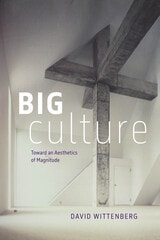
Big Culture
Toward an Aesthetics of MagnitudeDavid Wittenberg
University of Chicago Press, 2025
Big Culture asks a simple question: why do big things give us big feelings? Skyscrapers, disasters, and other large phenomena can elicit fear, attraction, and awe. David Wittenberg argues that these feelings cannot be explained through objects’ size alone. Instead, he contends that an encounter with bigness is a primal, even violent sensation like little else that we experience in our well-proportioned adult lives.
Drawing on examples as commonplace and as singular as atomic bombs, cinematic effects, pornographic “macrophilia,” monstrous creatures, and more, Wittenberg demonstrates how big things tap into our earliest experiences of the world, reigniting our most fundamental feelings about reality. In doing so, Wittenberg offers a new aesthetics of magnitude and of the special role that bigness plays in our everyday perception of objects and images.
Biology and Ideology from Descartes to Dawkins
Edited by Denis R. Alexander and Ronald L. Numbers
University of Chicago Press, 2010
Over the course of human history, the sciences, and biology in particular, have often been manipulated to cause immense human suffering. For example, biology has been used to justify eugenic programs, forced sterilization, human experimentation, and death camps—all in an attempt to support notions of racial superiority. By investigating the past, the contributors to Biology and Ideology from Descartes to Dawkins hope to better prepare us to discern ideological abuse of science when it occurs in the future.
Denis R. Alexander and Ronald L. Numbers bring together fourteen experts to examine the varied ways science has been used and abused for nonscientific purposes from the fifteenth century to the present day. Featuring an essay on eugenics from Edward J. Larson and an examination of the progress of evolution by Michael J. Ruse, Biology and Ideology examines uses both benign and sinister, ultimately reminding us that ideological extrapolation continues today. An accessible survey, this collection will enlighten historians of science, their students, practicing scientists, and anyone interested in the relationship between science and culture.