Results by title
67 books match the query 'Mexican American women' and 6 start with b

Barrio Dreams
Selected PlaysSilviana Wood; Edited by Norma E. Cantú and Rita E. Urquijo-Ruiz
University of Arizona Press, 2016
Barrio Dreams is the first book to collect the work of one of Arizona’s foremost teatristas, playwright Silviana Wood. During her decades-long involvement in theater, Wood forged a reputation as a playwright, actor, director, and activist. Her works form a testimonio of Chicana life, steeped in art, politics, and the borderlands. Wood’s plays challenge, question, and incite women to consider their lot in life. She ruptures stereotypes and raises awareness of social issues via humor and with an emphasis on the use of the physical body on stage.
The play Una vez, en un barrio de sueños . . . offers a glimpse into familiar terrain—the barrio and its dwellers—in three actos. In Amor de hija, a fraught mother-daughter relationship in contemporary working-class Arizona is dealt an additional blow as the family faces Alzheimer’s disease. In the tragedy A Drunkard’s Tale of Melted Wings and Memories, and in the trilingual (Spanish, English, and Yaqui) tragicomedy Yo, Casimiro Flores, characters love, live, die, travel through time and space, and visit the afterlife. And in Anhelos por Oaxaca, a grandfather travels back in time through flashbacks, as he and his grandson travel through homelands from Arizona to Oaxaca.
Part of Wood’s genius is the way she portrays life in what Gloria Anzaldúa called “el mundo zurdo,” that space inhabited by the people of color, the poor, the female, and the outsiders. It is a place for the atravesados, the odd, the different, those who do not fit the mainstream. The people who inhabit Wood’s plays are common folk—janitors, mothers, grandmothers, and teenagers—hardworking people who, in one way or another, have made their way in life and who embody life in the barrio.
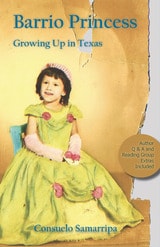
Barrio Princess
Growing Up in TexasConsuelo Samarripa
Parkhurst Brothers, Inc., 2014
"Made in Mexico, born in America," Barrio Princess shares heartwarming family stories, cultural tradition stories, learning English by total immersion, socialization as a minority, education, stories of her mother as a single parent, and women’s stories from a minority point of view.
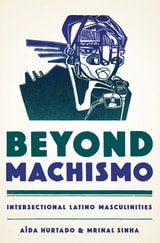
Beyond Machismo
Intersectional Latino MasculinitiesBy Aída Hurtado and Mrinal Sinha
University of Texas Press, 2016
Long considered a pervasive value of Latino cultures both south and north of the US border, machismo—a hypermasculinity that obliterates any other possible influences on men’s attitudes and behavior—is still used to define Latino men and boys in the larger social narrative. Yet a closer look reveals young, educated Latino men who are going beyond machismo to a deeper understanding of women’s experiences and a commitment to ending gender oppression. This new Latino manhood is the subject of Beyond Machismo.
Applying and expanding the concept of intersectionality developed by Chicana feminists, Aída Hurtado and Mrinal Sinha explain how the influences of race, class, ethnicity, sexuality, and gender shape Latinos’ views of manhood, masculinity, and gender issues in Latino communities and their acceptance or rejection of feminism. In particular, the authors show how encountering Chicana feminist writings in college, as well as witnessing the horrors of sexist oppression in the United States and Latin America, propels young Latino men to a feminist consciousness. By focusing on young, high-achieving Latinos, Beyond Machismo elucidates this social group’s internal diversity, thereby providing a more nuanced understanding of the processes by which Latino men can overcome structural obstacles, form coalitions across lines of difference, and contribute to movements for social justice.
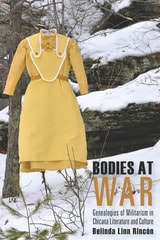
Bodies at War
Genealogies of Militarism in Chicana Literature and CultureBelinda Linn Rincón
University of Arizona Press, 2017
Bodies at War examines the rise of neoliberal militarism from the early 1970s to the present and its transformation of political, economic, and social relations. It charts neoliberal militarism’s impact on democratic practices, economic policies, notions of citizenship, race relations, and gender norms by focusing on how these changes affect the Chicana/o community and, more specifically, on how it shapes and is shaped by Chicana bodies. The book raises important questions about the cultural legacies of war and the gendering of violence—topics that reach across multiple disciplinary fields of inquiry, including cultural and media studies. It draws attention to the relationship between war and society, to neoliberal militarism’s destructive social impact, and to the future of Latina soldiering. Through Chicana art, activism, and writing, Rincón offers a visionary foundation for an antiwar feminist politic.
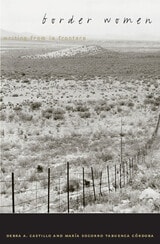
Border Women
Writing From La FronteraDebra A. Castillo
University of Minnesota Press, 2002
The first study to foreground writing by women who live at the U.S.-Mexico Border.
It is a peculiar fact that U.S.-Mexico border theory is dominated by those who write about, not from, the border. By looking at the work of women writers from both sides of the border, Debra A. Castillo and María-Socorro Tabuenca Córdoba open border studies to a truly transnational analysis while bringing questions of gender to the fore.
Border Women rethinks border theory by emphasizing women writers whose work—in Spanish, English, or a mixture of the two languages—calls into question accepted notions of border identities. These writers include those who are already well recognized internationally (Helena María Viramontes, Sheila and Sandra Ortiz Taylor, and María Novaro); those who have become part of the Chicano canon (Norma Cantú, Alicia Gaspar de Alba, and Demetria Martínez); along with some of the lesser-known, yet most exciting, women’s voices from the Mexican border (Rosario Sanmiguel, Rosina Conde, and Regina Swain).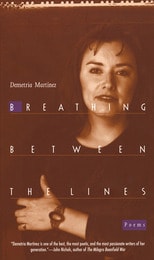
Breathing Between the Lines
PoemsDemetria Martínez
University of Arizona Press, 1997
Weaving together threads of love and family, social conviction and activism, loss and renewal, Breathing between the Lines carries the reader deep inside the head and heart of a talented Chicana writer. Page by page, the journey is an exhilarating one. What we find at the end is up to us.