Results by title
364 books match the query 'Michigan' and 18 start with b

Backpacking in Michigan
Jim DuFresne
University of Michigan Press, 2007
With 65 photographs and 77 detailed maps, this indispensable guide to the state's hiking trails gives beginners to advanced hikers all the information they need to plan their next Michigan overnight or weekend backpacking trip. Featuring 50 trails---27 in the Lower Peninsula---ranging from one-hour to multiple-day treks in both the Upper and Lower Peninsulas, Backpacking in Michigan has something for every hiker.
Information on hike length and difficulty, elevation gain, the amount of time needed to complete the hike, camping facilities, and nearby towns accompanies each of the trail listings. The author also provides extensive reference maps along with a description of scenic highlights. In addition to backcountry explorations of remote trails, Backpacking in Michigan includes classic Michigan adventures such as the Lakeshore Trail in Pictured Rocks National Lakeshore, the Greenstone Ridge Trail in Isle Royale National Park, North Manitou Island in Sleeping Bear Dunes National Lakeshore, and Jordan River Pathway in the Mackinaw State Forest.
While Backpacking in Michigan focuses primarily on the trails themselves, it also makes planning your Michigan adventure as easy as possible by providing important information on routes to and from the trailhead, as well as park fees and reservation information for shelters, walk-in cabins, rental yurts, and overnight camping.
Jim DuFresne is a Michigan native and author of more than a dozen wilderness, travel, and hiking guidebooks. He is author of Isle Royale National Park: Foot Trails and Water Routes; 50 Hikes in Michigan: The Best Walks, Hikes, and Backpacks in the Lower Peninsula; Best Hikes with Children: Michigan; Porcupine Mountains Wilderness State Park: A Backcountry Guide for Hikers, Campers, Backpackers, and Skiers; as well as The Complete Guide to Michigan Sand Dunes, copublished by the University of Michigan Press and Petoskey Publishing.

Baseball Fever
Early Baseball in MichiganPeter Morris
University of Michigan Press, 2003
Baseball seems tailor-made for the historian, yet even today, after almost a century and a half of organized play, baseball's origins remain unclear. Most accounts focus on Eastern teams and the advent of professionals, but how the game spread across a predominantly rural America to become our national pastime is a question still largely unresolved.
In this well-researched study of Michigan baseball from the 1830s to the 1870s, baseball scholar Peter Morris offers many answers. Drawing on such sources as personal memoirs, period photographs, and an extensive, often hilarious variety of newspaper accounts, he paints a vivid portrait of a game that was widely---if erratically---played well before the Civil War and gradually evolved from an informal amusement into an activity for local groups of young men and finally into a serious, organized sport.
Baseball began with pick-up "raisin'" games---so called because they took place after rural roof-raisings---played purely for fun by any number of participants, with myriad local variations. The first amateur clubs appeared in the 1850s and were often ridiculed for playing a child's game---"baseball fever" was then a term of mockery---but as they persevered and issued challenges to other teams from nearby towns, rivalries developed, rules began to conform, and a tradition started to take shape.
Tournaments, often connected with county fairs, and increased newspaper coverage gave the game new momentum after the Civil War, and what had been sociable matches became serious contests, sometimes marred by bad blood. Enclosed grounds changed the nature of the game--most notably with respect to home runs--and allowed teams to charge admission, which introduced a new element of commercialism, community involvement, and a heightened sense of competition. Ultimately, it brought about a level of play that made the best "amateur" clubs able to challenge professional teams from the East when they toured the country.
As he traces the exploits of clubs like the Excelsiors, the Wahoos, and the Unknowns, season by season and often game by game, Morris adds a wealth of new detail to the story of baseball's early days, showing how decades of at least nominally amateur play prepared the way for the advent of the National League in the 1870s, and with it the true beginnings of the professional sport we know today. In the process, he also paints a fascinating portrait of the attitudes, values, and lives of rural Americans in the mid-nineteenth century.

Bath Massacre
America's First School BombingArnie Bernstein
University of Michigan Press, 2009
---Gregg Olsen, New York Times best-selling author of Starvation Heights
"A chilling and historic character study of the unfathomable suffering that desperation and fury, once unleashed inside a twisted mind, can wreak on a small town. Contemporary mass murderers Timothy McVeigh, Columbine's Dylan Klebold, and Virginia Tech's Seung-Hui Cho can each trace their horrific genealogy of terror to one man: Bath school bomber Andrew Kehoe."
---Mardi Link, author of When Evil Came to Good Hart

Battle for the Soul
Mètis Children Encounter Evangelical Protestants at Mackinaw Mission, 1823-1837Keith R. Widder
Michigan State University Press, 1999
In 1823 William and Amanda Ferry opened a boarding school for Métis children on Mackinac Island, Michigan Territory, setting in motion an intense spiritual battle to win the souls and change the lives of the children, their parents, and all others living at Mackinac. Battle for the Soul demonstrates how a group of enthusiastic missionaries, empowered by an uncompromising religious motivation, served as agents of Americanization. The Ferrys' high hopes crumbled, however, as they watched their work bring about a revival of Catholicism and their students refuse to abandon the fur trade as a way of life. The story of the Mackinaw Mission is that of people who held differing world views negotiating to create a "middle-ground," a society with room for all.
Widder's study is a welcome addition to the literature on American frontier missions. Using Richard White's "middle ground" paradigm, it focuses on the cultural interaction between French, British, American, and various native groups at the Mackinac mission in Michigan during the early 19th century. The author draws on materials from the American Board of Commissioners for Foreign Missions archives, as well as other manuscript sources, to trace not only the missionaries' efforts to Christianize and Americanize the native peoples, but the religious, social, and cultural conflicts between Protestant missionaries and Catholic priests in the region. Much attention has been given to the missionaries to the Indians in other areas of the US, but little to this region.

Bear County, Michigan
StoriesJohn Counts
Northwestern University Press, 2025
Following desperate characters in desperate circumstances in the rural Midwest
In these colorful, darkly comic stories, veteran journalist and crime reporter John Counts takes readers to an often-ignored part of the country: a fictional Great Lakes coastal town in northern Michigan defined by beauty and bleakness. The cast of characters in these connected stories ranges from addicts to backwoods misfits to ruined lumber families, all bound together by their desire to obtain something just out of reach. Big Frank breaks out of a rehab facility trying to outrun grief. The women in the village of Brotherhood grapple with sterility resulting from an environmental calamity. A local politician must convince her mother to leave a nudist colony. And in the final, sweeping story, a splinter group from the local tribe attempts to reclaim its ancestral land by force. The people of Bear County and their predicaments encompass the wildly original and yet totally ordinary truths about American life off the beaten track.

Beautiful Wasteland
The Rise of Detroit as America's Postindustrial FrontierRebecca J. Kinney
University of Minnesota Press, 2016
According to popular media and scholarship, Detroit, the once-vibrant city that crumbled with the departure of the auto industry, is where dreams can be reborn. It is a place that, like America itself, is gritty and determined. It has faced the worst kind of adversity, and supposedly now it’s back. But what does this narrative of “new Detroit” leave out? Beautiful Wasteland reveals that the contemporary story of Detroit’s rebirth is an upcycled version of the American Dream, which has long imagined access to work, home, and upward mobility as race-neutral projects. They’re not. As Rebecca J. Kinney shows, the narratives of Detroit’s rise, decline, and potential to rise again are deeply steeped in material and ideological investments in whiteness.
By remapping the narratives of contemporary Detroit through an extension of America’s frontier mythology, Kinney analyzes a cross-section of twentieth and twenty-first century cultural locations—an Internet forum, ruin photography, advertising, documentary film, and print and online media. She illuminates how the stories we tell about Detroit as a frontier of possibility enable the erasure of white privilege and systemic racism. By situating Detroit as a “beautiful wasteland,” both desirable and distressed, this shows how the narrative of ruin and possibility form a mutually constituted relationship: the city is possible precisely because of its perceived ruin.
Beautiful Wasteland tackles the key questions about the future of postindustrial America. As cities around the country reckon with their own postindustrial landscapes, Rebecca Kinney cautions that development that elides considerations of race and class will only continue to replicate uneven access to the city for the poor, working class, and people of color.
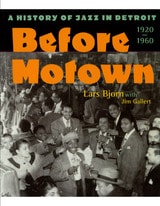
Before Motown
A History of Jazz in Detroit, 1920-60Lars Bjorn with Jim Gallert
University of Michigan Press, 2001

Belgians in Michigan
Bernard A. Cook
Michigan State University Press, 2007
At the beginning of the twenty-first century, Michigan was home to the second-largest Belgian population in the United States, and Detroit had one of the largest Belgian populations in the nation. Although immigration declined after World War I, the Belgian- American community is still prominent in the state. Political, religious, and economic conditions, including a nineteenth- century economic depression, helped motivate the move to America. Belgians brought with them the ability and willingness to innovate, as well as a tradition of hard work and devotion. The Gazette van Detroit, a Flemish-language newspaper first printed in Detroit in 1914, continues to be produced and distributed to subscribers throughout the United States and overseas. Belgian-Americans continue to incorporate traditional values with newfound American values, enabling them to forever preserve their heritage.

Beyond Pontiac's Shadow
Michilimackinac and the Anglo-Indian War of 1763Keith R. Widder
Michigan State University Press, 2013
On June 2, 1763, the Ojibwe captured Michigan’s Fort Michilimackinac from the British. Ojibwe warriors from villages on Mackinac Island and along the Cheboygan River had surprised the unsuspecting garrison while playing a game of baggatiway. On the heels of the capture, Odawa from nearby L’Arbre Croche arrived to rescue British prisoners, setting into motion a complicated series of negotiations among Ojibwe, Odawa, and Menominee and other Indians from Wisconsin. Because nearly all Native people in the Michilimackinac borderland had allied themselves with the British before the attack, they refused to join the Michilimackinac Ojibwe in their effort to oust the British from the upper country; the turmoil effectively halted the fur trade. Beyond Pontiac’s Shadow examines the circumstances leading up to the attack and the course of events in the aftermath that resulted in the regarrisoning of the fort and the restoration of the fur trade. At the heart of this discussion is an analysis of French-Canadian and Indian communities at the Straits of Mackinac and throughout the pays d’en haut. An accessible guide to this important period in Michigan, American, and Canadian history, Beyond Pontiac’s Shadow sheds invaluable light on a political and cultural crisis.

Black Detroit and the Rise of the UAW
August Meier and Elliott Rudwick
University of Michigan Press, 2007

Black Eden
The Idlewild CommunityLewis Walker
Michigan State University Press, 2002

Black Power Praxis
Theory, Practice, and Activist Intellectuals in Detroit's Black Power MovementMatt Birkhold
University of Michigan Press, 2026
Black Power Praxis shows how four groups of activist-intellectuals—James and Grace Lee Boggs, Richard and Milton Henry, Reverend Albert Cleage, and a group of college students called Uhuru—shifted the consciousness and political perspectives of Black Detroiters in the 1960s and 1970s. By developing theories that they could unite with community-organizing practices, these activist-intellectuals turned the focus of the grassroots movement for racial equality from Civil Rights to Black Power. Following the 1967 Detroit Rebellion, these Black Power activist-intellectuals were already positioned to harness the energy that emerged from the uprising and directed it into the city’s first citywide Black Power organization, the Citywide Citizens Action Committee.
Even as Black Power theories became dominant over Detroit’s grassroots movement, their influence faltered when they failed to develop community organizing practices corresponding to the lived experiences of Black Detroiters. Black Power Praxis reveals how the relationships between ideas, practices, leadership, material reality, and consciousness drove the historical development of Black Power. Ideal for readers curious about social movements, Detroit history, African American history, and African American Studies, the book sheds light on how, why, and when Detroit’s activist-intellectual leaders successfully showed everyday people how their power might be used in transformative ways.
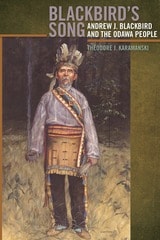
Blackbird's Song
Andrew J. Blackbird and the Odawa PeopleTheodore J. Karamanski
Michigan State University Press, 2012
For much of U.S. history, the story of native people has been written by historians and anthropologists relying on the often biased accounts of European-American observers. Though we have become well acquainted with war chiefs like Pontiac and Crazy Horse, it has been at the expense of better knowing civic-minded intellectuals like Andrew J. Blackbird, who sought in 1887 to give a voice to his people through his landmark book History of the Ottawa and Chippewa People. Blackbird chronicled the numerous ways in which these Great Lakes people fought to retain their land and culture, first with military resistance and later by claiming the tools of citizenship. This stirring account reflects on the lived experience of the Odawa people and the work of one of their greatest advocates.
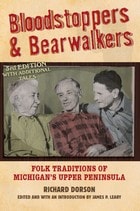
Bloodstoppers and Bearwalkers
Folk Traditions of Michigan’s Upper PeninsulaRichard M. Dorson
University of Wisconsin Press, 2008

Blues in Black and White
The Landmark Ann Arbor Blues FestivalsAs photographed by Stanley Livingston with Text and a History of the Ann Arbor Blues Festival by Michael Erlewine
University of Michigan Press, 2010
"This was really the first time that blues music, especially Chicago/urban blues, was showcased in this way. Sadly, the festivals were not recorded professionally. So Mr. Livingston's photos are the best record of the festivals."
---Michael Jewett, longtime weekday afternoon host of 89.1 Jazz and host of "Blues & Some Uthuh Stuff"
"The photos are works of art. It is great to see photos of musicians such as Buddy Guy and James Cotton looking so young and vibrant. And it is great to see photos of blues legends such as John Lee Hooker, Roosevelt Sykes, Howlin' Wolf, and Son House, who have long since passed away."
---Peter Madcat Ruth, Grammy-winning blues harmonica player
"If Woodstock was one of the Fifty Moments That Changed Rock 'n' Roll History, as honored in Rolling Stone magazine, then the Ann Arbor Blues Festival was the coronation for the blues roots that sired rock to begin with. . . . finally we have this amazing book of Stanley Livingston's priceless images, along with Michael Erlewine's detailed chronology."
---From the foreword by Jim O'Neal, Cofounder, Living Blues Magazine
In 1969 and 1970, the first Ann Arbor Blues Festivals brought together the greatest-ever selection of blues performers---an enormous blues party that seemed to feature every big name in the world of blues.
The Ann Arbor Blues Festival was just that: a festival and celebration of city blues. It helped to mark the discovery of modern blues music (and the musicians who made that music) by a much larger audience. The festival, however, was something more than just a white audience discovering black music.
Never before had such a far-reaching list of performers been assembled, including the grandfathers of southern country blues and the hottest electric bands from Chicago. These groundbreaking festivals were the seed that grew into the Ann Arbor Blues and Jazz Festival, which was continued annually for many years. To name just a few of the dozens of artists who performed at the festival: Luther Allison, John Lee Hooker, Howlin' Wolf, B.B. King, Muddy Waters, Otis Rush, Hound Dog Taylor, Big Mama Thorton, T-Bone Walker, Sippie Wallace, Junior Wells, and Mighty Joe Young.
Stanley Livingston, a professional photographer from Ann Arbor, captured these legendary performances onstage---as well as the goings-on backstage. Livingston's thousands of photographs from these festivals, previously unpublished and known only to a few, are among the finest candid blues shots ever taken. Together with editor and archivist Michael Erlewine's text accompaniments, these photographs, reproduced here as high-quality duotones, comprise a visual history and important keepsake for blues aficionados everywhere.
Stanley Livingston was an award-winning photographer living and working in Ann Arbor until he passed away in 2010, after the book was released.
Michael Erlewine, also from Ann Arbor, is a renowned archivist of popular culture and founder of the All-Music Guide (allmusic.com) and editor of a number of books on blues and jazz.
Cover photo of B.B. King by Stanley Livingston

Borne of the Wind
Michigan Sand DunesDennis A. Albert
University of Michigan Press, 2006
Borne of the Wind describes the environmental factors necessary for dune creation in an easy-to-understand format, introducing readers to the rich ecology of Michigan's dunes. Each of the distinct types of dunes encountered along the Great Lakes shoreline is explained and illustrated with color photographs and line drawings, while color photographs of the plants and animals found in duneland areas complement the story of these fragile, ever-changing landscapes.
For scholars and enthusiasts alike, Borne of the Wind provides a comprehensive and colorful introduction to one of our finest yet least-understood natural features.
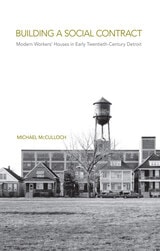
Building a Social Contract
Modern Workers' Houses in Early-Twentieth Century DetroitMcCulloch, Michael
Temple University Press, 2023
Through oral histories, letters, photographs, and period fiction, McCulloch traces wage earners’ agency in negotiating a new implicit social contract, one that rewarded hard work with upward mobility in modern houses. This promise reflected workers’ increased bargaining power but, at the same time, left them increasingly vulnerable to layoffs.
Building a Social Contract focuses on Detroit, the quintessential city of the era, where migrant workers came and were Americanized, and real estate agents and the speculative housebuilding industry thrived. The Motor City epitomized the struggle of Black workers in this period, who sought better lives through industrial labor but struggled to translate their wages into housing security amid racist segregation and violence. When Depression-era unemployment created an eviction crisis, the social contract unraveled, and workers rose up—at the polls and in the streets—to create a labor movement that reshaped American capitalism for decades.
Today, the lessons McCulloch provides from early twentieth-century Detroit are a necessary reminder that wages are not enough, and only working-class political power can secure affordable housing.

Butch Queens Up in Pumps
Gender, Performance, and Ballroom Culture in DetroitMarlon M. Bailey
University of Michigan Press, 2013
Butch Queens Up in Pumpsexamines Ballroom culture, in which inner-city LGBT individuals dress, dance, and vogue to compete for prizes and trophies. Participants are affiliated with a house, an alternative family structure typically named after haute couture designers and providing support to this diverse community. Marlon M. Bailey’s rich first-person performance ethnography of the Ballroom scene in Detroit examines Ballroom as a queer cultural formation that upsets dominant notions of gender, sexuality, kinship, and community.