Results by title
683 books match the query 'Middle East' and 35 start with b
Babylonian Chronographic Texts from the Hellenistic Period
R. J. van der Spek
SBL Press, 2025
Bad Girls of the Arab World
Edited by Nadia Yaqub and Rula Quawas
University of Texas Press, 2017
Women’s transgressive behaviors and perspectives are challenging societal norms in the Arab world, giving rise to anxiety and public debate. Simultaneously, however, other Arab women are unwillingly finding themselves labeled “bad” as authority figures attempt to redirect scrutiny from serious social ills such as patriarchy and economic exploitation, or as they impose new restrictions on women’s behavior in response to uncertainty and change in society. Bad Girls of the Arab World elucidates how both intentional and unintentional transgressions make manifest the social and cultural constructs that define proper and improper behavior, as well as the social and political policing of gender, racial, and class divisions.
The works collected here address the experiences of women from a range of ages, classes, and educational backgrounds who live in the Arab world and beyond. They include short pieces in which the women themselves reflect on their experiences with transgression; academic articles about performance, representation, activism, history, and social conditions; an artistic intervention; and afterwords by the acclaimed novelists Laila al-Atrash and Miral al-Tahawy. The book demonstrates that women’s transgression is both an agent and a symptom of change, a site of both resistance and repression. Showing how transnational forces such as media discourses, mobility and confinement, globalization, and neoliberalism, as well as the legacy of colonialism, shape women’s badness, Bad Girls of the Arab World offers a rich portrait of women’s varied experiences at the boundaries of propriety in the twenty-first century.
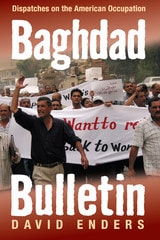
Baghdad Bulletin
Dispatches on the American OccupationDavid Enders
University of Michigan Press, 2009
-Joe Sacco, author of Safe Area Gorazde
"Baghdad Bulletin takes us where mainstream news accounts do not go. Disrupting the easy clichés that dominate U.S. journalism, Enders blows away the media fog of war. The result is a book that challenges Americans to see through double speak and reconsider the warfare being conducted in their names."
-Norman Solomon, author of War Made Easy: How Presidents and Pundits Keep Spinning Us to Death
"Journalism at its finest and on a shoestring to boot. David Enders shows that courage and honesty can outshine big-budget mainstream media. Wry but self-critical, Baghdad Bulletin tells a story that a few of us experienced but every journalist, nay every citizen, should read."
-Pratap Chatterjee, Managing Editor and Project Director, CorpWatch
"Young and tenacious, Dave Enders went, saw, and wrote it down. Here it is-a well-informed and detailed tale of Iraq's decline under American rule. Baghdad Bulletin offers tragic politics, wacky people, and keen insights about what really matters on the ground in Iraq."
-Christian Parenti
"I wrote my first piece for Baghdad Bulletin after visiting the mass graves at Al-Hilla in 2003. The Baghdad Bulletin was essential reading in the first few months after the end of the war. I handed that particular copy to Prime Minister Tony Blair. I am only sorry that I cannot read it anymore. David Enders and his team were brave, enterprising, and idealistic."
-Rt. Hon. Ann Clwyd, member of the British Parliament
Baghdad Bulletin is a street-level account of the war and turbulent postwar period as seen through the eyes of the young independent journalist David Enders. The book recounts Enders's story of his decision to go to Iraq, where he opened the only English-language newspaper completely written, printed, and distributed there during the war.
Young, courageous, and anti-authoritarian, Enders is the first reporter to cover the war as experienced by ordinary Iraqis. Deprived of the press credentials that gave his embedded colleagues access to press conferences and officially sanitized information, Enders tells the story of a different war, outside the Green Zone. It is a story in which the struggle of everyday life is interspersed with moments of sheer terror and bizarre absurdity: wired American troops train their guns on terrified civilians; Iraqi musicians prepare a recital for Coalition officials who never show; traveling clowns wreak havoc in a Baghdad police station.
Orphans and intellectuals, activists and insurgents: Baghdad Bulletin depicts the unseen complexity of Iraqi society and gives us a powerful glimpse of a new kind of warfare, one that coexists with-and sometimes tragically veers into-the everyday rhythms of life.
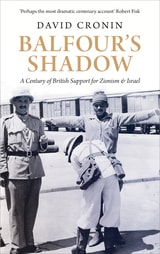
Balfour's Shadow
A Century of British Support for Zionism and IsraelDavid Cronin
Pluto Press, 2017
This is the infamous Balfour Declaration, which began one hundred years of conflict with the Palestinian people. Penned in 1917 by British Foreign Secretary Arthur James Balfour, these words had an immense impact on history that still emanates a century later. In the controversial, fast-paced Balfour’s Shadow, David Cronin traces the story of the rhetorical and practical assistance that Britain has given to the Zionist movement and the state of Israel since that day. Skillfully and engagingly written, Balfour’s Shadow uses previously unreleased sources and archives to reveal a new side to an old story. Cronin focuses on important historical events such as the Arab Revolt, the Nakba and establishment of the state, the ‘56 and ‘67 wars, the Cold War, and controversial public figures like Tony Blair. Marking the 100th anniversary of the Balfour Declaration, Cronin provides a fascinating take on this oft-maligned, important history.
Battling over the Balkans
Historiographical Questions and ControversiesJohn R. Lampe
Central European University Press, 2020
Beaches, Ruins, Resorts
The Politics of Tourism in the Arab WorldWaleed Hazbun
University of Minnesota Press, 2008
How Arab states use tourism for their own ends
Despite being viewed as a dangerous region to visit, leisure travel across the Middle East has thrived even in the post–9/11 era. In Beaches, Ruins, Resorts, Waleed Hazbun investigates this overlooked industry to show how tourism is shaping the economic development and international relations of the region in dramatic ways.
Following Europeans seeking Mediterranean beaches, Israelis crossing into Jordan as leisure tourists, and visitors discovering Dubai, Hazbun offers an original perspective on the Middle East and North Africa and challenges common portrayals of Arab nations as disconnected from the rest of the world. Rather, Hazbun reveals how government elites are using tourism to take part in globalization while, at the same time, crafting it to serve state interests. Paradoxically, the expansion of travel in the region has allowed states to encourage integration into the global economy while simultaneously expanding control over their society. Beaches, Ruins, Resorts also explores tourism’s broader beneficial effects on the region, such as aiding the peace process between Israel and Jordan, fostering Tunisia’s economic connection with Europe, and transforming Arab cities into hubs of international travel.Hazbun tells the new and surprising story of how the draw of glittering beaches, luxury hotels and resorts, and sightseeing at ancient ruins impacts the Arab world—promoting both economic globalization and political authoritarianism. In doing so, Beaches, Ruins, Resorts provides a much-needed guide for those interested in the changing nature of this fraught region and its place in the world.
Becoming American
The Early Arab Immigrant ExperienceAlixa Naff
Southern Illinois University Press, 1993
A unique study in American immigration and assimilation history that also provides a special view of one of the smaller ethnic groups in American society.
Naff focuses on the pre-World War I pioneering generation of Arabic-speaking immigrants, the generation that set the patterns for settlement and assimilation. Unlike many immigrants who were drawn to the United States by dreams of industrial jobs or to escape religious or economic persecution, most of these artisans and owners of small, disconnected plots of land came to America to engage in the enterprise of peddling. Most planned to stay two or three years and return to their homelands.
Becoming Israeli
National Ideals and Everyday Life in the 1950sAnat Helman
Brandeis University Press, 2014
Before Homosexuality in the Arab-Islamic World, 1500-1800
Khaled El-Rouayheb
University of Chicago Press, 2005
Attitudes toward homosexuality in the pre-modern Arab-Islamic world are commonly depicted as schizophrenic—visible and tolerated on one hand, prohibited by Islam on the other. Khaled El-Rouayheb argues that this apparent paradox is based on the anachronistic assumption that homosexuality is a timeless, self-evident fact to which a particular culture reacts with some degree of tolerance or intolerance. Drawing on poetry, biographical literature, medicine, dream interpretation, and Islamic texts, he shows that the culture of the period lacked the concept of homosexuality.
Before Writing, Vol. I
From Counting to CuneiformBy Denise Schmandt-Besserat
University of Texas Press, 1992
A fascinating book on the origins of writing.
Before Writing gives a new perspective on the evolution of communication. It points out that when writing began in Mesopotamia it was not, as previously thought, a sudden and spontaneous invention. Instead, it was the outgrowth of many thousands of years' worth of experience at manipulating symbols.
In Volume I: From Counting to Cuneiform, Denise Schmandt-Besserat describes how in about 8000 B.C., coinciding with the rise of agriculture, a system of counters, or tokens, appeared in the Near East. These tokens—small, geometrically shaped objects made of clay—represented various units of goods and were used to count and account for them. The token system was a breakthrough in data processing and communication that ultimately led to the invention of writing about 3100 B.C. Through a study of archaeological and epigraphic evidence, Schmandt-Besserat traces how the Sumerian cuneiform script, the first writing system, emerged from a counting device.
In Volume II: A Catalog of Near Eastern Tokens, Schmandt-Besserat presents the primary data on which she bases her theories. These data consist of several thousand tokens, catalogued by country, archaeological site, and token types and subtypes. The information also includes the chronology, stratigraphy, museum ownership, accession or field number, references to previous publications, material, and size of the artifacts. Line drawings and photographs illustrate the various token types.
Before Writing, Vol. II
A Catalog of Near Eastern TokensBy Denise Schmandt-Besserat
University of Texas Press, 1992
Before Writing gives a new perspective on the evolution of communication. It points out that when writing began in Mesopotamia it was not, as previously thought, a sudden and spontaneous invention. Instead, it was the outgrowth of many thousands of years' worth of experience at manipulating symbols.
In Volume I: From Counting to Cuneiform, Denise Schmandt-Besserat describes how in about 8000 B.C., coinciding with the rise of agriculture, a system of counters, or tokens, appeared in the Near East. These tokens—small, geometrically shaped objects made of clay—represented various units of goods and were used to count and account for them. The token system was a breakthrough in data processing and communication that ultimately led to the invention of writing about 3100 B.C. Through a study of archaeological and epigraphic evidence, Schmandt-Besserat traces how the Sumerian cuneiform script, the first writing system, emerged from a counting device.
In Volume II: A Catalog of Near Eastern Tokens, Schmandt-Besserat presents the primary data on which she bases her theories. These data consist of several thousand tokens, catalogued by country, archaeological site, and token types and subtypes. The information also includes the chronology, stratigraphy, museum ownership, accession or field number, references to previous publications, material, and size of the artifacts. Line drawings and photographs illustrate the various token types.
Behind the Veil in Arabia
Women in OmanUnni Wikan
University of Chicago Press, 1991
"Wikan does provide insights into the real position of these secluded and segregated women. . . . All this is interesting and valuable."—Ahdaf Soueif, Times Literary Supplement
"The book is detailed, insightful, and . . . engrossing. Anyone interested in the day-to-day triumphs and sorrows of women who live 'behind the veil' will want to read this account."—Arab Book World
"Wikan, a fine ethnographer, has an eye for everything that is distinctive about the culture and . . . builds up a wholly convincing picture. Above all, there is a sustained attempt to penetrate the inner lives of these strangely serene people."—Frank H. Stewart, Wilson Quarterly
"This book will certainly be of interest to all scholars concerned with sexual identity in the Islamic world."—Henry Munson, American Anthropologist
Belated Travelers
Orientalism in the Age of Colonial DissolutionAli Behdad
Duke University Press, 1994
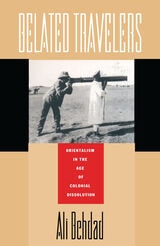
Through readings of Flaubert, Nerval, Kipling, Blunt, and Eberhardt, and following the transition in travel literature from travelog to tourist guide, Belated Travelers addresses the specific historical conditions of late nineteenth-century orientalism implicated in the discourses of desire and power. Behdad also views a broad range of issues in addition to nostalgia and tourism, including transvestism and melancholia, to specifically demonstrate the ways in which the heterogeneity of orientalism and the plurality of its practice is an enabling force in the production and transformation of colonial power.
An exceptional work that provides an important critique of issues at the forefront of critical practice today, Belated Travelers will be eagerly awaited by specialists in nineteenth-century British and French literatures, and all concerned with colonial and postcolonial discourse.
Between Banat
Queer Arab Critique and Transnational Arab ArchivesMejdulene Bernard Shomali
Duke University Press, 2023
Between Dixie and Zion
Southern Baptists and Palestine before IsraelWalker Robins
University of Alabama Press, 2020
Explores the roots of evangelical Christian support for Israel through an examination of the Southern Baptist Convention
One week after the establishment of the State of Israel in 1948, delegates to the Southern Baptist Convention (SBC) repeatedly and overwhelmingly voted down resolutions congratulating fellow Southern Baptist Harry Truman on his role in Israel’s creation. From today’s perspective, this seems like a shocking result. After all, Christians—particularly the white evangelical Protestants who populate the SBC—are now the largest pro-Israel constituency in the United States. How could conservative evangelicals have been so hesitant in celebrating Israel’s birth in 1948? How did they then come to be so supportive?
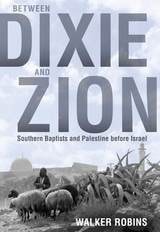
Between Dixie and Zion: Southern Baptists and Palestine before Israel addresses these issues by exploring how Southern Baptists engaged what was called the “Palestine question”: whether Jews or Arabs would, or should, control the Holy Land after World War I. Walker Robins argues that, in the decades leading up to the creation of Israel, most Southern Baptists did not directly engage the Palestine question politically. Rather, they engaged it indirectly through a variety of encounters with the land, the peoples, and the politics of Palestine. Among the instrumental figures featured by Robins are tourists, foreign missionaries, Arab pastors, converts from Judaism, biblical interpreters, fundamentalist rebels, editorialists, and, of course, even a president. While all revered Palestine as the Holy Land, each approached and encountered the region according to their own priorities.
Nevertheless, Robins shows that Baptists consistently looked at the region through an Orientalist framework, broadly associating the Zionist movement with Western civilization, modernity, and progress over and against the Arabs, whom they viewed as uncivilized, premodern, and backward. He argues that such impressions were not idle—they suggested that the Zionists were bringing to fruition Baptists’ long-expressed hopes that Israel would regain the prosperity it had held in the biblical era, the Holy Land would one day be revived, and biblical prophecies preceding the return of Christ would be fulfilled.
Between Home and Homeland
Youth Aliyah from Nazi GermanyBrian Amkraut
University of Alabama Press, 2006
As Hitler consolidated power, Jews and their allies in Germany began efforts to leave the country. Among them was the organization, Youth Aliyah. Based on abundant archival sources and a thorough use of secondary literature, Brian Amkraut details the story of the organization from its origins through its alliances and antagonisms with other Jewish organizations, and the challenges that vexed its efforts from every side, perhaps the greatest being sheer human naiveté ("surely things will get better").
Amkraut also discusses the identity dilemma for Jews who grew up feeling German, and then had to alter their self-image in the face of growing discrimination. He highlights the internal disagreements of Jewish agencies who wrestled with myriad problems. The author explores how German Jews were ideologically heterogeneous, and details how different groups coped with increasing antagonism in a variety of ways.
To this day, Youth Aliyah is considered by Israelis as a major contributor to the foundation of a Jewish presence leading to the modern state of Israel. Between Home and Homeland is an essential account of an important episode in the history of the Holocaust and the founding of the Isreali state.

Between Jaffa and Tel Aviv, 1870–1930
A MemoirYosef Eliyahu Chelouche
Brandeis University Press, 2025
Born in Jaffa in 1870, Yosef Eliyahu Chelouche grew up within a notable Sephardi family in the local Jewish community. He went on to become a prominent entrepreneur; a founder of Tel Aviv; and a fierce critic of the Ashkenazi Zionist leadership, Arab nationalism, and British colonial sectarianism; before emerging, in the last decade of his life, as an anguished public figure struggling to repair Arab-Jewish relations.
His memoir paints an intimate portrait of life in Palestine at the turn of the twentieth century, told from the perspective of a Middle Eastern Jew deeply embedded in local society. By centering on the world and experiences of a native Jew who was an eyewitness to and participant in the unfolding conflict in Palestine, this book shows how the course of Zionist politics and Jewish-Arab relations in pre-state Palestine might have taken alternative pathways. A comprehensive introduction sets the scene in late nineteenth- and early twentieth-century Jaffa and thoughtful annotations contextualize Chelouche’s story within the modern history of Palestine and Israel. Between Jaffa and Tel Aviv, 1870–1930 tells the fascinating story of a civic leader—and offers a complex view of the various cultural, social, and political forces that forged multilayered Jewish identities in the Middle East. The book includes a family tree and is illustrated with photographs of the family and scenes of Jaffa and early Tel Aviv.
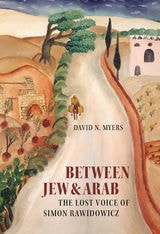
Between Jew and Arab
The Lost Voice of Simon RawidowiczDavid N. Myers
Brandeis University Press, 2009
Between the Middle East and the Americas
The Cultural Politics of DiasporaEdited by Evelyn Alsultany and Ella Shohat
University of Michigan Press, 2013
Between the Middle East and the Americas: The Cultural Politics of Diaspora traces the production and circulation of discourses about "the Middle East" across various cultural sites, against the historical backdrop of cross-Atlantic Mahjar flows. The book highlights the fraught and ambivalent situation of Arabs/Muslims in the Americas, where they are at once celebrated and demonized, integrated and marginalized, simultaneously invisible and spectacularly visible. The essays cover such themes as Arab hip-hop's transnational imaginary; gender/sexuality and the Muslim digital diaspora; patriotic drama and the media's War on Terror; the global negotiation of the Prophet Mohammad cartoons controversy; the Latin American paradoxes of Turcophobia/Turcophilia; the ambiguities of the bellydancing fad; French and American commodification of Rumi spirituality; the reception of Iranian memoirs as cultural domestication; and the politics of translation of Turkish novels into English. Taken together, the essays analyze the hegemonic discourses that position "the Middle East" as a consumable exoticized object, while also developing complex understandings of self-representation in literature, cinema/TV, music, performance, visual culture, and digital spaces. Charting the shifting significations of differing and overlapping forms of Orientalism, the volume addresses Middle Eastern diasporic practices from a transnational perspective that brings postcolonial cultural studies methods to bear on Arab American studies, Middle Eastern studies, and Latin American studies. Between the Middle East and the Americas disentangles the conventional separation of regions, moving beyond the binarist notion of "here" and "there" to imaginatively reveal the thorough interconnectedness of cultural geographies.
Beyond Babel
A Handbook for Biblical Hebrew and Related LanguagesJohn Kaltner
SBL Press, 2002
Beyond Babel provides a general introduction to and overview of the languages that are significant for the study of the Hebrew Bible and ancient Israel. Included are essays on biblical and inscriptional Hebrew, Akkadian, Northwest Semitic dialects (Ammonite, Edomite, and Moabite), Arabic, Aramaic, Egyptian, Hittite, Phoenician, postbiblical Hebrew, and Ugaritic.
Each chapter in the volume shares a common format, including an overview of the language, a discussion of its significance for the Hebrew Bible, and a list of ancient sources and modern resources for further study of the language. A general introduction by John Huehnergard discusses the importance of the study of Near Eastern languages for biblical scholarship, helping to make the volume an ideal resource for persons beginning an in-depth study of the Hebrew Bible.
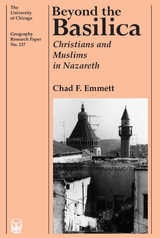
Beyond the Basilica
Christians and Muslims in NazarethChad F. Emmett
University of Chicago Press, 1994
Emmett describes both the positive and negative effects of Nazareth’s residential patterns. He shows that the addition of new and ethnically mixed quarters has promoted mixed schools, joint holiday celebrations, a common political culture, and social networks that cross ethnic boundaries. But he also finds that tensions exist among Christian groups and between Muslims and Christians in regard to intersectarian marriages, religious conversion, attempts to establish a joint Christian cemetery, and the emergence of a local Islamic party.
Extensive interviews with leaders of religious groups, political parties, and residents reveal the way in which members of each ethnic community perceive one another. A survey of 300 families gives a wealth of details about the make-up of Nazareth’s population, including residential histories, religion, level of religious conviction, friendship and shopping patterns, and much more. Fourteen maps trace changes in the distribution of religious groups and political affiliation in Nazareth from the mid-nineteenth century to the present.
Beyond the Basilica will interest cultural geographers, historians, demographers, political scientists, and anyone who would like to learn more about an ethnically divided community in the residents cooperate more than they fight.
Beyond the Wall
Writing a Path through PalestineBidisha
Seagull Books, 2025
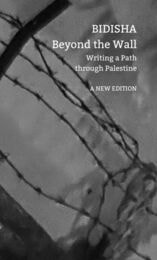
Their voices come from Bethlehem and Hebron. You can hear them from Jerusalem to Nazareth, and witness their protests in Gaza and Ramallah. From the refugee camps in the West Bank, you can hear the voices of the Palestinian people call out to demand self-determination and a better quality of life. But outside of Israel and the occupied territories, these individual voices are rarely heard—until now.
In Beyond the Wall: Writing a Path through Palestine, internationally renowned feminist critic and writer Bidisha collects the testimonies of an occupied people—ordinary citizens, activists, and children—alongside those of international aid workers and foreign visitors for a revelatory look at a population on the margins.
Called “beautifully belligerent, [and] fiercely intelligent” by The Independent and a “dazzlingly creative writer” by the London Times, Bidisha amplifies the voices of the Palestinian people in this book and lends them her own considerable strength.

Biographies in the Global South
Life Stories Embedded in Figurations and DiscoursesEdited by Gabriele Rosenthal and Artur Bogner
Campus Verlag, 2017
Black September to Desert Storm
A Journalist in the Middle EastClaude Salhani
University of Missouri Press, 1998
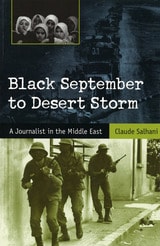
For more than twenty years, Claude Salhani traveled throughout the volatile Middle East as a photojournalist and reporter in search of the region's biggest stories. Wars, terrorist acts, demonstrations by religious extremists, and the flight of refugees were among the events he witnessed. "I have seen much through my lens . . . the most terrible cruelties, the most horrible suffering—and the most improbable and moving acts of love and generosity. I have been warmly received by kings, prime ministers, and secretaries of state. I have been shot at, kidnapped, and rifle-butted," writes Salhani in the prologue of this fascinating account.
From exclusive travels with former U.S. Secretary of State Henry Kissinger to intimate moments with combatants in the battle for Beirut to the forbidden world of drug smugglers in Lebanon, to the Iranian Revolution, and finally to the rise of Desert Storm, Salhani transports readers behind the scenes of many groundbreaking news stories. He proves that behind the front-page story we see, an equally intriguing tale is often hidden—that of the difficult, bizarre, even comical circumstances in which news is obtained.
Offering insight into the potent mixture of journalism and warfare, Black September to Desert Storm shares with readers an extraordinary journey into the headline-grabbing sagas that have plagued the Middle East in the last three decades. Salhani's "behind-the-lens" perspective will appeal to students of journalism and the Middle East, as well as anyone simply fascinated by the trials that many journalists undergo to capture "The Story."
Bordering on War
A Social and Political History of KhuzestanShaherzad Ahmadi
University of Texas Press, 2024
A study of transnational identity, migration, and state loyalties told through the social and political history of Iran’s Khuzestan province.
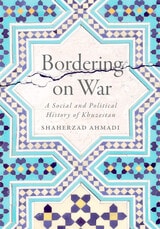
In 1980, Saddam Hussein’s Ba‘athist forces invaded Khuzestan, one of the oldest and richest provinces in Iran, triggering the Iran-Iraq War. Shaherzad Ahmadi’s Bordering on War examines the social history of Khuzestan and sheds light on how border dwellers, provincial leaders, and migrants in the region shaped Iran and Iraq's history before, during, and after the war.
Drawing from a rich collection of Persian- and Arabic-language archival sources—rarely used by western scholars due to restrictions in Iran—Ahmadi’s research focuses on Arab Iranians and argues that Iranian border dwellers and migrants formed local, non-national loyalties, thereby eschewing bureaucratic pressures to confine loyalties to a single nation-state. The transnational character and ethnically diverse composition of Khuzestan, especially in the oil-rich towns on the southwestern border, led many, including Iraq’s Ba‘ath Party, to question the national belonging of Arab Iranians. Bordering on War contributes to a wider discussion about the ability of individuals and communities to exert agency through migration, trade, education, and other activities.
Borders of Belief
Religious Nationalism and the Formation of Identity in Ireland and TurkeyGregory J. Goalwin
Rutgers University Press, 2022
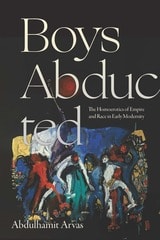
Boys Abducted
The Homoerotics of Empire and Race in Early ModernityAbdulhamit Arvas
Duke University Press, 2025
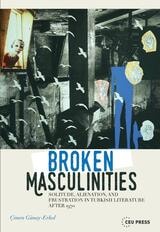
Broken Masculinities
Solitude, Alienation, and Frustration in Turkish Literature after 1970Cimen Günay-Erkol
Central European University Press, 2016
Broken Masculinities portrays the post-dictatorial novel of the 1970s in all its complexity, and introduces the reader to a 1968-era Turkey, a period which challenges Turkey’s now reinforced Islamic image by portraying the quest for sexual liberation and critical student uprisings. Günay-Erkol argues that the literature written after the 1971 coup in Turkey constitutes a coherent sub-genre and needs to be considered together. These novels share a common ground which is rich in images of men and women craving for power: general isolation, sexual-emotional frustration, and a traumatic sense of solitude and alienation.
This book is an original and significant contribution to two major fields of study: (1) gender and sexuality with respect to formation of subjectivity through literature, and (2) modern literature and history through the study of Turkish literature. The chief concern in this book is not only literature’s response to a particular period in Turkey, but also the role of literature in bearing witness to trauma and drastic political acts of violence—and coming to terms with them.B
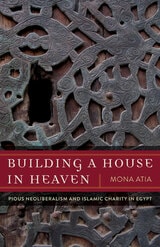
Building a House in Heaven
Pious Neoliberalism and Islamic Charity in EgyptMona Atia
University of Minnesota Press, 2013
Charity is an economic act. This premise underlies a societal transformation—the merging of religious and capitalist impulses that Mona Atia calls “pious neoliberalism.” Though the phenomenon spans religious lines, Atia makes the connection between Islam and capitalism to examine the surprising relations between charity and the economy, the state, and religion in the transition from Mubarak-era Egypt.
Mapping the landscape of charity and development in Egypt, Building a House in Heaven reveals the factors that changed the nature of Egyptian charitable practices—the state’s intervention in social care and religion, an Islamic revival, intensified economic pressures on the poor, and the subsequent emergence of the private sector as a critical actor in development. She shows how, when individuals from Egypt’s private sector felt it necessary to address poverty, they sought to make Islamic charities work as engines of development, a practice that changed the function of charity from distributing goods to empowering the poor. Drawing on interviews with key players, Atia explores the geography of Islamic charities through multiple neighborhoods, ideologies, sources of funding, projects, and wide social networks. Her work shifts between absorbing ethnographic stories of specific organizations and reflections on the patterns that appear across the sector.
An enlightening look at the simultaneous neoliberalization of Islamic charity work and Islamization of neoliberal development, the book also offers an insightful analysis of the political and socioeconomic movements leading up to the uprisings that ended Mubarak’s rule and that amplified the importance of not only the Muslim Brotherhood but also the broader forces of Islamic piety and charity.
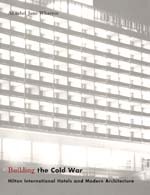
Building the Cold War
Hilton International Hotels and Modern ArchitectureAnnabel Jane Wharton
University of Chicago Press, 2001
Building the Cold War examines the architectural means by which the Hilton was written into the urban topographies of the major cities of Europe and the Middle East as an effective representation of the United States. Between 1953 and 1966, Hilton International built sixteen luxury hotels abroad. Often the Hilton was the first significant modern structure in the host city, as well as its finest hotel. The Hiltons introduced a striking visual contrast to the traditional architectural forms of such cities as Istanbul, Cairo, Athens, and Jerusalem, where the impact of its new architecture was amplified by the hotel's unprecedented siting and scale. Even in cities familiar with the Modern, the new Hilton often dominated the urban landscape with its height, changing the look of the city. The London Hilton on Park Lane, for example, was the first structure in London that was higher than St. Paul's cathedral.
In his autobiography, Conrad N. Hilton claimed that these hotels were constructed for profit and for political impact: "an integral part of my dream was to show the countries most exposed to Communism the other side of the coin—the fruits of the free world." Exploring everything the carefully drafted contracts for the buildings to the remarkable visual and social impact on their host cities, Wharton offers a theoretically sophisticated critique of one of the Cold War's first international businesses and demonstrates that the Hilton's role in the struggle against Communism was, as Conrad Hilton declared, significant, though in ways that he could not have imagined.
Many of these postwar Hiltons still flourish. Those who stay in them will learn a great deal about their experience from this new assessment of hotel space.

Bullets in Envelopes
Iraqi Academics in ExileLouis Yako
Pluto Press, 2021
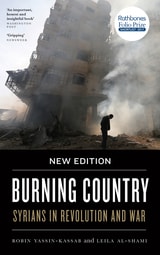
Burning Country
Syrians in Revolution and WarRobin Yassin-Kassab and Leila Al-Shami
Pluto Press, 2018
Burning Country explores the complicated reality of life in present-day Syria with unprecedented detail and sophistication, drawing on new firsthand testimonies from opposition fighters, exiles lost in an archipelago of refugee camps, and courageous human rights activists. Robin Yassin-Kassab and Leila Al-Shami expertly interweave these stories with an incisive analysis of the militarization of the uprising, the rise of the Islamists and sectarian warfare, and the role of Syria’s government in exacerbating the brutalization of the conflict. Through these accounts and a broad range of secondary source material, the authors persuasively argue that the international community has failed in its stated commitments to support the Syrian opposition movements.
This new edition brings the story up to the present, with a new chapter that covers the internationalization of the conflict, including interventions by the United States, Russia, and Iran; the rollback of ISIS; the fall of Daraya and Aleppo; the crushing of local democracy; sectarian cleansing; and the forced exile of millions of Syrians.
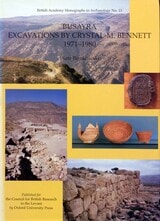
Busayra excavations by Crystal-M. Bennett, 1971-1980
Piotr Bienkowski
Council for British Research in the Levant, 2002
Library of Congress subject headings for this publication:
Busayra Site (Bu�sayr�a, Jordan)
Excavations (Archaeology) -- Jordan -- Bu�sayr�a.
Iron age -- Jordan -- Bu�sayr�a.