Results by title
188 books match the query 'Middle Eastern' and 12 start with b
Being Human
Political Modernity and Hospitality in Kurdistan-IraqFazil Moradi
Rutgers University Press, 2024
Between Military Rule and Democracy
Regime Consolidation in Greece, Turkey, and BeyondYaprak Gürsoy
University of Michigan Press, 2017
Based on more than 150 interviews with Greek and Turkish elites, Gürsoy offers a detailed analysis of both countries from the interwar period to recent regime crises. She argues that officers, politicians, and businesspeople prefer democracy, authoritarianism, or short-lived coups depending on the degree of threat they perceive to their interests from each other and the lower classes. The power of elites relative to the opposition, determined in part by the coalitions they establish with each other, affects the success of military interventions and the consolidation of regimes.
With historical and theoretical depth, Between Military Rule and Democracy will interest students of regime change and civil-military relations in Greece, Turkey, Thailand, and Egypt, as well as in countries facing similar challenges to democratization.
Beyond Memory
An Anthology of Contemporary Arab American Creative NonfictionPauline Kaldas
University of Arkansas Press, 2020
Beyond the Wall
Writing a Path through PalestineBidisha
Seagull Books, 2025
Their voices come from Bethlehem and Hebron. You can hear them from Jerusalem to Nazareth, and witness their protests in Gaza and Ramallah. From the refugee camps in the West Bank, you can hear the voices of the Palestinian people call out to demand self-determination and a better quality of life. But outside of Israel and the occupied territories, these individual voices are rarely heard—until now.
In Beyond the Wall: Writing a Path through Palestine, internationally renowned feminist critic and writer Bidisha collects the testimonies of an occupied people—ordinary citizens, activists, and children—alongside those of international aid workers and foreign visitors for a revelatory look at a population on the margins.
Called “beautifully belligerent, [and] fiercely intelligent” by The Independent and a “dazzlingly creative writer” by the London Times, Bidisha amplifies the voices of the Palestinian people in this book and lends them her own considerable strength.
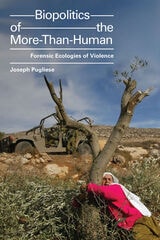
Biopolitics of the More-Than-Human
Forensic Ecologies of ViolenceJoseph Pugliese
Duke University Press, 2020
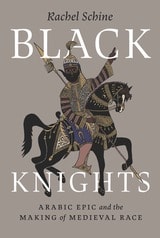
Black Knights
Arabic Epic and the Making of Medieval RaceRachel Schine
University of Chicago Press, 2024
In Black Knights, Rachel Schine reveals how the Arabic-speaking world developed a different form of racial knowledge than their European neighbors during the Middle Ages. Unlike in European vernaculars, Arabic-language ideas about ethnic difference emerged from conversations extending beyond the Mediterranean, from the Sahara to the Indian Ocean. In these discourses, Schine argues, racialized blackness became central to ideas about a global, ethnically inclusive Muslim world.
Schine traces the emergence of these new racial logics through popular Islamic epics, drawing on legal, medical, and religious literatures from the period to excavate a diverse and ever-changing conception of blackness and race. The result is a theoretically nuanced case for the existence and malleability of racial logics in premodern Islamic contexts across a variety of social and literary formations.
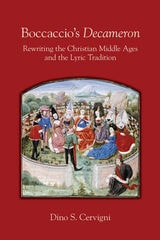
Boccaccio's "Decameron"
Rewriting the Christian Middle Ages and the Lyric TraditionDino S. Cervigni
Arizona Center for Medieval and Renaissance Studies, 2021
This study develops a new interpretation of The Decameron, Giovanni Boccaccio’s masterpiece, which has found new popularity in the wake of COVID. Dino S. Cervigni offers an inclusive and novel reading of the collection, theorizing that the first ninety tales offer a parodic rewriting of the Christian Middle Age, while the last ten tales craft a reconstruction of society based on human and liberal principles such as generosity and sacrifice.
Still relevant to this day, The Decameron offers a notable description of the bubonic plague of 1348 which devastated Western Europe—drawing striking parallels with the current global pandemic. Furthermore, Boccaccio’s concluding message applies to all of us in the present moment, plunged as we are into a world of intellectual and ethical chaos, exhorting us to practice forgiveness, compassion, tolerance, mutual acceptance, and generous open-mindedness. No other book on The Decameron offers such a relevant, up-to-date reading of the classic work.
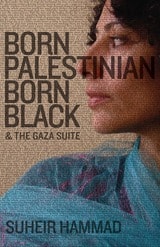
Born Palestinian, Born Black
& The Gaza SuiteSuheir Hammad
UpSet Press, 2012
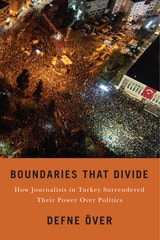
Boundaries That Divide
How Journalists in Turkey Surrendered Their Power over PoliticsDefne Över
Rutgers University Press, 2026
Turkey presents a striking example of the most recent wave of global authoritarian turns. The two-decade-long transition in the country’s political system also transformed its media environment. As mainstream journalists gradually yielded their places to sycophants, much more willing to praise the government in their news, the mainstream media that once oversaw—however imperfectly—political decisions started devoting its full service to cheerleading the government. Simultaneously, a new sphere of critical journalism began to emerge, with mainstream media journalists joining their fellows in the peripheries of the media. Considering the transformation of Turkey’s news media as the decay of a democratic institution, this book asks, How does the media break down under the rule of an elected government?
Drawing on fieldwork and in-depth interviews, the book traces the ruling AKP’s manipulation of social divides to consolidate power and journalists’ navigation of the resulting climate of fear, hope, doubt, and anger. The book shows how Turkey’s news media surrendered its power over politics as some journalists embraced disinformation as a path to heightened status, others turned to self-censorship for protection, and still others resisted capture through continuous but fragmented efforts.
The book portrays journalists as central actors in media decay, while also revealing that resilience to decay emerges where rising demand for “news” meets the contentious mobilization of journalists. Although focused on Turkey, the book’s insights extend far beyond, offering urgent lessons about the future of journalism in an age of populism, polarization, and institutional erosion.
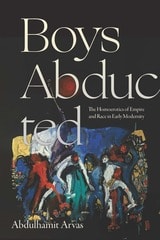
Boys Abducted
The Homoerotics of Empire and Race in Early ModernityAbdulhamit Arvas
Duke University Press, 2025
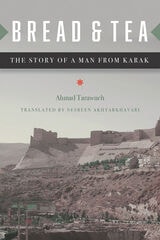
Bread and Tea
The Story of a Man from KarakAhmad Tarawneh
Michigan State University Press, 2017
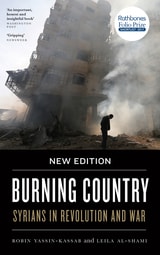
Burning Country
Syrians in Revolution and WarRobin Yassin-Kassab and Leila Al-Shami
Pluto Press, 2018
Burning Country explores the complicated reality of life in present-day Syria with unprecedented detail and sophistication, drawing on new firsthand testimonies from opposition fighters, exiles lost in an archipelago of refugee camps, and courageous human rights activists. Robin Yassin-Kassab and Leila Al-Shami expertly interweave these stories with an incisive analysis of the militarization of the uprising, the rise of the Islamists and sectarian warfare, and the role of Syria’s government in exacerbating the brutalization of the conflict. Through these accounts and a broad range of secondary source material, the authors persuasively argue that the international community has failed in its stated commitments to support the Syrian opposition movements.
This new edition brings the story up to the present, with a new chapter that covers the internationalization of the conflict, including interventions by the United States, Russia, and Iran; the rollback of ISIS; the fall of Daraya and Aleppo; the crushing of local democracy; sectarian cleansing; and the forced exile of millions of Syrians.