Results by title
2335 books match the query 'Modern' and 91 start with b
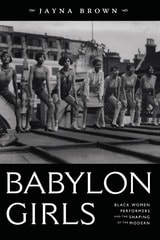
Babylon Girls
Black Women Performers and the Shaping of the ModernJayna Brown
Duke University Press, 2008
Investigating both well-known performers such as Ada Overton Walker and Josephine Baker and lesser-known artists such as Belle Davis and Valaida Snow, Brown weaves the histories of specific singers and dancers together with incisive theoretical insights. She describes the strange phenomenon of blackface performances by women, both black and white, and she considers how black expressive artists navigated racial segregation. Fronting the “picaninny choruses” of African American child performers who toured Britain and the Continent in the early 1900s, and singing and dancing in The Creole Show (1890), Darktown Follies (1913), and Shuffle Along (1921), black women variety-show performers of the early twentieth century paved the way for later generations of African American performers. Brown shows not only how these artists influenced transnational ideas of the modern woman but also how their artistry was an essential element in the development of jazz.

Backcountry War
The Rise of Francis Marion, Banastre Tarleton, and Thomas SumterAndrew Waters
Westholme Publishing, 2026
Over the past several decades, the history of the American Revolution in the South has undergone a transformation to better incorporate regional events into the greater narrative of the war. Among these events was the vicious “backcountry” war from the Georgia border, across the South Carolina wilderness, to the North Carolina Piedmont between rebel Americans and loyalist and British forces. Centered in South Carolina, this running battle saw some of the most intense and continuous fighting of the war, and from its skirmishes, feints, and sieges, three key leaders emerged: American partisans Francis “Swamp Fox” Marion and Thomas “Gamecock” Sumter, and British Legion commander Banastre “Bloody Ban” Tarleton.
For the first time, Backcountry War: The Rise of Francis Marion, Banastre Tarleton, and Thomas Sumter by Andrew Waters frames the history of these three men into in a single narrative, focusing on the events of 1780 in South Carolina that witnessed their collective ascendance from common soldiers to American legends. It was a time when British victories at Charleston and Camden left the Continental Army in tatters and the entire American South vulnerable to British conquest. Yet in those dark hours, Sumter, Marion, and others like them rose in the swamps and hills of the South Carolina wilderness. Fighting a wildly successful partisan war against better trained and better equipped British forces, including Tarleton’s British Legion, with victories at lesser-known places like Hanging Rock and Nelson’s Ferry, they gained precious months for the reorganizing Continental Army. Their collective efforts led to the stunning American victory at Cowpens and a stalemate at Guilford’s Courthouse the following year that finally convinced British general Charles Cornwallis to abandon the Carolinas for Virginia.
With background biographies of its three main protagonists, a thorough sketch of Great Britain’s Southern Strategy, and a sociocultural examination of the South Carolina frontier in the years leading up to the American Revolution, Backcountry War offers a fresh perspective on an extraordinary chapter of American history and a compelling account of the deadly contest between three of the war’s most charismatic leaders.
Backpack Ambassadors
How Youth Travel Integrated EuropeRichard Ivan Jobs
University of Chicago Press, 2017
From the Berlin Wall to the beaches of Spain, the Spanish Steps in Rome to the Pudding Shop in Istanbul, Jobs tells the stories of backpackers whose personal desire for freedom of movement brought the people and places of Europe into ever-closer contact. As greater and greater numbers of young people trekked around the continent, and a truly international youth culture began to emerge, the result was a Europe that, even in the midst of Cold War tensions, found its people more and more connected, their lives more and more integrated. Drawing on archival work in eight countries and five languages, and featuring trenchant commentary on the relevance of this period for contemporary concerns about borders and migration, Backpack Ambassadors brilliantly recreates a movement that was far more influential and important than its footsore travelers could ever have realized.

Bad Books
Rétif de la Bretonne, Sexuality, and PornographyAmy S. Wyngaard
University of Delaware Press, 2013
Published by University of Delaware Press. Distributed worldwide by Rutgers University Press.
Badiou and Politics
Bruno Bosteels
Duke University Press, 2011

Badiou
A Subject To TruthPeter Hallward
University of Minnesota Press, 2003
This book is the first comprehensive introduction to Badiou’s thought to appear in any language. Assuming no prior knowledge of his work, it provides a thorough and searching overview of all the main components of his philosophy, from its decisive political orientation through its startling equation of ontology with mathematics to its resolute engagement with its principal competition (from Wittgenstein, Heidegger, and Deleuze, among others). The book draws on all of Badiou’s published work and a wide sampling of his unpublished work in progress, along with six years of correspondence with the author.
Peter Hallward pays careful attention to the aspect of Badiou’s work most liable to intimidate readers in continental philosophy and critical theory: its crucial reliance on certain key developments in modern mathematics. Eschewing unnecessary technicalities, Hallward provides a highly readable discussion of each of the basic features of Badiou’s ontology, as well as his more recent account of appearance and “being-there.”
Without evading the difficulties, Peter Hallward demonstrates in detail and in depth why Badiou’s ongoing philosophical project should be recognized as the most resourceful and inspiring of his generation.
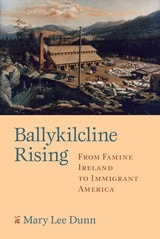
Ballykilcline Rising
From Famine Ireland to Immigrant AmericaMary Lee Dunn Maguire
University of Massachusetts Press, 2008
In 1847, in the third year of Ireland's Great Famine and the thirteenth year of their rent strike against the Crown, hundreds of tenant farmers in Ballykilcline, County Roscommon, were evicted by the Queen's agents and shipped to New York. Mary Lee Dunn tells their story in this meticulously researched book. Using numerous Irish and U.S. sources and with descendants' help, she traces dozens of the evictees to Rutland, Vermont, as railroads and marble quarries transformed the local economy. She follows the immigrants up to 1870 and learns not only what happened to them but also what light American experience and records cast on their Irish “rebellion.”
Dunn begins with Ireland's pre-Famine social and political landscape as context for the Ballykilcline strike. The tenants had rented earlier from the Mahons of Strokestown, whose former property now houses Ireland's Famine Museum. In 1847, landlord Denis Mahon evicted and sent nearly a thousand tenants to Quebec, where half died before or just after reaching the Grosse Ile quarantine station. Mahon was gunned down months later. His murder provoked an international controversy involving the Vatican. An early suspect in the case was a man from Ballykilcline.
In the United States, many of the immigrants resettled in clusters in several locations, including Vermont, Illinois, Iowa, Maryland, and New York. In Vermont they found jobs in the marble quarries, but some of them lost their homes again in quarry labor actions after 1859. Others prospered in their new lives. A number of Ballykilcline families who stopped in Rutland later moved west; one had a son kidnapped by Indians in Minnesota. Readers who have Irish Famine roots will gain a sense of their own “back story” from this account of Ireland and the native Irish, and scholars in the field of immigration studies will find it particularly useful.

Baroque Times in Old Mexico
Seventeenth-Century Persons, Places, and PracticesIrving A. Leonard
University of Michigan Press, 1959
This book opens a window on a forgotten and glorious time—the life of colonial Mexico. Here is the color of that era in a mosaic of life—a worldly ambitious archbishop, a beautiful nun-poetess, a Creole scholar torn between faith and scientific learning, poetasters, inquisitors—and in the background, the first glimmers of Mexican nationalism. Baroque in its intricate pattern of caste and custom, rich with silver pouring from its mines, the feudal society of Old Mexico lives in this account of a vanished time.
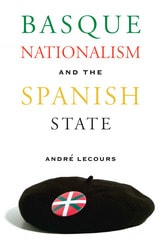
Basque Nationalism and the Spanish State
Andre Lecours
University of Nevada Press, 2016
An examination of Basque nationalism from a historical perspective. Basque nationalism has been extensively examined from the perspectives of Basque culture and internal conditions in the Basque Country, but André Lecours is among the first to demonstrate how Basque nationalism was shaped by the many forms and historical phases of the Spanish state. His discussion employs one of the most debated approaches in the social sciences—historical institutionalism—and it includes an up-to-date examination of the circumstances for, and consequences of, recent events such as ETA's announcement in 2006 of a permanent cease-fire. Lecours also analyzes other aspects of Basque nationalism, including the international relations of the Basque Autonomous Government, as well as the responses of the contemporary Spanish state and how it deploys its own brand of nationalism. Finally, the book offers a comparative discussion of Basque, Catalan, Scottish, Flemish, and Quebecois nationalist movements, suggesting that nationalism in the Basque Country, despite the historical presence of violence, is in many ways similar to nationalism in other industrialized democracies. Basque Nationalism and the Spanish State is an original and provocative discussion that is essential reading for anyone interested in the Basques or in the development of modern nationalist movements.
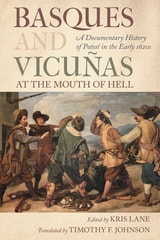
Basques and Vicuñas at the Mouth of Hell
A Documentary History of Potosí in the Early 1620sKris Lane
University of Nevada Press, 2024
As mines flooded and Indigenous workers died or fled, the city descended into a maelstrom of swordfights, gun battles, ambushes, sniper attacks, and summary executions. Though its roots were economic, the Basque-Vicuña conflict strained the sinews of Habsburg global governance even as it exposed festering local tensions, only some of which were unique to Potosí.
This rich collection of original sources, all of them archival documents housed in Bolivia, Spain, the United Kingdom, and the United States, consists of contemporary eyewitness accounts from several perspectives, allowing readers to play historian. All sources have been expertly translated and carefully annotated in a manner that will engage students and scholars alike. Basques and Vicuñas at the Mouth of Hell includes an extensive introduction, seven vital documents in translation, and appendices on everyday life in 1620s Potosí and on the historiography of this watershed episode of colonial violence.
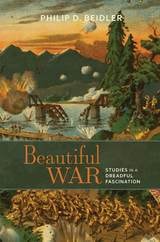
Beautiful War
Studies in a Dreadful FascinationPhilip D. Beidler
University of Alabama Press, 2016
Beautiful War: Studies in a Dreadful Fascination is a wide-ranging exploration of armed conflict as depicted in art that illustrates the constant presence of war in our everyday lives. Philip D. Beidler investigates the unending assimilation and pervasive presence of the idea of war in popular culture, the impulses behind the making of art out of war, and the unending and debatably aimless trajectories of war itself.
Beidler’s critical scope spans from Shakespeare’s plays, through the Victorian battle paintings of Lady Butler, into the post-World War I writings of F. Scott Fitzgerald and Virginia Woolf, and up to twenty-first-century films such as The Hurt Locker and Extremely Loud and Incredibly Close. As these works of art have become ubiquitous in contemporary culture, the many faces of war clearly spill over into our art and media, and Beidler argues that these portrayals in turn shift the perception of war from a savage truth to a concept.
Beautiful War argues that the representation of war in the arts has always been, and continues to be, an incredibly powerful force. Incorporating painting, music, photography, literature, and film, Beidler traces a disturbing but fundamental truth: that war has always provided an aesthetic inspiration while serving ends as various and complex as ideological or geopolitical history, public memory, and mass entertainment.
Beautiful War is a bold and vivid account of the role of war and military conflict as a subject of art that offers much of value to literary and cultural critics, historians, veterans, students of art history and communication studies, and those interested in expanding their understanding of art and media’s influence on contemporary values and memories of the past.

Beauty and the Beast
The Original StoryGabrielle-Suzanne Barbot de Villeneuve
Iter Press, 2020
The Other Voice in Early Modern Europe: The Toronto Series volume 74

Becoming Hybrid
J. Mae Barizo
University of Michigan Press, 2027
Becoming Hybrid offers an intimate exploration of creative process and hybrid poetics. Weaving together essays, interviews, personal narrative, and pedagogical reflections, this book explores what it means to be “hybrid” in the twenty-first century, as artists increasingly produce work that challenges traditional formal boundaries. The book examines the transdisciplinary practice of artists like Cecilia Vicuña, Don Mee Choi, and Claudia Rankine, many of whom write from diasporic experience or from identities historically pushed to the margins. Emerging from Barizo’s lifelong engagements with music, philosophy, art, and literature, the book illuminates the idiosyncratic pathways she has taken to unsettle disciplinary boundaries as an author, artist, and performer. Becoming Hybrid traces how disciplinary and genre-bound conventions have shifted and dissolved across time, offering tools for decolonial pedagogy and collaborative writing workshops that honor multiple voices, lived experiences, and cultural traditions. Accessible yet intellectually rigorous, the book opens up a conversation about hybridity and creativity, making it an essential guide for anyone interested in how contemporary art and literature are reshaping the ways we think, write, and create today.
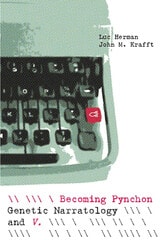
Becoming Pynchon
Genetic Narratology and V.Luc Herman and John M. Krafft
The Ohio State University Press, 2023
The 1963 publication of Thomas Pynchon’s V. changed the landscape of American fiction. Becoming Pynchon: Genetic Narratology and V. offers a detailed examination of the dramatic transformations that took place as Pynchon’s foundational novel went from typescript to published work. Luc Herman and John M. Krafft develop and deploy a rich theory of genetic narratology to examine the performance of genre in the novel. Pushing back against the current dominance of cognitive narratology, they discuss focalization, character construction, and evocation of consciousness as clues to Pynchon’s developing narratology of historical fiction. Their theoretical interventions offer an important and timely corrective to the field of narratology with a method that brings the author back into the analytical frame.
Herman and Krafft use as their guide the typescript of V. that surfaced in 2001, when it was acquired by the Harry Ransom Humanities Research Center, as well as Pynchon’s editorial correspondence with Corlies Smith, his first editor at J. B. Lippincott. Becoming Pynchon assembles a comprehensive and unequaled picture of Pynchon’s writing process that will appeal both to Pynchonians and to postmodernism scholars more broadly.

Before Grenfell
Fire, Safety and Deregulation in Twentieth-Century BritainShane Ewen
University of London Press, 2023
The 2017 Grenfell tower fire in London was a “slow disaster,” the product of a long accumulation of faults and errors that resulted from erroneous assumptions and organizational and governmental decision-making. This book offers a critical perspective on the systematic failures that lead to one of the greatest tragedies in Britain in our time.
Before Grenfell is a poignant and timely analysis of risk, fire, and safety in postwar Britain. Tracing the evolution of state housing policy in relation to multistory housing since the mid-1950s, the book adds to a burgeoning history of the British experience of fire and safety in high-rises and investigates a latent housing crisis in contemporary Britain against a backdrop of increasingly deregulated urban building development. Drawing on public inquiries, newspaper accounts, and oral histories, Shane Ewen details other avoidable disasters, including the Ronan Point tower block explosion in 1968, the Summerland leisure center fire in 1972, and the Bradford City Football Club fire in 1985. The book closes with a powerful chapter on fire safety campaigners, including survivor groups, who are seeking justice for the victims of fire disasters. Before Grenfell aims to exert pressure on policy-makers to act on the lessons of fatal disasters in order to both prevent future casualties and establish a legacy for those who lost their lives.
Before, Between, and Beyond
Three Decades of Dance WritingSally Banes; Edited and with an introduction by Andrea Harris
University of Wisconsin Press, 2007
Behind the Mask
Vernacular Culture in the Time of COVIDBen Bridges
Utah State University Press, 2023
Despite vernacular’s potential nod to dominant or external culture, it is the strong connection to the local that grounds the vernacular within the experiential context that it occupies. Exploring the nature and shape of vernacular responses to the ongoing public health crisis, Behind the Mask documents processes that are otherwise likely to be forgotten. Including different ethnographic presents, contributors capture moments during the pandemic rather than upon reflection, making the work important to students and scholars of folklore and ethnology, as well as general readers interested in the COVID pandemic.
Behold an Animal
Four Exorbitant ReadingsThangam Ravindranathan
Northwestern University Press, 2019
As animals recede from our world, what tale is being told by literature’s creatures? Behold an Animal: Four Exorbitant Readings examines incongruous animals in the works of four major contemporary French writers: an airborne horse in a novel by Jean-Philippe Toussaint, extinct orangutans in Éric Chevillard, stray dogs in Marie NDiaye, vanishing (bits of) hedgehogs in Marie Darrieussecq. Resisting naturalist assumptions that an animal in a story is simply—literally or metaphorically—an animal, Thangam Ravindranathan understands it rather as the location of something missing. The animal is a lure: an unfinished figure fleeing the frame, crossing bounds of period, genre, even medium and language. Its flight traces an exorbitant (self-)portrait in which thinking admits to its commerce with life and flesh. It is in its animals, at the same time unbearably real and exquisitely unreal, that literature may today be closest to philosophy.
This book’s primary focus is the contemporary French novel and continental philosophy. In addition to Toussaint, Chevillard, NDiaye, and Darrieussecq, it engages the work of Jean de La Fontaine, Eadweard Muybridge, Edgar Allan Poe, Lewis Carroll, Samuel Beckett, and Francis Ponge.
Beloved Children
History of Aristocratic Childhood in Hungary in the Early Modern AgeKatalin Peter
Central European University Press, 2001
Drawing on evidence from a wide collection of surviving family papers, Beloved Children is a valuable contribution to literature available concerning childhood history in pre-industrial Central Europe.
With the aid of detailed case studies, the volume illustrates every aspect of Hungarian childhood in the early modern age from a variety of contrasting perspectives—birth, care, education, marriage, orphanhood and death. The book also includes a unique portrayal of family life in the Hungarian aristocracy.
Beloved Children is a comprehensive study examining topics such as family intimacy, paternal and maternal attitudes, providing the reader with a valuable insight into a child’s life in Hungary during the sixteenth and seventeenth centuries.
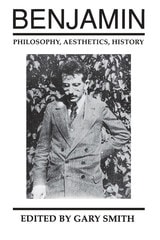
Benjamin
Philosophy, Aesthetics, HistoryEdited by Gary Smith
University of Chicago Press, 1989
A balance of original work by Benjamin and important commentary on his works, this volume includes the crucial chapter from Benjamin's magnum opus The Arcades Project, his "Program of the Coming Philosophy," and "Central Park," as well as essays by leading scholars (including Theodor W. Adorno, Leo Lowenthal, and Rolf Tiedemann) that treat single philosophical themes and relate his ideas to those of other thinkers such as Gadamer, Goodmann, and Rosenzweig. Gary Smith's introduction to the volume provides an extremely useful and sophisticated entrée for readers unaccustomed to the breadth of Benjamin's philosophical allusions, as well as an informative summation of the contents of the volume. This book will be of interest to philosophers, literary theorists, art historians, anthropologists, and other social scientists.
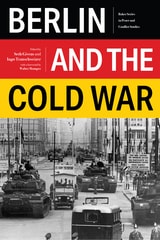
Berlin and the Cold War
Seth Givens; Ingo Trauschweizer
Ohio University Press, 2024

Bertrand Russell
A. J. Ayer
University of Chicago Press, 1988
"I am sure [this] is the best introduction of any length to Russell, and I suspect that it might serve as one of the best introductions to modern philosophy. . . . Ayer begins with a brief, austere, and balanced account of Russell's life: as in Russell's autobiography this means his thought, books, women, and politics. Tacitus (and Russell) would have found the account exemplary. Ayer ends with a sympathetic and surprisingly detailed survey of Russell's social philosophy. But the bulk of this book consists of a chapter on Russell's work in logic and the foundations of mathematics, followed by a chapter on his epistemological views and one on metaphysics. . . . I find it impossible to imagine that this book will not remain indefinitely the very best book of its sort."—Review of Metaphysics
"The confrontation or conjunction of Ayer and Russell is a notable event and has produced a remarkable book—brilliantly argued and written."—Martin Lebowitz, The Nation
Beside the Bard
Scottish Lowland Poetry in the Age of BurnsGeorge S. Christian
Bucknell University Press, 2020
Published by Bucknell University Press. Distributed worldwide by Rutgers University Press.
Between Home and Homeland
Youth Aliyah from Nazi GermanyBrian Amkraut
University of Alabama Press, 2006
As Hitler consolidated power, Jews and their allies in Germany began efforts to leave the country. Among them was the organization, Youth Aliyah. Based on abundant archival sources and a thorough use of secondary literature, Brian Amkraut details the story of the organization from its origins through its alliances and antagonisms with other Jewish organizations, and the challenges that vexed its efforts from every side, perhaps the greatest being sheer human naiveté ("surely things will get better").
Amkraut also discusses the identity dilemma for Jews who grew up feeling German, and then had to alter their self-image in the face of growing discrimination. He highlights the internal disagreements of Jewish agencies who wrestled with myriad problems. The author explores how German Jews were ideologically heterogeneous, and details how different groups coped with increasing antagonism in a variety of ways.
To this day, Youth Aliyah is considered by Israelis as a major contributor to the foundation of a Jewish presence leading to the modern state of Israel. Between Home and Homeland is an essential account of an important episode in the history of the Holocaust and the founding of the Isreali state.
Between Market and Myth
The Spanish Artist Novel in the Post-Transition, 1992-2014Katie J. Vater
Bucknell University Press, 2020
Published by Bucknell University Press. Distributed worldwide by Rutgers University Press.
Between Mussolini and Hitler
The Jews and the Italian Authorities in France and TunisiaDaniel Carpi
University Press of New England, 2002
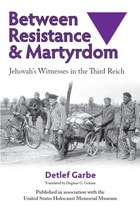
Between Resistance and Martyrdom
Jehovah's Witnesses in the Third ReichDetlef Garbe
University of Wisconsin Press, 2008
Although persecuted and banned from practicing their beliefs by the Nazi regime in 1933, the Jehovah’s Witnesses’ unified resistance has been largely forgotten. Basing his work on a wide range of sources, including documents and archives previously unconsidered as well as critical analyses of Jehovah’s Witness literature and survivor interviews, Detlef Garbe chronicles the Nazi’s relentless persecution of this religious group before and during World War II.
The English translation of this important work features a series of original photographs not published in the German edition. These striking images bring a sense of individual humanity to this story and help readers comprehend the reality of the events documented. Between Resistance and Martyrdom is an indispensable work that will introduce an English-speaking audience to this important but lesser-known part of Holocaust history.
Between the Brown and the Red
Nationalism, Catholicism, and Communism in Twentieth-Century Poland—The Politics of Boleslaw PiaseckiMikolaj Stanislaw Kunicki
Ohio University Press, 2012
Between the Brown and the Red captures the multifaceted nature of church-state relations in communist Poland, relations that oscillated between mutual confrontation, accommodation, and dialogue. Ironically, under communism the bond between religion and nation in Poland grew stronger. This happened in spite of the fact that the government deployed nationalist themes in order to portray itself as more Polish than communist. Between the Brown and the Red also introduces one of the most fascinating figures in the history of twentieth-century Poland and the communist world.
In this study of the complex relationships between nationalism, communism, authoritarianism, and religion in twentieth-century Poland, Mikołaj Kunicki shows the ways in which the country’s communist rulers tried to adapt communism to local traditions, particularly ethnocentric nationalism and Catholicism. Focusing on the political career of Bolesław Piasecki, a Polish nationalist politician who began his surprising but illuminating journey as a fascist before the Second World War and ended it as a procommunist activist, Kunicki demonstrates that Polish communists reinforced an ethnocentric self-definition of Polishness and—as Piasecki’s case demonstrates—thereby prolonged the existence of Poland’s nationalist Right.

Beyond Bach
Music and Everyday Life in the Eighteenth CenturyAndrew Talle
University of Illinois Press, 2018
Eschewing the great composer style of music history, Andrew Talle takes us on a journey that looks at how ordinary people made music in Bach's Germany. Talle focuses in particular on the culture of keyboard playing as lived in public and private. As he ranges through a wealth of documents, instruments, diaries, account ledgers, and works of art, Talle brings a fascinating cast of characters to life. These individuals--amateur and professional performers, patrons, instrument builders, and listeners--inhabited a lost world, and Talle's deft expertise teases out the diverse roles music played in their lives and in their relationships with one another. At the same time, his nuanced re-creation of keyboard playing's social milieu illuminates the era's reception of Bach's immortal works.
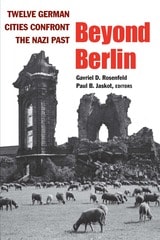
Beyond Berlin
Twelve German Cities Confront the Nazi PastGavriel D. Rosenfeld and Paul B. Jaskot, Editors
University of Michigan Press, 2015
Beyond Berlin breaks new ground in the ongoing effort to understand how memorials, buildings, and other spaces have figured in Germany's confrontation with its Nazi past. The contributors challenge reigning views of Germany's postwar memory work by examining how specific urban centers apart from the nation's capital have wrestled with their respective Nazi legacies. A wide range of West and East German cities is profiled in the volume: prominent metropolises like Hamburg, dynamic regional centers like Dresden, gritty industrial cities like Wolfsburg, and idyllic rural towns like Quedlinburg. In employing historical, art historical, anthropological, and geographical methodologies to examine these and other important urban centers, the volume's case studies shed new light upon the complex ways in which the confrontation with the Nazi past has directly shaped the German urban landscape since the end of the Second World War.
"Beyond Berlin is one of the most fascinating, deeply probing collections ever published on Germany's ongoing confrontation with its Nazi past. Its editors, Gavriel Rosenfeld and Paul Jaskot, have taken the exploration of Germany's urban memorial landscape to its highest level yet."
---James E. Young, Professor and Chair, Department of Judaic and Near Eastern Studies, University of Massachusetts Amherst, and author of The Texture of Memory and At Memory's Edge
"This is a top-notch collection of essays that positions itself in the populated field of memory studies by bringing together original contributions representing the best of new scholarship on architecture, urban design, monuments, and memory in East and West Germany. Taken together, the essays remind readers that the Nazi past is always present when German architects, urban planners, and politicians make decisions to tear down, rebuild, restore, and memorialize."
---S. Jonathan Wiesen, Department of History, Southern Illinois University, Carbondale
Beyond Human
Vital Materialisms in the Andean Avant-GardesDaly, Tara
Bucknell University Press, 2019
Published by Bucknell University Press. Distributed worldwide by Rutgers University Press.
Beyond Nihilism
Nietzsche without MasksOfelia Schutte
University of Chicago Press, 1984

Beyond Prejudice
The Moral Significance of Human and Nonhuman AnimalsEvelyn B. Pluhar
Duke University Press, 1995
Exposing the traditional view—which restricts the moral realm to autonomous, fully fledged "persons"—as having horrific implications for the treatment of many humans, Pluhar goes on to argue positively that sentient individuals of any species are no less morally significant than the most automomous human. Her position provides the ultimate justification that is missing from previous defenses of the moral status of nonhuman animals. In the process of advancing her position, Pluhar discusses the implications of determining moral significance for children and "abnormal" humans as well as its relevance to population policies, the raising of animals for food or product testing, decisions on hunting and euthanasia, and the treatment of companion animals. In addition, the author scrutinizes recent assertions by environmental ethicists that all living things or that natural objects and ecosystems be considered highly morally significant. This powerful book of moral theory challenges all defenders of the moral status quo—which decrees that animals decidedly do not count—to reevaluate their convictions.
Beyond Progress
An Interpretive Odyssey to the FutureHugh De Santis
University of Chicago Press, 1996
Explaining that we have arrived at a great historic divide, De Santis asserts that the old modern order is giving way to an age of "mutualism." He draws on world history and the study of international relations to explore the emerging future, in which new forms of social and political identity and regional associations and alignments will be needed to solve global problems. Demonstrating that mutualism will require a dramatic change in the way states, international institutions, corporations, and local communities interact, De Santis argues that this transformation will be especially difficult for the United States, which will have to abandon its exceptionalist identity and rejoin a world it can no longer escape.
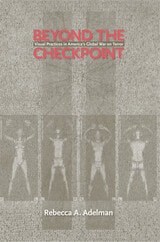
Beyond the Checkpoint
Visual Practices in America's Global War on TerrorRebecca A. Adelman
University of Massachusetts Press, 2014
Tracing the connections between citizenship and spectatorship, and moving beyond the close reading of visual representations, this book focuses on the institutions and actors that create, monitor, and regulate the visual landscape of the GWOT. Adelman looks around and through common images to follow the complex patterns of practice by which institutions and audiences engage them in various contexts. In the process, she proposes a new methodology for studying visual cultures of conflict, and related phenomena like violence, terror, and suffering that are notoriously difficult to represent.
Attending to previously unanalyzed dimensions of this conflict, this book illustrates the complexity of GWOT visual culture and the variegated experiences of citizenship that result as Americans navigate this terrain.
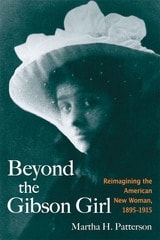
Beyond the Gibson Girl
Reimagining the American New Woman, 1895-1915Martha H. Patterson
University of Illinois Press, 2005
Challenging monolithic images of the New Woman as white, well-educated, and politically progressive, this study focuses on important regional, ethnic, and sociopolitical differences in the use of the New Woman trope at the turn of the twentieth century. Using Charles Dana Gibson's "Gibson Girls" as a point of departure, Martha H. Patterson explores how writers such as Pauline Hopkins, Margaret Murray Washington, Sui Sin Far, Mary Johnston, Edith Wharton, Ellen Glasgow, and Willa Cather challenged and redeployed the New Woman image in light of other “new” conceptions: the "New Negro Woman," the "New Ethics," the "New South," and the "New China."
As she appears in these writers' works, the New Woman both promises and threatens to effect sociopolitical change as a consumer, an instigator of evolutionary and economic development, and (for writers of color) an icon of successful assimilation into dominant Anglo-American culture. Examining a diverse array of cultural products, Patterson shows how the seemingly celebratory term of the New Woman becomes a trope not only of progressive reform, consumer power, transgressive femininity, modern energy, and modern cure, but also of racial and ethnic taxonomies, social Darwinist struggle, imperialist ambition, assimilationist pressures, and modern decay.
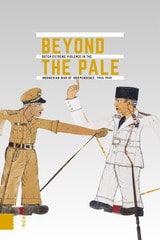
Beyond the Pale
Dutch Extreme Violence in the Indonesian War of Independence, 1945-1949Kon. Inst. v. Taal-, Land- en Volkenkunde (KITLV)
Amsterdam University Press, 2022
In 2005, the Dutch government declared that the Netherlands should never have waged the war. The government’s 1969 position on the violence used by the Dutch armed forces during the war remained unchanged, however: although there had been ‘excesses’, on the whole the armed forces had behaved ‘correctly’. As the indications of Dutch extreme violence mounted, this official position proved increasingly difficult to maintain. In 2016, the Dutch government therefore decided to fund a broad study on the dynamics of the violence. The most important conclusions of that research programme are summarized in this book. The authors show that the Dutch armed forces used extreme violence on a structural basis, and that this was concealed both at the time and for many years after the war by the Dutch government and by society more broadly. All of this – like the entire colonial history – is at odds with the rose-tinted self-image of the Netherlands.
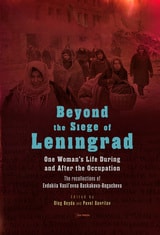
Beyond the Siege of Leningrad
One Woman’s Life during and after the Occupation: The Recollections of Evdokiia Vasil’evna Baskakova-BogachevaPavel Gavrilov
Central European University Press, 2024
This memoir about the experiences of German occupation during the siege of Leningrad (now Saint Petersburg) was written by Moscow-born Evdokiia Vasil’evna Baskakova-Bogacheva (1888–1976), an émigré in Australia, at the age of eighty-one. The text had been forgotten in the Museum of Russian Culture in San Francisco since 1970 until the editors of this volume discovered it.
In the memoirs, after accounting on her youth spent against the background of the First World War and of the two Russian revolutions of 1917, Evdokiia describes the inferno of the Nazi occupation as experienced in a suburb of Leningrad in 1941-43. She survived for nearly two years almost on the front line, within a few kilometers of the blockade ring. As a medical practitioner, she became useful for the occupational authorities and the ever-shrinking town population, until her family was evacuated to the west in October 1943. Besides hunger, discord, disease, the hunt for food and firewood, along with violence and death, Evdokiia’s account deals with various forms of cooperation between Soviet citizens and the new authorities.
All the events she recalls can be confirmed through other sources. The introduction and the detailed notes to the text help the reader to locate Evdokiia’s recollections in time and place, and situate them in their historical context.
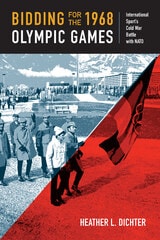
Bidding for the 1968 Olympic Games
International Sport's Cold War Battle with NATOHeather L. Dichter
University of Massachusetts Press, 2021
During the Cold War, political tensions associated with the division of Germany came to influence the world of competitive sport. In the 1950s, West Germany and its NATO allies refused to recognize the communist East German state and barred its national teams from sporting competitions. The construction of the Berlin Wall in 1961 further exacerbated these pressures, with East German teams denied travel to several world championships. These tensions would only intensify in the run-up to the 1968 Olympics.
In Bidding for the 1968 Olympic Games, Heather L. Dichter considers how NATO and its member states used sport as a diplomatic arena during the height of the Cold War, and how international sport responded to political interference. Drawing on archival materials from NATO, foreign ministries, domestic and international sport functionaries, and newspapers, Dichter examines controversies surrounding the 1968 Summer and Winter Olympic Games, particularly the bidding process between countries to host the events. As she demonstrates, during the Cold War sport and politics became so intertwined that they had the power to fundamentally transform each other.

Binding Words
Conscience and Rhetoric in Hobbes, Hegel, and HeideggerKaren Feldman
Northwestern University Press, 2006
Hobbes's Leviathan, Hegel's Phenomenology of Spirit, and Heidegger's Being and Time dramatize conscience's relation to language and knowledge, morality and duty, and ontology. Feldman investigates how, within these works, conscience is described as binding upon us while at the same time asking how texts themselves may be read as binding.
Bio-Imperialism
Disease, Terror, and the Construction of National FragilityGwen Shuni D'Arcangelis
Rutgers University Press, 2021
Biological Modernism
The New Human in Weimar CultureCarl Gelderloos
Northwestern University Press, 2020
Honorable Mention for the DAAD/GSA Book Prize for the Best Book in Germanistik or Cultural Studies
Biological Modernism identifies an intellectual current in the Weimar Republic that drew on biology, organicism, vitalism, and other discourses associated with living nature in order to redefine the human being for a modern, technological age. Contrary to the assumption that any turn toward the organic indicated a reactionary flight from modernity or a longing for wholeness, Carl Gelderloos shows that biology and other discourses of living nature offered a nuanced way of theorizing modernity rather than fleeing from it. Organic life, instead of representing a stabilizing sense of wholeness, by the 1920s had become a scientific, philosophical, and disciplinary problem. In their work, figures such as Alfred Döblin, Ernst Jünger, Helmuth Plessner, and August Sander interrogated the relationships between technology, nature, and the human and radically reconsidered the relationship between the disciplines as well as the epistemological and political consequences for defining the human being. Biological Modernism will be of interest to scholars of German literature and culture, literary modernism, photography, philosophical anthropology, twentieth-century intellectual history, the politics of culture, and the history of science.

Biopower in Putin’s Russia
From Taking Care to Taking LivesSergei Medvedev
Central European University Press, 2024
In this book, Makarychev and Medvedev examine the importance of biopolitics in fueling Russia’s confrontation with the West. In their view, the development of Putin’s illiberal authoritarianism was largely triggered by what they call a biopolitical turn. This shift is exemplified by the use of an increasing number of regulatory mechanisms to discipline and constrain the human body. Such political practices concern issues of sexuality, reproductive behavior, adoption, fertility, family planning, public hygiene, and demography. This turn created a new disciplinary framework for the population and the elite. Bans and restrictions of a biopolitical nature, became one of the main tools for articulating the rules of belonging in the political community and drawing its political boundaries. Biopolitical discourses have taken up the core of the Russian identity formation, which contrasts a positive “conservative Russia” with a supposedly vicious “liberal West.”
The presentation of the political genealogy of the body-centric structures of power and hegemony in Russia implies their transformation from bio- to necropolitics. Necropolitical (repressive and life-depriving) components are inscribed in the biopolitical regimes of power: they form the core of Putin’s rule over Russia and are a key factor behind the war against Ukraine.
Biopower
Foucault and BeyondEdited by Vernon W. Cisney and Nicolae Morar
University of Chicago Press, 2015
Situating biopower as a radical alternative to traditional conceptions of power—what Foucault called “sovereign power”—the contributors examine a host of matters centered on life, the body, and the subject as a living citizen. Altogether, they pay testament to the lasting relevance of biopower in some of our most important contemporary debates on issues ranging from health care rights to immigration laws, HIV prevention discourse, genomics medicine, and many other topics.

Bird Strike
The Crash of the Boston ElectraMichael N. Kalafatas
Brandeis University Press, 2010
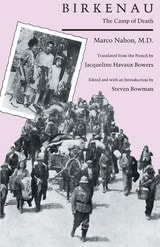
Birkenau, The Camp Of Death
Marco Nahon
University of Alabama Press, 1989

Birkenau
The Camp of DeathMarco Nahon, translated from the French by Jacqueline Bowers, edited and with an introduction by Steven B. Bowan
University of Alabama Press, 1989
Step into Birkenau, Marco Nahon’s unflinching memoir of survival in Auschwitz, where a Greek doctor bears witness to brutality, loss, and endurance—preserving forgotten voices and compelling readers to confront history through one unforgettable, human testimony
Birkenau is a searing firsthand Holocaust memoir by Greek physician Marco Nahon, recounting his deportation to Auschwitz-Birkenau and survival of one of history’s most lethal extermination camps. Writing soon after liberation, Nahon offers a deeply personal chronicle of Nazi persecution. He recounts the occupation of Greece, the ghettoization of Greek Jews, their transport to German death camps, and the daily horrors of camp life. He documents the dehumanization and destruction of Greek Jews while preserving the memory of those who perished.
Nahon presents his story episodically, guiding readers through his arrest, transport, forced labor, and survival. He illuminates the historical context of the Holocaust with vivid stories from daily life in the death camps. Rounding out the work are maps, appendices, and Bowman’s introduction, which provides background on Greek Jewry—whose complex story is little known—and describes the progress of the Nazi occupation of Greece and the Balkans.
Nahon, an MD trained in Beirut who lost much of his family, writes with restrained objectivity that heightens the emotional force of his account, while the translation and editorial framing make this early memoir accessible to modern readers.
This book will resonate with scholars of the Holocaust, students of World War II, and general readers seeking an authentic survivor voice. It is especially valuable for those interested in lesser-known aspects of the genocide, such as the fate of Greek Jewish communities. Both an indispensable historical document and a powerful act of remembrance, it speaks urgently to anyone committed to understanding—and never forgetting—the human realities of genocide.

Bismarck and His Times
George O. Kent
Southern Illinois University Press, 1978
A new account of the life and policies of the first German chancellor, Otto von Bismarck, this concise historical-biography reflects, for the first time in English, the historical shift in emphasis from the traditional political-economic approach to the more complex social-economic one of post—World War II scholarship.
Since the middle of the 1950s, much new material on Bismarck and nineteenth-century Germany and new interpretations of existing material have been published in Germany, Great Britain, and the United States. Professor George O. Kent’s brilliant synthesis, drawing on this mass of material, examines changes in emphasis in post—World War II scholarship. The book, particularly in the historiographical notes and bibliographical essay, provides the serious student with an invaluable guide to the intricacies of recent Bismarckian scholarship. For the general reader, the main text presents a picture of the man, the issues, and the age in the light of modern scholarship.
The major shift in historical emphasis described in this new account is the importance scholars give to the period 1877–79, the years of change from free trade to protectionism, rather than to 1870–71 the founding of the Reich. Bismarck’s political machinations, particularly his willingness to explore the possibilities of a coup d’état, are more fully discussed here than in any other book.
Black Bourgeois
Class and Sex in the FleshCandice M. Jenkins
University of Minnesota Press, 2019
Exploring the forces that keep black people vulnerable even amid economically privileged lives
At a moment in U.S. history with repeated reminders of the vulnerability of African Americans to state and extralegal violence, Black Bourgeois is the first book to consider the contradiction of privileged, presumably protected black bodies that nonetheless remain racially vulnerable. Examining disruptions around race and class status in literary texts, Candice M. Jenkins reminds us that the conflicted relation of the black subject to privilege is not, solely, a recent phenomenon.
Focusing on works by Toni Morrison, Spike Lee, Danzy Senna, Rebecca Walker, Reginald McKnight, Percival Everett, Colson Whitehead, and Michael Thomas, Jenkins shows that the seemingly abrupt discursive shift from post–Civil Rights to Black Lives Matter, from an emphasis on privilege and progress to an emphasis on vulnerability and precariousness, suggests a pendulum swing between two interrelated positions still in tension. By analyzing how these narratives stage the fraught interaction between the black and the bourgeois, Jenkins offers renewed attention to class as a framework for the study of black life—a necessary shift in an age of rapidly increasing income inequality and societal stratification.
Black Bourgeois thus challenges the assumed link between blackness and poverty that has become so ingrained in the United States, reminding us that privileged subjects, too, are “classed.” This book offers, finally, a rigorous and nuanced grasp of how African Americans live within complex, intersecting identities.
Black Chicago's First Century
1833-1900Christopher Robert Reed
University of Missouri Press, 2005