95 books match the query 'Money' and 7 start with b
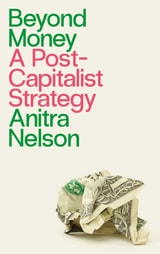
cover of Beyond Money: A Postcapitalist Strategy

Beyond Money

A Postcapitalist Strategy

Anitra Nelson

Pluto Press, 2022

'A fascinating portal into arguments about why we need to get beyond money' - Harry Cleaver

What would a world without money look like? This book is a lively thought experiment that deepens our understanding of how money is the driver of political power, environmental destruction and social inequality today, arguing that it has to be abolished rather than repurposed to achieve a postcapitalist future.

Grounded in historical debates about money, Anitra Nelson draws on a spectrum of political and economic thought and activism, including feminism, ecoanarchism, degrowth, permaculture, autonomism, Marxism and ecosocialism. Looking to Indigenous rights activism and the defense of commons, an international network of activists engaged in a fight for a money-free society emerges.

Beyond Money shows that, by organizing around post-money versions of the future, activists have a hope of creating a world that embodies their radical values and visions.
[more]
cover of Beyond Money: A Postcapitalist Strategy

Beyond Money

A Postcapitalist Strategy

Anitra Nelson

Pluto Press, 2022

'A fascinating portal into arguments about why we need to get beyond money' - Harry Cleaver

What would a world without money look like? This book is a lively thought experiment that deepens our understanding of how money is the driver of political power, environmental destruction and social inequality today, arguing that it has to be abolished rather than repurposed to achieve a postcapitalist future.

Grounded in historical debates about money, Anitra Nelson draws on a spectrum of political and economic thought and activism, including feminism, ecoanarchism, degrowth, permaculture, autonomism, Marxism and ecosocialism. Looking to Indigenous rights activism and the defense of commons, an international network of activists engaged in a fight for a money-free society emerges.

Beyond Money shows that, by organizing around post-money versions of the future, activists have a hope of creating a world that embodies their radical values and visions.

[more]
cover of BigLaw: Money and Meaning in the Modern Law Firm

BigLaw

Money and Meaning in the Modern Law Firm

Mitt Regan and Lisa H. Rohrer

University of Chicago Press, 2021

The Great Recession intensified large law firms’ emphasis on financial performance, leading to claims that lawyers in these firms were now guided by business rather than professional values.  Based on interviews with more than 250 partners in large firms, Mitt Regan and Lisa H. Rohrer suggest that the reality is much more complex. It is true that large firm hiring, promotion, compensation, and termination policies are more influenced by business considerations than ever before and that firms actively recruit profitable partners from other firms to replace those they regard as unproductive. At the same time, law firm partners continue to seek the non-financial rewards of being members of a distinct profession and are sensitive to whether their firms are committed to providing them. Regan and Rohrer argue that modern firms responding effectively to business demands while credibly affirming the importance of non-financial professional values can create strong cultures that enhance their ability to weather the storms of the modern legal market.
[more]
cover of Black Magic City: How Gods, Money, and Healing Shaped Rio de Janeiro

Black Magic City

How Gods, Money, and Healing Shaped Rio de Janeiro

Ana Paulina Lee

Duke University Press, 2027

In Black Magic City, Ana Paulina Lee tells the untold story of how “black magic” became one of modern Brazil’s most dangerous and revealing phrases for governing life after slavery. Drawing on criminal trials, archives, literature, and anthropology, Lee shows how authorities turned ritual into evidence, sacred objects into contraband, healing into crime, and care into fraud. Lee restores the worlds that policing tried and failed to contain: women who read cards and palms, Afro-Brazilian healers who offered protection and counsel, migrants searching for spiritual aid, and writers who saw magic as one of the hidden engines of modern life. Lee offers a vivid new history of religion, race, law, and urban power in Brazil and reveals how accusations of black magic helped define the boundaries of freedom, labor, sexuality, and religious legitimacy after slavery. At once a story of repression and survival, Black Magic City shows how modern Rio was made through battles over who could heal, who could believe, and who had the power to decide what counted as crime.
[more]
cover of Bread, Wine, and Money: The Windows of the Trades at Chartres Cathedral

Bread, Wine, and Money

The Windows of the Trades at Chartres Cathedral

Jane Welch Williams

University of Chicago Press, 1993

At Chartres Cathedral, for the first time in medieval art, the lowest register of stained-glass windows depicts working artisans and merchants instead of noble and clerical donors. Jane Welch Williams challenges the prevailing view that pious town tradesmen donated these windows. In Bread, Wine, and Money, she uncovers a deep antagonism between the trades and the cathedral clergy in Chartres; the windows, she argues, portray not town tradesmen but trusted individuals that the fearful clergy had taken into the cloister as their own serfs.

Williams weaves a tight net of historical circumstances, iconographic traditions, exegetical implications, political motivations, and liturgical functions to explain the imagery in the windows of the trades. Her account of changing social relationships in thirteenth-century Chartres focuses on the bakers, tavern keepers, and money changers whose bread, wine, and money were used as means of exchange, tithing, and offering throughout medieval society. Drawing on a wide variety of original documents and scholarly work, this book makes important new contributions to our knowledge of one of the great monuments of Western culture.
[more]
cover of Business Cycles: Part I

Business Cycles

Part I

F. A. Hayek

University of Chicago Press, 2012
In the years following its publication, F. A. Hayek’s pioneering work on business cycles was regarded as an important challenge to what was later known as Keynesian macroeconomics. Today, as debates rage on over the monetary origins of the current economic and financial crisis, economists are once again paying heed to Hayek’s thoughts on the repercussions of excessive central bank interventions.
 
The latest editions in the University of Chicago Press’s ongoing series The Collected Works of F. A. Hayek, these volumes bring together Hayek’s work on what causes periods of boom and bust in the economy. Moving away from the classical emphasis on equilibrium, Hayek demonstrates that business cycles are generated by the adaptation of the structure of production to changes in relative demand. Thus, when central banks artificially lower interest rates, the result is a misallocation of capital and the creation of asset bubbles and additional instability. Business Cycles, Part I contains Hayek’s two major monographs on the topic: Monetary Theory and the Trade Cycle and Prices and Production. Reproducing the text of the original 1933 translation of the former, this edition also draws on the original German, as well as more recent translations. For Prices and Production, a variorum edition is presented, incorporating the 1931 first edition and its 1935 revision. Business Cycles, Part II assembles a series of Hayek’s shorter papers on the topic, ranging from the 1920s to 1981.
 
In addition to bringing together Hayek’s work on the evolution of business cycles, the two volumes of Business Cycles also include extensive introductions by Hansjoerg Klausinger, placing the writings in intellectual context—including their reception and the theoretical debates to which they contributed—and providing background on the evolution of Hayek’s thought.
[more]
cover of Business Cycles: Part II

Business Cycles

Part II

F. A. Hayek

University of Chicago Press, 2012

In the years following its publication, F. A. Hayek’s pioneering work on business cycles was regarded as an important challenge to what was later known as Keynesian macroeconomics. Today, as debates rage on over the monetary origins of the current economic and financial crisis, economists are once again paying heed to Hayek’s thoughts on the repercussions of excessive central bank interventions.
 
The latest editions in the University of Chicago Press’s ongoing series The Collected Works of F. A. Hayek, these volumes bring together Hayek’s work on what causes periods of boom and bust in the economy. Moving away from the classical emphasis on equilibrium, Hayek demonstrates that business cycles are generated by the adaptation of the structure of production to changes in relative demand. Thus, when central banks artificially lower interest rates, the result is a misallocation of capital and the creation of asset bubbles and additional instability. Business Cycles, Part I contains Hayek’s two major monographs on the topic: Monetary Theory and the Trade Cycle and Prices and Production. Reproducing the text of the original 1933 translation of the former, this edition also draws on the original German, as well as more recent translations. For Prices and Production, a variorum edition is presented, incorporating the 1931 first edition and its 1935 revision. Business Cycles, Part II assembles a series of Hayek’s shorter papers on the topic, ranging from the 1920s to 1981.
 
In addition to bringing together Hayek’s work on the evolution of business cycles, the two volumes of Business Cycles also include extensive introductions by Hansjoerg Klausinger, placing the writings in intellectual context—including their reception and the theoretical debates to which they contributed—and providing background on the evolution of Hayek’s thought.
[more]