Results by title
94 books match the query 'New' and 5 start with b
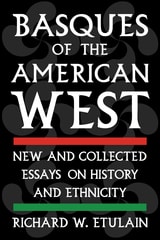
Basques of the American West
New and Collected Essays on History and EthnicityRichard W. Etulain
University of Nevada Press, 2026
Basques of the American West: New and Collected Essays on History and Ethnicity brings together new and previously published work by Richard W. Etulain, blending historical analysis and literary criticism to explore the lives, stories, and representations of the Basques in this region. The essays examine key figures such as Robert Laxalt and Frank Bergon; survey historical studies, memoirs, and novels; and trace evolving interpretations of Basque identity in Western literature and scholarship. Etulain highlights major trends in both Basque and Western American historiography while identifying important topics that remain open for additional research.
This collection offers readers a thoughtful and engaging look at the enduring presence and influence of Basques across the cultural and historical landscape of the American West.
This collection offers readers a thoughtful and engaging look at the enduring presence and influence of Basques across the cultural and historical landscape of the American West.
[more]
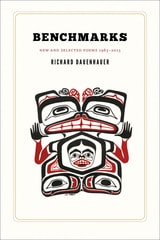
Benchmarks
New and Selected Poems 1963-2013Richard Dauenhauer
University of Alaska Press, 2013
Russian, German, Tlingit. Like the languages he translates, Richard Dauenhauer’s poetry offers unexpected surprises. A prolific translator who also works in Finnish, Swedish, and classical Greek, he has a poetic command of language that has earned him wide recognition over fifty years of published work. Benchmarks spans these decades of writing, and each poem contained within marks a certain place in time and space, like a surveyor’s benchmark. The poems play with language while focusing on the land and people of Alaska. And like Alaska itself, this book offers a variety of delights—readers will find a new experience with each turn.
[more]
Bettering Humanomics
A New, and Old, Approach to Economic ScienceDeirdre Nansen McCloskey
University of Chicago Press, 2021
Deirdre Nansen McCloskey's latest meticulous work examines how economics can become a more "human" science.
Economic historian Deirdre Nansen McCloskey has distinguished herself through her writing on the Great Enrichment and the betterment of the poor—not just materially but spiritually. In Bettering Humanomics she continues her intellectually playful yet rigorous analysis with a focus on humans rather than the institutions. Going against the grain of contemporary neo-institutional and behavioral economics which privilege observation over understanding, she asserts her vision of “humanomics,” which draws on the work of Bart Wilson, Vernon Smith, and most prominently, Adam Smith. She argues for an economics that uses a comprehensive understanding of human action beyond behaviorism.
McCloskey clearly articulates her points of contention with believers in “imperfections,” from Samuelson to Stiglitz, claiming that they have neglected scientific analysis in their haste to diagnose the ills of the system. In an engaging and erudite manner, she reaffirms the global successes of market-tested betterment and calls for empirical investigation that advances from material incentives to an awareness of the human within historical and ethical frameworks. Bettering Humanomics offers a critique of contemporary economics and a proposal for an economics as a better human science.
[more]
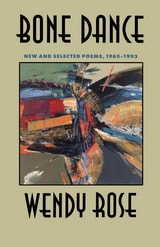
Bone Dance
New and Selected Poems, 1965-1993Wendy Rose
University of Arizona Press, 1994
A prolific voice in Native American writing for more than twenty years, Rose has been widely anthologized, and is the author of eight volumes of poetry. Bone Dance is a major anthology of her work, comprising selections from her previous collections along with new poems. The 56 selections move from observation of the earth to a search for one's place and identity on it. In an introduction written for this anthology, Rose comments on the place each past collection had in her development as a poet.
"Rich in poems which enhance our awareness of the human complexity of our social and moral dilemmas." —Book Review Digest
"There is a whisper in the wind among the chapters . . . and a singing rain beyond the window." —American Indian Culture Research Journal
"Rich in poems which enhance our awareness of the human complexity of our social and moral dilemmas." —Book Review Digest
"There is a whisper in the wind among the chapters . . . and a singing rain beyond the window." —American Indian Culture Research Journal
[more]
Building the Perfect Animal
New and Selected PoemsC. Dale Young
Four Way Books, 2025
C. Dale Young, Winner of the 2017 Hanes Award in Poetry from The Fellowship of Southern Writers, brings together decades of work in Building the Perfect Animal: New and Selected Poems. These lyrics cut cleanly and exquisitely, performing a sacrifice at the altar of language. Remedying the inaccurate reports missionaries left in their “filthy journals,” “Memento” imagines instead the surgical precision Aztec priests must have used to “slice from the umbilicus up and through the diaphragm,” keeping the heart “while discarding the body, the feeble thing / tumbling down the steps of the pyramid.” As a tenured artist and veteran doctor, Young writes with a dual awareness of life’s fragility and the lyric’s endurance, presenting readers with new work that is entirely fresh even as it speaks to his broader legacy and dialogues with his preceding oeuvre. This book unfolds like the poet’s experience of time: “‘All my life.’ It sounds so odd to say that out loud. / But strange thing after strange thing transpired.” Representing the still-warm heart, what will one day be the only surviving memento of the outlasted body that bore them, these poems explore the author’s simultaneous embrace of mortality’s richness and resignation to death’s inevitable decay. Young surveys the perpetual ultimatum of his roles: as an oncologist, the patients (including his parents) he couldn’t save; as an artist, the self he intends to confront honestly as his body ages; and, as a mortal raised with stories of the Taino gods, the impossibility of building the perfect animal. When teaching bedside manner, how to break the news to a patient that their cancer will kill them, Young’s student “wants a guide, a checklist,” he says, “but nothing like that exists. It has never existed.” Building the Perfect Animal is a monument to that inconceivable instruction manual, honoring the ceaselessly unprecedented work and gift of being now alive.
[more]