Results by title
9 books match the query 'Glass'
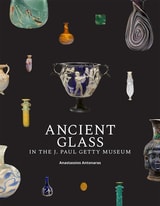
Ancient Glass in the J. Paul Getty Museum
Anastassios Antonaras
J. Paul Getty Trust, The, 2024
The J. Paul Getty Museum’s collection of ancient glass—astonishingly delicate, richly hued, and fancifully shaped—is among the most celebrated in the United States. Ranging from the Bronze Age to the medieval period (1500 BCE–1000 CE), the 584 objects included in this publication originated from a wide geographical area, including the Middle East, the Mediterranean, and central Europe.
This catalogue, written by acclaimed scholar Anastassios Antonaras, begins with a fascinating essay on the history of glassmaking—a highly technical art form that is still practiced similarly today—and continues with detailed and informative entries on the works. Each entry is accompanied by vivid photography. The book also includes a history of the collection, glossary of glassmaking terms, technical study, and full bibliography.
The free online edition of this open-access publication is available at getty.edu/publications/ancient-glass/ and includes 360-degree views and zoomable high-resolution photography. Also available are free PDF and EPUB downloads of the book, and JPG downloads of the main catalogue images.

Beyond Breaking the Glass
A Spiritual Guide to Your Jewish Wedding, Revised EditionRabbi Nancy H. Wiener, Dmin
Central Conference of American Rabbis, 2012
This compendium explores the rich history of wedding rituals and customs practiced by Jews through the years. Included are multiple options of traditional, contemporary, and creative rituals as well as prayers for couples of all approaches, orientations, and identities.
Beyond Breaking the Glass is a rich source of practical information for planning a Jewish wedding, and includes a variety of ceremonies, checklists, references, and a planning timeline. This beautiful guidebook will help all couples create a wedding that will resonate with Jewish tradition while offering the very best of contemporary innovations.
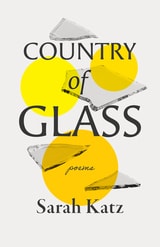
Country of Glass
PoemsSarah Katz
Gallaudet University Press, 2022
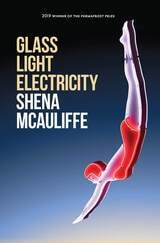
Glass, Light, and Electricity
EssaysShena McAuliffe
University of Alaska Press, 2020
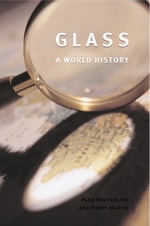
Glass
A World HistoryAlan Macfarlane and Gerry Martin
University of Chicago Press, 2002
In Glass: A World History, Alan Macfarlane and Gerry Martin tell the fascinating story of how glass has revolutionized the way we see ourselves and the world around us. Starting ten thousand years ago with its invention in the Near East, Macfarlane and Martin trace the history of glass and its uses from the ancient civilizations of India, China, and Rome through western Europe during the Renaissance, Enlightenment, and Industrial Revolution, and finally up to the present day. The authors argue that glass played a key role not just in transforming humanity's relationship with the natural world, but also in the divergent courses of Eastern and Western civilizations. While all the societies that used glass first focused on its beauty in jewelry and other ornaments, and some later made it into bottles and other containers, only western Europeans further developed the use of glass for precise optics, mirrors, and windows. These technological innovations in glass, in turn, provided the foundations for European domination of the world in the several centuries following the Scientific Revolution.
Clear, compelling, and quite provocative, Glass is an amazing biography of an equally amazing subject, a subject that has been central to every aspect of human history, from art and science to technology and medicine.
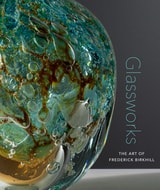
Glassworks
The Art of Frederick BirkhillFrederick Birkhill
The Artist Book Foundation, 2020
Glass as an art form has an ancient tradition; the archaeological record suggests that artisans in Egypt and Mesopotamia were fabricating glass vessels and ornaments during the fourth millennium BCE. Its durable nature, range of colors, malleability, and most of all, its optical transparency are qualities that have made glass a premiere art medium. Over a lifetime, Frederick Birkhill (1951–2023) has explored the unique qualities of glass and the numerous techniques and intricacies of working with it. The result of these decades of study is a body of work that is extraordinary in scope, technical expertise, and sheer virtuosity. The Artist Book Foundation is delighted to present a new monograph honoring this gifted artist: Glassworks: The Art of Frederick Birkhill.
From his time in England at Burleighfield House, the studio of stained-glass artist Patrick Reyntiens, to his unprecedented visit to Lauscha, the village in the former East Germany famous for both its art and scientific glass production, and his subsequent career as an explorer, teacher, and master of the glass arts, Birkhill has devoted himself to furthering the appreciation of the medium and sharing his vast experience with colleagues, collectors, and students.
Complementing the scholarly contributions by authors with significant backgrounds in the glass arts, the book features in its extensive plate section the lavish photography of Henry Leutwyler, which offers readers an opportunity to examine the complex details and artistic mastery of Birkhill's oeuvre. In addition, the monograph offers a glossary of glass-art terms, a detailed chronology of the artist's life, his extensive exhibition history, and a list of the numerous awards he has received. For those who are passionate about the glass arts, this monograph is a feast for the eyes.
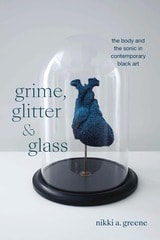
Grime, Glitter, and Glass
The Body and the Sonic in Contemporary Black ArtNikki A. Greene
Duke University Press, 2024
Optical Play
Glass, Vision, and Spectacle in Russian CultureJulia Bekman Chadaga
Northwestern University Press, 2014
Longlist finalist, 2015 Historia Nova Prize for Best Book on Russian Intellectual and Cultural History
Julia Bekman Chadaga’s ambitious study posits that glass—in its uses as a material and as captured in culture—is a key to understanding the evolution of Russian identity from the eighteenth century onward. From the contemporary perspective, it is easy to overlook how glass has profoundly transformed vision. Chadaga shows the far-reaching effects of this phenomenon.
Her book examines the similarities between glass and language, the ideological uses of glass, and the material’s associations with modernity, while illuminating the work of Lomonosov, Dostoevsky, Zamyatin, and Eisenstein, among others. In particular, Chadaga explores the prominent role of glass in the discourse around Russia’s contentious relationship with the West—by turns admiring and antagonistic—as the nation crafted a vision for its own future. Chadaga returns throughout to the spectacular aspect of glass and shows how both the tendentious capacity and the playfulness of this material have shaped Russian culture.
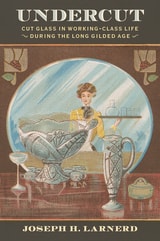
Undercut
Cut Glass in Working-Class Life During the Long Gilded AgeJoseph Larnerd
University of Delaware Press, 0
How did workers experience cut glass during its cultural heyday? Rather than privilege the stories of factory owners or wealthy consumers, Undercut: Cut Glass in Working-Class Life During the Long Gilded Age refracts the medium’s history through the labors required to make and maintain these dazzling artifacts as well as popular representations of this work, from demonstrations at world's fairs to images of domestic workers with finished pieces in their charge. Cut glass and the many manifestations of public interest in its labors offered working people, too, occasions for self-reflection and, perhaps, self-realization. Foregrounding their lives, Undercut offers a multifaceted social art history of a once-popular genre of decorative art that cuts across class, gender, and race.