Results by title

9 books match the query 'Antiblackness'
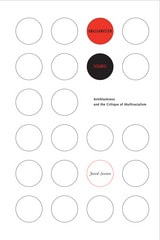
cover of Amalgamation Schemes: Antiblackness and the Critique of Multiracialism

Amalgamation Schemes

Antiblackness and the Critique of Multiracialism

Jared Sexton

University of Minnesota Press, 2008

Despite being heralded as the answer to racial conflict in the post–civil rights United States, the principal political effect of multiracialism is neither a challenge to the ideology of white supremacy nor a defiance of sexual racism. More accurately, Jared Sexton argues in Amalgamation Schemes, multiculturalism displaces both by evoking long-standing tenets of antiblackness and prescriptions for normative sexuality.

In this timely and penetrating analysis, Sexton pursues a critique of contemporary multiracialism, from the splintered political initiatives of the multiracial movement to the academic field of multiracial studies, to the melodramatic media declarations about “the browning of America.” He contests the rationales of colorblindness and multiracial exceptionalism and the promotion of a repackaged family values platform in order to demonstrate that the true target of multiracialism is the singularity of blackness as a social identity, a political organizing principle, and an object of desire. From this vantage, Sexton interrogates the trivialization of sexual violence under chattel slavery and the convoluted relationship between racial and sexual politics in the new multiracial consciousness.

An original and challenging intervention, Amalgamation Schemes posits that multiracialism stems from the conservative and reactionary forces determined to undo the gains of the modern civil rights movement and dismantle radical black and feminist politics.

Jared Sexton is assistant professor of African American studies and film and media studies at the University of California, Irvine.

[more]
cover of Antiblackness

Antiblackness

Moon-Kie Jung and João H. Costa Vargas, editors

Duke University Press, 2021

Antiblackness investigates the ways in which the dehumanization of Black people has been foundational to the establishment of modernity. Drawing on Black feminism, Afropessimism, and critical race theory, the book's contributors trace forms of antiblackness across time and space, from nineteenth-century slavery to the categorization of Latinx in the 2020 census, from South Africa and Palestine to the Chickasaw homelands, from the White House to convict lease camps, prisons, and schools. Among other topics, they examine the centrality of antiblackness in the introduction of Carolina rice to colonial India, the presence of Black people and Native Americans in the public discourse of precolonial Korea, and the practices of denial that obscure antiblackness in contemporary France. Throughout, the contributors demonstrate that any analysis of white supremacy---indeed, of the world---that does not contend with antiblackness is incomplete.

Contributors. Mohan Ambikaipaker, Jodi A. Byrd, Iyko Day, Anthony Paul Farley, Crystal Marie Fleming, Sarah Haley, Tanya Katerí Hernández, Sarah Ihmoud, Joy James, Moon-Kie Jung, Jae Kyun Kim, Charles W. Mills, Dylan Rodríguez, Zach Sell, João H. Costa Vargas, Frank B. Wilderson III, Connie Wun

[more]
cover of Dance Cadaverous: Antiblackness of the Social World and Social Theory

Dance Cadaverous

Antiblackness of the Social World and Social Theory

Moon-Kie Jung and João H. Costa Vargas

Duke University Press, 2027

In Dance Cadaverous, Moon-Kie Jung and João H. Costa Vargas argue that the modern social world and modern social theory are foundationally antiblack. Antiblackness, the ontological exclusion inaugurated by racial slavery, persists while social theorists reproduce the exclusion, missing and misrecognizing this profoundly antisocial predicament at the heart of modernity. Across three historical moments—antebellum, Jim Crow, and contemporary—Jung and Vargas offer fundamental critiques of antiblackness, putting under scrutiny humanist and posthumanist social theories, science and technology studies, agency, genocide, racism, people-of-color intersectionality, and environmental justice. Drawing on radical Black study, freedom struggles, and jazz improvisation, they propose antisociology and abolitionist antipolitics as paths forward to provincialize and leave behind the modern social world.
[more]
cover of Metaracial: Hegel, Antiblackness, and Political Identity

Metaracial

Hegel, Antiblackness, and Political Identity

Rei Terada

University of Chicago Press, 2023

A formidable critical project on the limits of antiracist philosophy.

Exploring anxieties raised by Atlantic slavery in radical enlightenment literature concerned about political unfreedom in Europe, Metaracial argues that Hegel's philosophy assuages these anxieties for the left. Interpreting Hegel beside Rousseau, Kant, Mary Shelley, and Marx, Terada traces Hegel's transposition of racial hierarchy into a hierarchy of stances toward reality. By doing so, she argues, Hegel is simultaneously antiracist and antiblack. In dialogue with Black Studies, psychoanalysis, and critical theory, Metaracial offers a genealogy of the limits of antiracism.
[more]
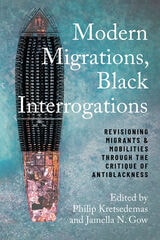
cover of Modern Migrations, Black Interrogations: Revisioning Migrants and Mobilities through the Critique of Antiblackness

Modern Migrations, Black Interrogations

Revisioning Migrants and Mobilities through the Critique of Antiblackness

Edited by Philip Kretsedemas and Jamella N. Gow

Temple University Press, 2024

Modern Migrations, Black Interrogations uses reflections on the Black experience to consider the “unasked question of blackness” in modern migration and movement. The editors and contributors use the lens of Black Studies to show how migration—compelled by force or suggestion, from the transatlantic African slave trade to the Great Migration and the current refugee crisis—has been structured to reinforce white supremacy.

Focusing on antiblackness in immigration and examining restrictions on freedom of movement and on settling alike, chapters address how Black im/mobility operates and how it can be distinguished from that of the migrant and the colonial settler, as well as from the transgressive mobilities of Indigenous populations. Looking at blackness, borders and border practices, and displacement, Modern Migrations, Black Interrogations investigates racialized boundaries that determine immigration policy, citizenship, legality, and inclusion. Additional chapters analyze communities, such as the Haitian diaspora in Miami, antiblackness in the context of Australian migration, and explore literary representations of justice, slavery and Black feminist consciousness.

Modern Migrations, Black Interrogations uses (anti)blackness to rethink the way we understand borders, immigrant identity, barriers to integration, and the dynamics of migrant exclusion, while also providing an understanding of “otherness” for Black populations across nationalities.  

Contributors: Maya Hislop, P. Khalil Saucier, Hyacinth Udah, Paula von Gleich, Tryon P. Woods, and the editors
[more]
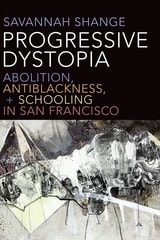
cover of Progressive Dystopia: Abolition, Antiblackness, and Schooling in San Francisco

Progressive Dystopia

Abolition, Antiblackness, and Schooling in San Francisco

Savannah Shange

Duke University Press, 2019

San Francisco is the endgame of gentrification, where racialized displacement means that the Black population of the city hovers at just over 3 percent. The Robeson Justice Academy opened to serve the few remaining low-income neighborhoods of the city, with the mission of offering liberatory, social justice--themed education to youth of color. While it features a progressive curriculum including Frantz Fanon and Audre Lorde, the majority Latinx school also has the district's highest suspension rates for Black students. In Progressive Dystopia Savannah Shange explores the potential for reconciling the school's marginalization of Black students with its sincere pursuit of multiracial uplift and solidarity. Drawing on ethnographic fieldwork and six years of experience teaching at the school, Shange outlines how the school fails its students and the community because it operates within a space predicated on antiblackness. Seeing San Francisco as a social laboratory for how Black communities survive the end of their worlds, Shange argues for abolition over revolution or progressive reform as the needed path toward Black freedom.
[more]
cover of The Denial of Antiblackness: Multiracial Redemption and Black Suffering

The Denial of Antiblackness

Multiracial Redemption and Black Suffering

João H. Costa Vargas

University of Minnesota Press, 2018

An incisive new look at the black diaspora, examining the true roots of antiblackness and its destructive effects on all of society

Thanks to movements like Black Lives Matter, Western society’s chronic discrimination against black individuals has become front-page news. Yet, there is little awareness of the systemic factors that make such a distinct form of dehumanization possible. In both the United States and Brazil—two leading nations of the black diaspora—a very necessary acknowledgment of black suffering is nonetheless undercut by denial of the pervasive antiblackness that still exists throughout these societies.

In The Denial of Antiblackness, João H. Costa Vargas examines how antiblackness affects society as a whole through analyses of recent protests against police killings of black individuals in both the United States and Brazil, as well as the everyday dynamics of incarceration, residential segregation, and poverty. With multisite ethnography ranging from a juvenile prison in Austin, Texas, to grassroots organizing in Los Angeles and Black social movements in Brazil, Vargas finds the common factors that have perpetuated antiblackness, regardless of context. Ultimately, he asks why the denial of antiblackness persists, whom this narrative serves, and what political realities it makes possible.

[more]
cover of Trafficking in Antiblackness: Modern-Day Slavery, White Indemnity, and Racial Justice

Trafficking in Antiblackness

Modern-Day Slavery, White Indemnity, and Racial Justice

Lyndsey P. Beutin

Duke University Press, 2023

In Trafficking in Antiblackness Lyndsey P. Beutin analyzes how campaigns to end human trafficking—often described as “modern-day slavery”—invoke the memory of transatlantic slavery to support positions ultimately grounded in antiblackness. Drawing on contemporary antitrafficking visual culture and media discourse, she shows how a constellation of media, philanthropic, NGO, and government actors invested in ending human trafficking repurpose the history of transatlantic slavery and abolition in ways that undermine contemporary struggles for racial justice and slavery reparations. The recurring narratives, images, and figures such as “slavery in Africa,” “Arab slave traders,” and “Black incapacity for self-governance” discursively turn Black people across the diaspora into the enslavers of the past and present in place of white Americans and Europeans. Doing so, Beutin contends, creates a rhetorical defense against being held liable for slavery’s dispossessions and violence. Despite these implications, Beutin demonstrates that antitrafficking discourse remains popular and politically useful for former slaving nations and their racial beneficiaries because it refashions historic justifications for white supremacy into today’s abolition of slavery.
[more]
cover of Unsettling Geographies: Antiblackness, Gendered Violence, and Indigenous Dispossession in Guyana

Unsettling Geographies

Antiblackness, Gendered Violence, and Indigenous Dispossession in Guyana

Shanya Cordis

Duke University Press, 2027

Unsettling Geographies offers an original approach to examining Guyana’s post-independence political landscape, tracing how colonial imaginaries of frontier extraction—the plantation and the bush—haunt everyday life. From an embodied ethnographic attunement to the erasure of Indigenous political life and the racialized intimacies that transgress partitioned geographies of the coastland and hinterland, Shanya Cordis puts forth what she calls “relational difference,” a feminist framework that illuminates the co-constitutive logics of Indigenous dispossession, antiblackness, and gendered violence that undergird capital. She critically interrogates state and party politics that promise the good life yet situate Indigenous peoples and working-class Afro- and Indo-Guyanese as sacrifices to developmentalism’s seemingly progressive arc. These colonial logics operate through the gendered and sexualized positioning of Amerindian, African, and Indian bodies under the plantation system, recognition policies, and the appropriation and economic management of Indigenous territories that inform contemporary land relations. Formulating relational difference as a means to render visible interlocking relations of power, Cordis disrupts the mirage of political parties and the state as the arbiters of redress, gesturing toward liberatory possibilities and relational ways of being.
[more]