Results by title
85 books match the query 'Pacific Northwest (OR, WA)' and 6 start with b
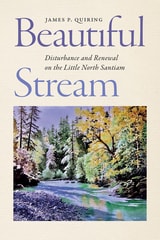
Beautiful Stream
Disturbance and Renewal on the Little North SantiamJames P. Quiring
Oregon State University Press, 2026
Through personal reflection and historic events, Beautiful Stream chronicles the natural and human story of Oregon’s Little North Santiam River, sentimentally referred to as the North Fork. James Quiring showcases this remote community’s love of the land, resilience, and dedication to conservation alongside his own memories of his family’s retreat in the mountains. By conducting nearly one hundred interviews and combing through homestead-era journals, historic newspapers, and other sources, Quiring shares the canyon’s history, including the 2020 Beachie Creek Fire, the decades-long political battle for Opal Creek, and the timeless stories of neighbors coming together through challenging times.
In Beautiful Stream, Quiring shares the remarkable history of those who have encountered the North Fork: the Native Kalapuyan and Molallan peoples, the early homesteaders of Elkhorn, and turn-of-the-century settlers. Many cherished the land and took actions to protect it. In 1893 the upper North Fork received its first official conservation protection, which helped preserve the natural qualities of this special place. Quiring parallels the story of the North Fork with his own, writing, “my early years along the North Fork gave me the footing to move out to the path of my career, and then my career experiences steered me right back to the North Fork to learn and share its story.” Upon retirement, Quiring returned to the remote canyon and reflects on this place and people with fondness and keen insight. It’s with this affection that the recollections, records, and stories gathered in Beautiful Stream tell a moving history of a place and its people.
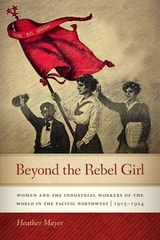
Beyond the Rebel Girl
Women and the Industrial Workers of the World in the Pacific Northwest, 1905-1924Heather Mayer
Oregon State University Press, 2018
In Beyond the Rebel Girl, historian Heather Mayer questions the well-worn vision of Wobblies as young, single, male, itinerant workers. While such workers formed a large portion of the membership, they weren’t the whole picture. In small towns across the Northwest, and in the larger cities of Seattle, Portland, and Spokane, women played an integral role in Wobbly life. Single women, but also families—husband and wife Wobbly teams—played important roles in some of the biggest fights for justice. IWW halls in these Northwest cities often functioned as community centers, with family-friendly events and entertainment.
Women were drawn to the IWW for its radical vision, inclusionary policies, birth control advocacy, and emphasis on freedom of choice in marriage. The IWW also offered women an avenue for activism that wasn’t focused primarily on the fight for suffrage. Beyond the Rebel Girl deepens our understanding of how the IWW functioned and how the union supported women in their fight for birth control, sexual emancipation, and better labor conditions, all while facing persecution at the local, state, and federal levels.
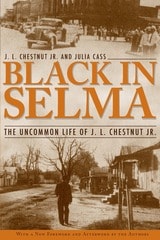
Black in Selma
The Uncommon Life of J. L. Chestnut Jr.J. L. Chestnut
University of Alabama Press, 2007
One man’s fight for justice. One town’s reckoning with history.
Born in Selma in 1930, J. L. Chestnut left home to study law at Howard University in Washington, DC. Returning to Selma, Chestnut was the town’s first and only African American attorney in the late 1950s. As the turbulent struggle for civil rights spread across the South, Chestnut became an active and ardent promoter of social and legal equality in his hometown. A key player on the local and state fronts, Chestnut accrued deep insights into the racial tensions in his community and deftly opened paths toward a more equitable future.
Though intimately involved in many events that took place in Selma, Chestnut was nevertheless often identified in history books simply as “a local attorney.” Black in Selma reveals his powerful yet little-known story.
In the 2014 film Selma, director Ava DuVernay takes audiences to the climactic confrontation between civil rights advocates and the state’s security forces of March 1965. Readers looking for a deeper understanding of the events that preceded that epic moment, as well as how racial integration unfolded in Selma in the decades that followed, will find Chestnut’s story and memories both a vital primary source and an inspiration.
Boots, Bikes, and Bombers
Adventures of Alaska Conservationist Ginny Hill WoodEdited by Karen Brewster
University of Alaska Press, 2012
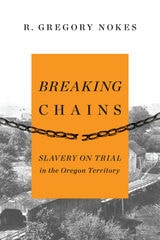
Breaking Chains
Slavery on Trial in the Oregon TerritoryR. Gregory Nokes
Oregon State University Press, 2013
In Breaking Chains, R. Gregory Nokes tells the story of the only slavery case adjudicated in Oregon’s pre-Civil War courts—Holmes v. Ford. Through the lens of this landmark case, Nokes explores the historical context of racism in Oregon and the West, reminding readers that there actually were slaves in Oregon, though relatively few in number.
Drawing on the court record, Nokes offers an intimate account of the relationship between a slave and his master from the slave’s point of view. He also explores the experiences of other slaves in early Oregon, examining attitudes toward race and revealing contradictions in the state’s history. Oregon was the only free state admitted to the union with a voter-approved constitutional clause banning African Americans and, despite the prohibition of slavery in the state, many in Oregon tolerated it and supported politicians who advocated for slavery, including Oregon’s first territorial governor.
Breaking Chains sheds light on a somber part of Oregon’s history, bringing the story of slavery in Oregon to a broader audience. The book will appeal to readers interested in Pacific Northwest history and in the history of slavery in the United States.
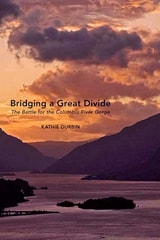
Bridging a Great Divide
The Battle for the Columbia River GorgeKathie Durbin
Oregon State University Press, 2013
In Bridging a Great Divide, award-winning environmental journalist Kathie Durbin draws on interviews, correspondence, and extensive research to tell the story of the major shifts in the Gorge since the Act’s passage. Sweeping change has altered the Gorge’s landscape: upscale tourism and outdoor recreation, gentrification, the end of logging in national forests, the closing of aluminum plants, wind farms, and a population explosion in the metropolitan area to its west. Yet, to the casual observer, the Gorge looks much the same as it did twenty-five years ago.
How can we measure the success of the Columbia River Gorge National Scenic Area Act? In this insightful and revealing history, Durbin suggests that the answer depends on who you are: a small business owner, an environmental watchdog group, a chamber of commerce. The story of the Columbia River Gorge National Scenic Area is the story of the Pacific Northwest in microcosm, as the region shifts from a natural-resource-based economy to one based on recreation, technology, and quality of life.