Results by title
314 books match the query 'Plants' and 11 start with b
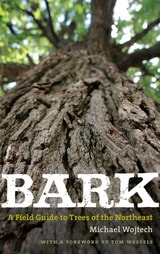
Bark
A Field Guide to Trees of the NortheastMichael Wojtech
Brandeis University Press, 2020
What kind of tree is that? Whether you’re hiking in the woods or simply sitting in your backyard, from Maine to New York you’ll never be without an answer to that question, thanks to this handy companion to the trees of the Northeast. Featuring detailed information and illustrations covering each phase of a tree’s lifecycle, this indispensable guidebook explains how to identify trees by their bark alone—no more need to wait for leaf season. Chapters on the structure and ecology of tree bark, descriptions of bark appearance, an easy-to-use identification key, and supplemental information on non-bark characteristics—all enhanced by more than 450 photographs, illustrations, and maps—will show you how to distinguish the textures, shapes, and colors of bark to recognize various tree species, and also understand why these traits evolved.
Whether you’re a professional naturalist or a parent leading a family hike, this new edition of Bark: A Field Guide to Trees of the Northeast is your essential guide to the region’s 67 native and naturalized tree species.
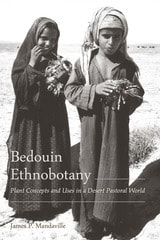
Bedouin Ethnobotany
Plant Concepts and Uses in a Desert Pastoral WorldJames P. Mandaville
University of Arizona Press, 2011
Bedouin Ethnobotany offers the first detailed study of plant uses among the Najdi Arabic–speaking tribal peoples of eastern Saudi Arabia. It also makes a major contribution to the larger project of ethnobotany by describing aspects of a nomadic peoples’ conceptual relationships with the plants of their homeland.
The modern theoretical basis for studies of the folk classification and nomenclature of plants was developed from accounts of peoples who were small-scale agriculturists and, to a lesser extent, hunter-gatherers. This book fills a major gap by extending such study into the world of the nomadic pastoralist and exploring the extent to which these patterns are valid for another major subsistence type. James P. Mandaville, an Arabic speaker who lived in Saudi Arabia for many years, focuses first on the role of plants in Bedouin life, explaining their uses for livestock forage, firewood, medicinals, food, and dyestuffs, and examining other practical purposes. He then explicates the conceptual and linguistic aspects of his subject, applying the theory developed by Brent Berlin and others to a previously unstudied population. Mandaville also looks at the long history of Bedouin plant nomenclature, finding that very little has changed among the names and classifications in nearly eleven centuries.
This volume includes a CD-ROM featuring more than 340 color images of the people, the terrain, and nearly all of the plants mentioned in the text as well as an audio file of a traditional Bedouin song and its translation and analysis.
An essential volume for anyone interested in the interaction between human culture and plant life, Bedouin Ethnobotany will stand as a definitive source for years to come.
Beyond the Trees
Stories of Wisconsin ForestsCandice Gaukel Andrews
Wisconsin Historical Society Press, 2011
Nature writer Candice Andrews weaves together contemporary observations and historical reminisces in Beyond the Trees: Stories of Wisconsin Forests. Readers will journey to some of the most pristine and notable places in the Upper Midwest—Wisconsin’s state and national forests.
The diversity of landscapes evoked in Beyond the Trees is matched only by the characters who inhabit them. Traverse the footsteps of Ojibwe hunters and early explorers in the remote woods of Brule River State Forest. Trek past the remains of bygone logging and CCC camps in the Chequamegon-Nicolet National Forest. Glimpse into the world of Great Lakes shipping in Point Beach State Forest. Walk on trails named after John Muir and Increase Lapham in the Kettle Moraine State Forest, and experience urban green space at Milwaukee’s Havenwoods State Forest. From orchids to oak savanna, beaver to brook trout, and white-tailed deer to timber wolves, discover Wisconsin’s wildlife and flora and fauna. Archival images, informative sidebars, locator maps, and contact information for Wisconsin state and national forests round out this unique book.
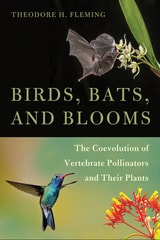
Birds, Bats, and Blooms
The Coevolution of Vertebrate Pollinators and Their PlantsTheodore H. Fleming
University of Arizona Press, 2024
Vertebrate pollinators like bats and birds are keystone species of the Sonoran Desert. Biologist Theodore H. Fleming uses these species—found in the desert around his home—to address two big questions dealing with the evolution of life on Earth: How did these animals evolve, and how did they coevolve with their food plants?
A deeply thoughtful and researched dive into evolutionary history, Birds, Bats, and Blooms offers an engaging trip across evolutionary trajectories as it discusses nectar-feeding birds and bats and their coevolution as pollinators with flowering plants. The primary focus is on New World birds such as hummingbirds and their chiropteran counterparts (nectar-feeding bats in the family Phyllostomidae). It also discusses their Old World ecological counterparts, including sunbirds, honeyeaters, lorikeets, and nectar-feeding bats in the Pteropodidae family. Fleming also addresses the conservation status of these beautiful animals.
Through engaging prose, Fleming pulls together the most recent research in evolutionary biology and pairs it with accounts of his personal interactions with bats and birds. His account includes fourteen color photographs taken by the author during his research trips around the world.
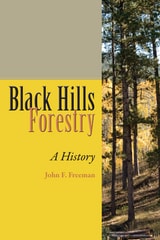
Black Hills Forestry
A HistoryJohn F. Freeman
University Press of Colorado, 2023
One of the first forests actively managed by the federal government and the site of the first sale of federally owned timber to a private party, the Black Hills National Forest has served as a management model for all national forests. Its many uses, activities, and issues—recreation, timber, mining, grazing, tourism, First American cultural usage, and the intermingling of public and private lands—expose the ongoing tensions between private landowners and public land managers. Freeman shows how forest management in the Black Hills encapsulates the Forest Service's failures to keep up with changes in the public's view of forest values until compelled to do so by federal legislation and the courts. In addition, he explores how more recent events in the region like catastrophic wildfires and mountain pine beetle epidemics have provided forest managers with the chance to realign their efforts to create and maintain a biologically diverse forest that can better resist natural and human disturbances.
This study of the Black Hills offers an excellent prism through which to view the history of the US Forest Service's land management policies. Foresters, land managers, and regional historians will find Black Hills Forestry a valuable resource.
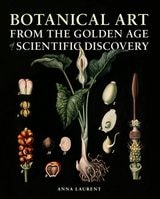
Botanical Art from the Golden Age of Scientific Discovery
Anna Laurent
University of Chicago Press, 2016
This beautifully illustrated oversized book gives the humble wall chart its due, reproducing more than two hundred of them in dazzling full color. Each wall chart is accompanied by captions that offer accessible information about the species featured, the scientists and botanical illustrators who created it, and any particularly interesting or innovative features the chart displays. And gardeners will be pleased to discover useful information about plant anatomy and morphology and species differences. We see lilies and tulips, gourds, aquatic plants, legumes, poisonous plants, and carnivorous plants, all presented in exquisite, larger-than-life detail.
A unique fusion of art, science, and education, the wall charts gathered here offer a glimpse into a wonderful scientific heritage and are sure to thrill naturalists, gardeners, and artists alike.
Botanical Companions
A Memoir of Plants and PlaceFrieda Knobloch
University of Iowa Press, 2005
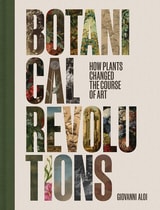
Botanical Revolutions
How Plants Changed the Course of ArtGiovanni Aloi
J. Paul Getty Trust, The, 2025
Desired for their aesthetic beauty, sought after for their medicinal properties, harvested for their scents and flavors, or grown as essential material resources, plants are indissolubly entwined with our existence. In art it is no different: plants have played a critical role. Yet despite their significant material and conceptual contributions, plants have been sidelined in the commentary of art historians and critics.
Botanical Revolutions presents a global history of plants in art, focusing on the crucial moments that signaled the formation of new movements and styles, as well as the creation of media that could not have occurred without the involvement of and interaction with the vegetal world. In this fascinating and beautifully illustrated book, author Giovanni Aloi delves deeply into the history and representation of plants in art, advocates for a change in our relationship with the botanical world, and presents an alternative history of art that foregrounds the truly indispensable contributions of plants.
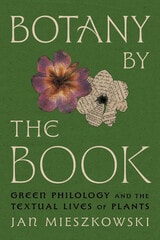
Botany by the Book
Green Philology and the Textual Lives of PlantsJan Mieszkowski
University of Chicago Press, 0
Drawing on philosophers and poets with a passion for botany, this book shows that the study of plants has always been a study of language as much as of living things.
At a moment when environmental thought is struggling to move beyond inherited assumptions about nature and humanity’s place within it, Botany by the Book offers a new perspective on the history of ecological thinking. Bringing together a diverse range of writers, it uncovers a long and largely forgotten tradition of “green philology” in which empirical inquiry and literary reflection developed side by side. Figures such as Locke, Rousseau, Goethe, Mill, Dickinson, Akhmatova, Luxemburg, Celan, and Heidegger were avid botanizers, collecting specimens and in some cases meticulously curating herbaria. Spanning centuries, this hidden conversation links poets, philosophers, and naturalists whose intellectual kinship was often stronger than they themselves realized.
Tracing a line from Carl Linnaeus’s love of metaphor to Emily Dickinson’s adolescent herbarium to the contemporary politics of floral aesthetics, Jan Mieszkowski reveals how efforts to conceptualize plant life raise fundamental questions about power and knowledge. He also takes up contemporary writers, such as Hanif Abdurraqib and Ross Gay, whose flower poems refuse to play by the rules. Ultimately, Mieszkowski shows that botany has inspired a green philology, its distinctive reflections on language and epistemology offering fertile soil for ecocriticism today. Going beyond traditional distinctions between the sciences and the humanities, Botany by the Book argues that reckoning honestly with how we represent nature is inseparable from imagining more livable ecological futures.
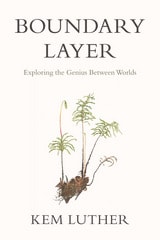
Boundary Layer
Exploring the Genius Between WorldsKem Luther
Oregon State University Press, 2016
In Boundary Layer, Luther takes a voyage of discovery through the stegnon, exploring the life forms that thrive there and introducing readers to the scientists who study them. With a keen ear for conversation and an eye for salient detail, the author brings a host of characters to life, people as unique and intriguing as the species inhabiting the stegnon.
A pair of park employees on a windswept beach shows how the violent clash of sea and land creates a sandy home for some of the world’s most endangered plants, including the almost-extinct pink sand-verbena. An expert on mosses, as ingenuous as the plants he loves, leads the author up a mountain and into a sphagnum bog. A husband and wife team, exiled by brutal repression in the wake of the Prague Spring, introduce European plant sociology to North America. A scientist, while revolutionizing the study of lichens, hides himself, hermitlike, inside one of the largest park reserves in the American West.
An exhilarating mix of natural history, botanical exploration, and philosophical speculation, Boundary Layer guides readers, in the end, into the author’s own landscape of metaphor. It will be welcomed by naturalists, botanists, outdoor adventurers, and anyone who savors good storytelling. Luther translates into luminous prose what boundary regions have to say, not only about the in-between places of nature, but also about the conceptual borderlands that lie between species and ecosystems, culture and nature, science and the humanities.
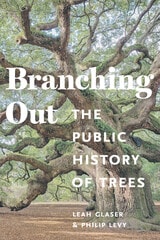
Branching Out
The Public History of TreesEdited by Leah S. Glaser and Philip Levy
University of Massachusetts Press, 2025
Trees are not just natural resources; they are also cultural ones that present unique challenges and opportunities for public historians. Trees can serve as important objects of memory, recalling past triumphs or tragedies. They can be the last living witness to important events or community stories. Trees can also be objects of preservation, sometimes as individuals, other times as stands or even forests, all of which can take on historical significance for people, sites, and institutions. But as living entities they defy the kind of permanent legal preservation applicable to buildings and other non-living historical objects. Furthermore, their organic fragility can actually make them significant problems for historical sites and local preservation activities. For example, communities have had to cope with extensive tree loss from storm and fire damage, and dying trees can drop limbs or topple over, creating considerable danger to people and resources. Climate-change-driven increasing storm intensity has also highlighted the ways that trees—however historical or beloved—can become considerable threats.
The fourteen new essays in this volume explore the many ways that trees are an integral part of public history practice and sites. The authors draw on a range of approaches and historiographies to look at how memories of race-based hate, patriotic stories, community identities, and changed places have all centered on trees. In addition to contributions from the volume editors, this collection features scholarship by Sonja Dümpelmann Andrew Hurley, Carolyn M. Barske Crawford, Brian Dempsey, Liz Sargent, Sasha Coles, Mariaelena DiBenigno, Evan Haefeli, Krista McCracken, Alena Pirok, Christian Kosmas Mayer Alaina Scapicchio, and David Glassberg.