336 books match the query 'Political Economy' and 7 start with b
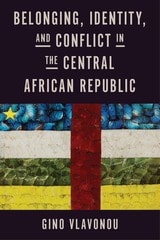
cover of Belonging, Identity, and Conflict in the Central African Republic

Belonging, Identity, and Conflict in the Central African Republic

Gino Vlavonou

University of Wisconsin Press, 2023

Political conflict in many parts of the world has been shaped by notions of who rightfully belongs to a place. The concept of autochthony—that a true, original people are born of a land and belong to it above all others—has animated struggles across postcolonial Africa. But is this sense of rootedness from time immemorial necessary to assertions of original being and thus political supremacy? Belonging, Identity, and Conflict in the Central African Republic examines how political conflict unfolds when the language of autochthony is detached from historical land claims. 

Focusing on violent struggles in the Central African Republic between 2012 and 2019, Gino Vlavonou explores the social practices, discursive strategies, and government policies that emerged in the relentless project of African state building. Conflict pitted Christian-animist communities, loosely organized as vigilante groups under the name anti-Balaka, against Muslim rebels known as the Séléka. Fighters of the anti-Balaka claimed that they were autochthonous, the “true Central Africans,” reframing their Muslim neighbors as foreigners to be expelled. While the country had previously witnessed episodes of violence, both peoples had lived together relatively peacefully and intermarried. The speed and ferocity with which identity was weaponized puzzled many observers. To understand this phenomenon, Vlavonou probes autochthony as a category of identity that differs from ethnicity in important ways. He argues that elites and ordinary citizens alike mobilize the language of original belonging as “identity capital,” a resource to be deployed. The value of that capital is lodged in what people say and do every day to give meaning to their identity, and its content changes across time and space. 

[more]
cover of Between Field and Cooking Pot: The Political Economy of Marketwomen in Peru, Revised Edition

Between Field and Cooking Pot

The Political Economy of Marketwomen in Peru, Revised Edition

By Florence E. Babb

University of Texas Press, 1998

From reviews of the first edition:

"Between Field and Cooking Pot offers details of the daily lives of marketwomen in the central Andean departmental capital of Huaraz.... A welcome addition to studies of women and international development, this book contains a wealth of firsthand material, collected through informal participant-observation as well as formal interviews and analysis of statistical data.... The book encourages us to imagine how the dynamic culture of marketwomen might intersect with the construction, representation, and effects of class and gender."
—American Anthropologist

"The book has a clear and readable style, moving easily between vignettes of marketwomen's lives, descriptions of the markets themselves, and surveys of the theoretical literature. Babb's long, close involvement with the Huaraz markets is apparent. As someone who has spent a lot of time in Andean markets, I found the book pleasurable to read, because it recreated the experience of the marketplace so well."
—American Ethnologist

This revised edition of Between Field and Cooking Pot offers an updated appraisal of what neoliberal politics and economics mean in the lives of marketwomen in the nineties, based on new fieldwork conducted in 1997. Babb also reflects on how recent currents in feminist and anthropological studies have caused her to rethink some aspects of Andean marketers in Peruvian culture and society.

[more]
cover of Between HIV Prevention and LGBTI Rights: The Political Economy of Queer Activism in Ghana

Between HIV Prevention and LGBTI Rights

The Political Economy of Queer Activism in Ghana

Ellie Gore

University of Michigan Press, 2024

Between HIV Prevention and LGBTI Rights investigates the transformative impacts of global development's sexual rights agenda on queer politics and activism in Ghana. With queer men bearing a disproportionate burden of HIV in Africa, rights-based health interventions have sought to tackle the epidemic by bringing together, educating, and ‘empowering’ queer African communities. Gore argues that queer Ghanaian men are not benefiting from development’s turn to sexual health and sexual rights. Instead, HIV and other sexual rights–based initiatives operate through neoliberal paradigms that reinforce class divides and de-politicize queer struggle. These dynamics are further shaping and shaped by the politicization of homophobia within the contemporary Ghanaian state.

Gore combines original ethnography, documentary analysis, and the examination of development and global health data to connect the struggle for queer liberation in Ghana to broader trajectories of capitalist transformation and crisis and the afterlives of colonialism. In doing so, Between HIV Prevention and LGBTI Rights offers fascinating insights into the political economy of sexuality and global development for scholars, activists, and policymakers seeking to understand and address sexual injustice and oppression, both in Africa and beyond.

The open access edition of this book was made possible through the support of the Economic and Social Research Council (UK).
[more]
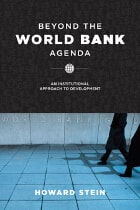
cover of Beyond the World Bank Agenda: An Institutional Approach to Development

Beyond the World Bank Agenda

An Institutional Approach to Development

Howard Stein

University of Chicago Press, 2008

Despite massive investment of money and research aimed at ameliorating third-world poverty, the development strategies of the international financial institutions over the past few decades have been a profound failure. Under the tutelage of the World Bank, developing countries have experienced lower growth and rising inequality compared to previous periods. In Beyond the World Bank Agenda, Howard Stein argues that the controversial institution is plagued by a myopic, neoclassical mindset that wrongly focuses on individual rationality and downplays the social and political contexts that can either facilitate or impede development.
            Drawing on the examples of Africa, Asia, Latin America, and transitional European economies, this revolutionary volume proposes an alternative vision of institutional development with chapter-length applications to finance, state formation, and health care to provide a holistic, contextualized solution to the problems of developing nations. Beyond the World Bank Agenda will be essential reading for anyone concerned with forging a new strategy for sustainable development. 


[more]
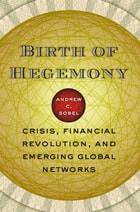
cover of Birth of Hegemony: Crisis, Financial Revolution, and Emerging Global Networks

Birth of Hegemony

Crisis, Financial Revolution, and Emerging Global Networks

Andrew C. Sobel

University of Chicago Press, 2012
With American leadership facing increased competition from China and India, the question of how hegemons emerge—and are able to create conditions for lasting stability—is of utmost importance in international relations. The generally accepted wisdom is that liberal superpowers, with economies based on capitalist principles, are best able to develop systems conducive to the health of the global economy.
 
In Birth of Hegemony, Andrew C. Sobel draws attention to the critical role played by finance in the emergence of these liberal hegemons. He argues that a hegemon must have both the capacity and the willingness to bear a disproportionate share of the cost of providing key collective goods that are the basis of international cooperation and exchange. Through this, the hegemon helps maintain stability and limits the risk to productive international interactions. However, prudent planning can account for only part of a hegemon’s ability to provide public goods, while some of the necessary conditions must be developed simply through the processes of economic growth and political development. Sobel supports these claims by examining the economic trajectories that led to the successive leadership of the Netherlands, Britain, and the United States.
 
Stability in international affairs has long been a topic of great interest to our understanding of global politics, and Sobel’s nuanced and theoretically sophisticated account sets the stage for a consideration of recent developments affecting the United States.
[more]
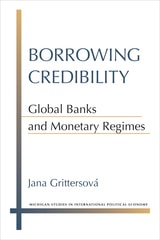
cover of Borrowing Credibility: Global Banks and Monetary Regimes

Borrowing Credibility

Global Banks and Monetary Regimes

Jana Grittersová

University of Michigan Press, 2017

Nations with credible monetary regimes borrow at lower interest rates in international markets and are less likely to suffer speculative attacks and currency crises. While scholars typically attribute credibility to domestic institutions or international agreements, Jana Grittersová argues that when reputable multinational banks headquartered in Western Europe or North America open branches and subsidiaries within a nation, they enhance that nation’s monetary credibility.

These banks enhance credibility by promoting financial transparency in the local system, improving the quality of banking regulation and supervision, and by serving as private lenders of last resort. Reputable multinational banks provide an enforcement mechanism for publicized economic policies, signaling to international financial markets that the host government is committed to low inflation and stable currency.

Grittersová examines actual changes in government behavior of nations trying to gain legitimacy in international financial markets, and the ways in which perceptions of these nations change in relation to multinational banks. In addition to quantitative analysis of over 80 emerging-market countries, she offers extensive case studies of credibility building in the transition countries of Eastern Europe, Argentina in 2001, and the global financial crisis of 2008. Grittersová illuminates the complex interactions between multinational banks and national policymaking that characterize the process of financial globalization to reveal the importance of market confidence in a world of mobile capital. 
 
[more]
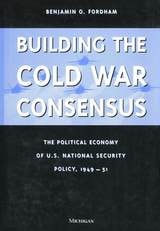
cover of Building the Cold War Consensus: The Political Economy of U.S. National Security Policy, 1949-51

Building the Cold War Consensus

The Political Economy of U.S. National Security Policy, 1949-51

Benjamin O. Fordham

University of Michigan Press, 1998

In 1950, the U.S. military budget more than tripled while plans for a national health care system and other new social welfare programs disappeared from the agenda. At the same time, the official campaign against the influence of radicals in American life reached new heights. Benjamin Fordham suggests that these domestic and foreign policy outcomes are closely related. The Truman administration's efforts to fund its ambitious and expensive foreign policy required it to sacrifice much of its domestic agenda and acquiesce to conservative demands for a campaign against radicals in the labor movement and elsewhere.
Using a statistical analysis of the economic sources of support and opposition to the Truman Administration's foreign policy, and a historical account of the crucial period between the summer of 1949 and the winter of 1951, Fordham integrates the political struggle over NSC 68, the decision to intervene in the Korean War, and congressional debates over the Fair Deal, McCarthyism and military spending. The Truman Administration's policy was politically successful not only because it appealed to internationally oriented sectors of the U.S. economy, but also because it was linked to domestic policies favored by domestically oriented, labor-sensitive sectors that would otherwise have opposed it.
This interpretation of Cold War foreign policy will interest political scientists and historians concerned with the origins of the Cold War, American social welfare policy, McCarthyism, and the Korean War, and the theoretical argument it advances will be of interest broadly to scholars of U.S. foreign policy, American politics, and international relations theory.
Benjamin O. Fordham is Assistant Professor of Political Science, State University of New York at Albany.
[more]