213 books match the query 'Political parties' and 5 start with b
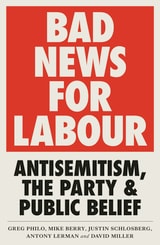
cover of Bad News for Labour: Antisemitism, the Party and Public Belief

Bad News for Labour

Antisemitism, the Party and Public Belief

Greg Philo

Pluto Press, 2019

Jointly written by five leading voices on the topic, this book looks at the contentious issue of antisemitism in the Labour Party today, and sets out ways of addressing the problem while maintaining the integrity of the organisation. The first part of the book includes original material on public beliefs about antisemitism in the Labour Party, and the kinds of problems this poses regarding voting intentions and demoralization of the membership. The writers then investigate the institutional problems and policy decisions that prevented a coherent and well-planned response from the party, and how Labour can rectify this today. The book progresses to explore in depth the coverage of the issue in mainstream media outlets, and the partial accounts presented to the public. The writers focus on the debates around the IHRA definition, and the accusations made against David Miller which were eventually dismissed and set an important precedent. At the end of the book, Mike Berry provides a helpful chronological account of the arguments surrounding this issue from the beginning of Corbyn's leadership to the present.
[more]
cover of Banking on Reform: Political Parties and Central Bank Independence in the Industrial Democracies

Banking on Reform

Political Parties and Central Bank Independence in the Industrial Democracies

William Bernhard

University of Michigan Press, 2002

Banking on Reform examines the political determinants of recent reforms to monetary policy institutions in the industrial democracies. With these reforms, political parties have sought to draw on the political credibility of an independent central bank to cope with electoral consequences of economic internalization and deindustrialization.
New Zealand and Italy made the initial efforts to grant their central banks independence. More recently, France, Spain, Britain, and Sweden have reformed their central banks' independence. Additionally, members of the European Union have implemented a single currency, with an independent European central bank to administer monetary policy.
Banking on Reform stresses the politics surrounding the choice of these institutions, specifically the motivations of political parties. Where intraparty conflicts have threatened the party's ability to hold office, politicians have adopted an independent central bank. Where political parties have been secluded from the political consequences of economic change, reform has been thwarted or delayed. The drive toward a single currency also reflects these political concerns. By delegating monetary policy to the European level, politicians in the member states removed a potentially divisive issue from the domestic political agenda, allowing parties to rebuild their support constructed on the basis of other issues. William T. Bernhard provides a variety of evidence to support his argument, such as in-depth case accounts of recent central bank reforms in Italy and Britain, the role of the German Bundesbank in the policy process, and the adoption of the single currency in Europe. Additionally, he utilizes quantitative and statistical tests to enhance his argument.
This book will appeal to political scientists, economists, and other social scientists interested in the political and institutional consequences of economic globalization.
William T. Bernhard is Assistant Professor of Political Science, University of Illinois, Urbana-Champaign.
[more]
cover of Beyond Ideology: Politics, Principles, and Partisanship in the U. S. Senate

Beyond Ideology

Politics, Principles, and Partisanship in the U. S. Senate

Frances E. Lee

University of Chicago Press, 2009

The congressional agenda, Frances Lee contends, includes many issues about which liberals and conservatives generally agree. Even over these matters, though, Democratic and Republican senators tend to fight with each other. What explains this discord? Beyond Ideology argues that many partisan battles are rooted in competition for power rather than disagreement over the rightful role of government.

The first book to systematically distinguish Senate disputes centering on ideological questions from the large proportion of them that do not, this volume foregrounds the role of power struggle in partisan conflict. Presidential leadership, for example, inherently polarizes legislators who can influence public opinion of the president and his party by how they handle his agenda. Senators also exploit good government measures and floor debate to embarrass opponents and burnish their own party’s image—even when the issues involved are broadly supported or low-stakes. Moreover, Lee contends, the congressional agenda itself amplifies conflict by increasingly focusing on issues that reliably differentiate the parties. With the new president pledging to stem the tide of partisan polarization, Beyond Ideology provides a timely taxonomy of exactly what stands in his way.

[more]
cover of Beyond Left, Right, and Center: The Politics of Gender and Ethnicity in Contemporary Germany

Beyond Left, Right, and Center

The Politics of Gender and Ethnicity in Contemporary Germany

Christina Xydias

Temple University Press, 2024

Women’s political representation is often expected to be better on “the left.” However, the reality is more complicated. Using Germany’s multi-party system as its central case study, Beyond Left, Right, and Center challenges this conventional wisdom on political ideology.

Christina Xydias shows that some right-leaning parties advocate for women’s rights and interests, while left- and right-leaning parties can be equally indifferent to lack of representation for women from marginalized groups. These findings follow from analyses of election results, transcripts from debates and speeches, and personal interviews, as well as from a close reading of intertwined military and citizenship policies that illustrate how women’s and ethnic minority groups’ rights are constructed.

Beyond Left, Right, and Center concludes with an analysis of women’s representation across OECD countries, showing that right-leaning parties are more likely to support women’s rights and interests in societies that are more egalitarian.

[more]
cover of Broken Government?

Broken Government?

Edited by Iwan Morgan and Philip D. Davies

University of London Press, 2013

Barack Obama's election as president in 2008 generated widespread hope that the United States was entering a new era whereby government, in a reversal of Ronald Reagan's famous dictum, would be the solution to the nation's manifold problems amid the worst economic downturn since the Great Depression. The Obama election slogan of ""Yes We Can"" seemed to voice a hope that new leadership would put right what had gone wrong with America. Anticipating a new era of government activism, some commentators read the death rites on ""The Age of Reagan,"" the post-1980 anti-statist trend of American politics. Within a short time, however, ""Yes We Can"" gave way to ""No We Can't,"" as America's government became enmeshed in gridlock and political polarization. The contributors to Broken Government? add their voices to the debate on whether American government truly is broken and, if so, what can be done to fix it.
[more]