Results by title
102 books match the query 'Poor' and 6 start with b
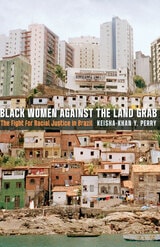
Black Women against the Land Grab
The Fight for Racial Justice in BrazilKeisha-Khan Y. Perry
University of Minnesota Press, 2013
In Brazil and throughout the African diaspora, black women, especially poor black women, are rarely considered leaders of social movements let alone political theorists. But in the northeastern city of Salvador, Brazil, it is these very women who determine how urban policies are established. Focusing on the Gamboa de Baixo neighborhood in Salvador’s city center, Black Women against the Land Grab explores how black women’s views on development have radicalized local communities to demand justice and social change.
In Black Women against the Land Grab, Keisha-Khan Y. Perry describes the key role of local women activists in the citywide movement for land and housing rights. She reveals the importance of geographic location for understanding the gendered aspects of urban renewal and the formation of black women–led social movements. How have black women shaped the politics of urban redevelopment, Perry asks, and what does this kind of political intervention tell us about black women’s agency? Her work uncovers the ways in which political labor at the neighborhood level is central to the mass mobilization of black people against institutional racism and for citizenship rights and resources in Brazil.
Highlighting the political life of black communities, specifically those in urban contexts often represented as socially pathological and politically bankrupt, Black Women against the Land Grab offers a valuable corrective to how we think about politics and about black women, particularly poor black women, as a political force.
Blaming the Poor
The Long Shadow of the Moynihan Report on Cruel Images about PovertyGreenbaum, Susan D
Rutgers University Press, 2015

Born Again in Brazil
The Pentecostal Boom and the Pathogens of PovertyR. Andrew Chesnut
Rutgers University Press, 1997
Both Hands Tied
Welfare Reform and the Race to the Bottom in the Low-Wage Labor MarketJane L. Collins and Victoria Mayer
University of Chicago Press, 2010
Both Hands Tied studies the working poor in the United States, focusing in particular on the relation between welfare and low-wage earnings among working mothers. Grounded in the experience of thirty-three women living in Milwaukee and Racine, Wisconsin, it tells the story of their struggle to balance child care and wage-earning in poorly paying and often state-funded jobs with inflexible schedules—and the moments when these jobs failed them and they turned to the state for additional aid.
Jane L. Collins and Victoria Mayer here examine the situations of these women in light of the 1996 national Personal Responsibility and Work Opportunity Reconciliation Act and other like-minded reforms—laws that ended the entitlement to welfare for those in need and provided an incentive for them to return to work. Arguing that this reform came at a time of gendered change in the labor force and profound shifts in the responsibilities of family, firms, and the state, Both Hands Tied provides a stark but poignant portrait of how welfare reform afflicted poor, single-parent families, ultimately eroding the participants’ economic rights and affecting their ability to care for themselves and their children.

Bread of Dreams
Food and Fantasy in Early Modern EuropePiero Camporesi
University of Chicago Press, 1989
"Camporesi is as much a poet as a historian. . . . His appeal is to the senses as well as to the mind. . . . Fascinating in its details and compelling in its overall message."—Vivian Nutton, Times Literary Supplement
"It is not often that an academic monograph in history is also a book to fascinate the discriminating general reader. Bread of Dreams is just that."—Kenneth McNaught, Toronto Star
"Not religion but bread was the opiate of the poor, Mr. Camporesi argues. . . . Food has always been a social and mythological construct that conditions what we vainly imagine to be matters of personal taste. Our hunger for such works should tell us that food is not only good but essential to think and to read as if our lives depended on it, which they do."—Betty Fussell, New York Times Book Review
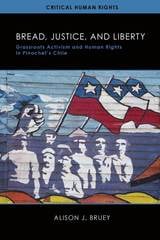
Bread, Justice, and Liberty
Grassroots Activism and Human Rights in Pinochet's ChileAlison J. Bruey
University of Wisconsin Press, 2020
As Bruey shows, crucial to the popular movement built in the 1970s were the activism of both men and women and the coalition forged by liberation-theology Catholics and Marxist-Left militants. These alliances made possible the mass protests of the 1980s that paved the way for Chile's return to democracy, but the changes fell short of many activists' hopes. Their grassroots demands for human rights encompassed not just an end to state terror but an embrace of economic opportunity and participatory democracy for all.
Deeply grounded by both extensive oral history interviews and archival research, Bread, Justice, and Liberty offers innovative contributions to scholarship on Chilean history, social movements, popular protest and democratization, neoliberal economics, and the Cold War in Latin America.