Results by title
194 books match the query 'Practice' and 3 start with b
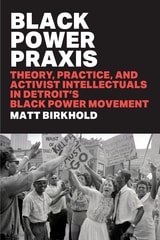
Black Power Praxis
Theory, Practice, and Activist Intellectuals in Detroit's Black Power MovementMatt Birkhold
University of Michigan Press, 2026
Black Power Praxis shows how four groups of activist-intellectuals—James and Grace Lee Boggs, Richard and Milton Henry, Reverend Albert Cleage, and a group of college students called Uhuru—shifted the consciousness and political perspectives of Black Detroiters in the 1960s and 1970s. By developing theories that they could unite with community-organizing practices, these activist-intellectuals turned the focus of the grassroots movement for racial equality from Civil Rights to Black Power. Following the 1967 Detroit Rebellion, these Black Power activist-intellectuals were already positioned to harness the energy that emerged from the uprising and directed it into the city’s first citywide Black Power organization, the Citywide Citizens Action Committee.
Even as Black Power theories became dominant over Detroit’s grassroots movement, their influence faltered when they failed to develop community organizing practices corresponding to the lived experiences of Black Detroiters. Black Power Praxis reveals how the relationships between ideas, practices, leadership, material reality, and consciousness drove the historical development of Black Power. Ideal for readers curious about social movements, Detroit history, African American history, and African American Studies, the book sheds light on how, why, and when Detroit’s activist-intellectual leaders successfully showed everyday people how their power might be used in transformative ways.
Bodies of Knowledge
Embodied Rhetorics in Theory and PracticeA. Abby Knoblauch
Utah State University Press, 2021
The pieces in Bodies of Knowledge draw explicit attention to the impact of the body on text, the impact of the body in text, the impact of the body as text, and the impact of the body upon textual production. The contributors investigate embodied rhetorics through the lenses of race and ethnicity, gender and sexuality, disability and pain, technologies and ecologies, clothing and performance, and scent, silence, and touch. In doing so, they challenge the (false) notion that academic knowledge—that is, “real” knowledge—is disembodied and therefore presumed white, middle class, cis-het, able-bodied, and male. This collection lays bare how myriad bodies invent, construct, deliver, and experience the processes of knowledge building.
Experts in the field of writing studies provide the necessary theoretical frameworks to better understand productive (and unproductive) uses of embodied rhetorics within the academy and in the larger social realm. To help meet the theoretical and pedagogical needs of the discipline, Bodies of Knowledge addresses embodied rhetorics and embodied writing more broadly though a rich, varied, and intersectional approach. These authors address larger questions around embodiment while considering the various impacts of the body on theories and practices of rhetoric and composition.
Contributors: Scot Barnett, Margaret Booker, Katherine Bridgman, Sara DiCaglio, Kristie S. Fleckenstein, Vyshali Manivannan, Temptaous Mckoy, Julie Myatt, Julie Nelson, Ruth Osorio, Kate Pantelides, Caleb Pendygraft, Nadya Pittendrigh, Kellie Sharp-Hoskins, Anthony Stagliano, Megan Strom
Bridging the Multimodal Gap
From Theory to PracticeSantosh Khadka
Utah State University Press, 2018
After an introductory section reviewing the theory literature, chapters present research on implementing multimodal composition in diverse contexts. Contributors address starter subjects like using comics, blogs, or multimodal journals; more ambitious topics such as multimodal assignments in online instruction or digital story telling; and complex issues like assessment, transfer, and rhetorical awareness.
Bridging the Multimodal Gap translates theory into practice and will encourage teachers, including WPAs, TAs, and contingent faculty, to experiment with multiple modes of communication in their projects.
Contributors: Sara P. Alvarez, Steven Alvarez, Michael Baumann, Joel Bloch, Aaron Block, Jessie C. Borgman, Andrew Bourelle, Tiffany Bourelle, Kara Mae Brown, Jennifer J. Buckner, Angela Clark-Oates, Michelle Day, Susan DeRosa, Dànielle Nicole DeVoss, Stephen Ferruci, Layne M. P. Gordon, Bruce Horner, Matthew Irwin, Elizabeth Kleinfeld, Ashanka Kumari, Laura Sceniak Matravers, Jessica S. B. Newman, Mark Pedretti, Adam Perzynski, Breanne Potter, Caitlin E. Ray, Areti Sakellaris, Khirsten L. Scott, Rebecca Thorndike-Breeze, Jon Udelson, Shane A. Wood, Rick Wysocki, Kathleen Blake Yancey