Results by title
70 books match the query 'Prisons' and 4 start with b

Behind the Walls
A Guide for Families and Friends of Texas Prison InmatesJorge Antonio Renaud
University of North Texas Press, 2002
[more]
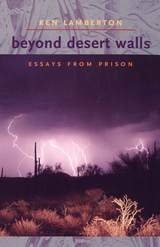
Beyond Desert Walls
Essays from PrisonKen Lamberton
University of Arizona Press, 2005
“From the upper bunk where I write, a narrow window allows me a southern exposure of the desert beyond this prison. Saguaro cacti, residents here long before this rude concrete pueblo, fill the upper part of my frame. If I could open the window and reach out across the razed ground, sand traps, and shining perimeter fence, I might touch their fluted sides, their glaucous and waxen skins.”
For some people, even prison cannot shut out the natural world.
A teacher and family man incarcerated in Arizona State Prison—the result of a transgression that would cost him a dozen years of his life—Ken Lamberton can see beyond his desert walls. In essays that focus on the natural history of the region and on his own personal experiences with desert places, the author of the Burroughs Medal-winning book Wilderness and Razor Wire takes readers along as he revisits the Southwest he knew when he was free, and as he makes an inner journey toward self-awareness. Whether considering the seemingly eternal cacti or the desolate beauty of the Pinacate, he draws on sharp powers of observation to re-create what lies beyond his six-by-eight cell and to contemplate the thoughts that haunt his mind as tenaciously as the kissing bugs that haunt his sleep.
Ranging from prehistoric ruins on the Colorado Plateau to the shores of the Sea of Cortez, these writings were begun before Wilderness and Razor Wire and serve as a prequel to it. They seamlessly interweave natural and personal history as Lamberton explores caves, canyons, and dry ponds, evoking the mysteries and rhythms of desert life that elude even the most careful observers. He offers new ways of thinking about how we relate to the natural world, and about the links between those relationships and the ones we forge with other people. With the assurance of a gifted writer, he seeks to make sense of his own place in life, crafting words to come to terms with an insanity of his own making, to look inside himself and understand his passions and flaws.
Whether considering rattlesnakes of the hellish summer desert or the fellow inmates of his own personal hell, Lamberton finds meaningful connections—to his crime and his place, to the people who remained in his life and those who didn’t. But what he reveals in Beyond Desert Walls ultimately arises from language itself: a deep, and perhaps even frightening, understanding of a singular human nature.
[more]
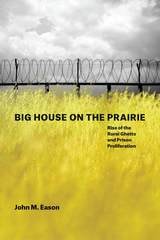
Big House on the Prairie
Rise of the Rural Ghetto and Prison ProliferationJohn M. Eason
University of Chicago Press, 2017
For the past fifty years, America has been extraordinarily busy building prisons. Since 1970 we have tripled the total number of facilities, adding more than 1,200 new prisons to the landscape. This building boom has taken place across the country but is largely concentrated in rural southern towns.
In 2007, John M. Eason moved his family to Forrest City, Arkansas, in search of answers to key questions about this trend: Why is America building so many prisons? Why now? And why in rural areas? Eason quickly learned that rural demand for prisons is complicated. Towns like Forrest City choose to build prisons not simply in hopes of landing jobs or economic wellbeing, but also to protect and improve their reputations. For some rural leaders, fostering a prison in their town is a means of achieving order in a rapidly changing world. Taking us into the decision-making meetings and tracking the impact of prisons on economic development, poverty, and race, Eason demonstrates how groups of elite whites and black leaders share power. Situating prisons within dynamic shifts that rural economies are undergoing and showing how racially diverse communities lobby for prison construction, Big House on the Prairie is a remarkable glimpse into the ways a prison economy takes shape and operates.
In 2007, John M. Eason moved his family to Forrest City, Arkansas, in search of answers to key questions about this trend: Why is America building so many prisons? Why now? And why in rural areas? Eason quickly learned that rural demand for prisons is complicated. Towns like Forrest City choose to build prisons not simply in hopes of landing jobs or economic wellbeing, but also to protect and improve their reputations. For some rural leaders, fostering a prison in their town is a means of achieving order in a rapidly changing world. Taking us into the decision-making meetings and tracking the impact of prisons on economic development, poverty, and race, Eason demonstrates how groups of elite whites and black leaders share power. Situating prisons within dynamic shifts that rural economies are undergoing and showing how racially diverse communities lobby for prison construction, Big House on the Prairie is a remarkable glimpse into the ways a prison economy takes shape and operates.
[more]
Building the Prison State
Race and the Politics of Mass IncarcerationHeather Schoenfeld
University of Chicago Press, 2018
The United States incarcerates more people per capita than any other industrialized nation in the world—about 1 in 100 adults, or more than 2 million people—while national spending on prisons has catapulted 400 percent. Given the vast racial disparities in incarceration, the prison system also reinforces race and class divisions. How and why did we become the world’s leading jailer? And what can we, as a society, do about it?
Reframing the story of mass incarceration, Heather Schoenfeld illustrates how the unfinished task of full equality for African Americans led to a series of policy choices that expanded the government’s power to punish, even as they were designed to protect individuals from arbitrary state violence. Examining civil rights protests, prison condition lawsuits, sentencing reforms, the War on Drugs, and the rise of conservative Tea Party politics, Schoenfeld explains why politicians veered from skepticism of prisons to an embrace of incarceration as the appropriate response to crime. To reduce the number of people behind bars, Schoenfeld argues that we must transform the political incentives for imprisonment and develop a new ideological basis for punishment.
[more]