140 books match the query 'Queer theory' and 12 start with b

cover of Bad Education: Why Queer Theory Teaches Us Nothing

Bad Education

Why Queer Theory Teaches Us Nothing

Lee Edelman

Duke University Press, 2022

Long awaited after No Future, and making queer theory controversial again, Lee Edelman’s Bad Education proposes a queerness without positive identity—a queerness understood as a figural name for the void, itself unnamable, around which the social order takes shape. Like Blackness, woman, incest, and sex, queerness, as Edelman explains it, designates the antagonism, the structuring negativity, preventing that order from achieving coherence. But when certain types of persons get read as literalizing queerness, the negation of their negativity can seem to resolve the social antagonism and totalize community. By translating the nothing of queerness into the something of “the queer,” the order of meaning defends against the senselessness that undoes it, thus mirroring, Edelman argues, education’s response to queerness: its sublimation of irony into the meaningfulness of a world. Putting queerness in relation to Lacan’s “ab-sens” and in dialogue with feminist and Afropessimist thought, Edelman reads works by Shakespeare, Jacobs, Almodóvar, Lemmons, and Haneke, among others, to show why queer theory’s engagement with queerness necessarily results in a bad education that is destined to teach us nothing.
[more]
cover of Bad Environmentalism: Irony and Irreverence in the Ecological Age

Bad Environmentalism

Irony and Irreverence in the Ecological Age

Nicole Seymour

University of Minnesota Press, 2018

Traces a tradition of ironic and irreverent environmentalism, asking us to rethink the movement’s reputation for gloom and doom

Activists today strive to educate the public about climate change, but sociologists have found that the more we know about alarming issues, the less likely we are to act. Meanwhile, environmentalists have acquired a reputation as gloom-and-doom killjoys. Bad Environmentalism identifies contemporary texts that respond to these absurdities and ironies through absurdity and irony—as well as camp, frivolity, irreverence, perversity, and playfulness. 

Nicole Seymour develops the concept of “bad environmentalism”: cultural thought that employs dissident affects and sensibilities to reflect critically on our current moment and on mainstream environmental activism. From the television show Wildboyz to the short film series Green Porno, Seymour shows that this tradition of thought is widespread—spanning animation, documentary, fiction film, performance art, poetry, prose fiction, social media, and stand-up comedy since at least 1975. Seymour argues that these texts reject self-righteousness and sentimentality, undercutting public negativity toward activism and questioning basic environmentalist assumptions: that love and reverence are required for ethical relationships with the nonhuman and that knowledge is key to addressing problems like climate change.

Funny and original, Bad Environmentalism champions the practice of alternative green politics. From drag performance to Indigenous comedy, Seymour expands our understanding of how environmental art and activism can be pleasurable, even in a time of undeniable crisis.
[more]
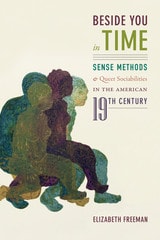
cover of Beside You in Time: Sense Methods and Queer Sociabilities in the American Nineteenth Century

Beside You in Time

Sense Methods and Queer Sociabilities in the American Nineteenth Century

Elizabeth Freeman

Duke University Press, 2019

In Beside You in Time Elizabeth Freeman expands biopolitical and queer theory by outlining a temporal view of the long nineteenth century. Drawing on Foucauldian notions of discipline as a regime that yoked the human body to time, Freeman shows how time became a social and sensory means by which people assembled into groups in ways that resisted disciplinary forces. She tracks temporalized bodies across many entangled regimes—religion, secularity, race, historiography, health, and sexuality—and examines how those bodies act in relation to those regimes. In analyses of the use of rhythmic dance by the Shakers; African American slave narratives; literature by Mark Twain, Pauline Hopkins, Herman Melville, and others; and how Catholic sacraments conjoined people across historical boundaries, Freeman makes the case for the body as an instrument of what she calls queer hypersociality. As a mode of being in which bodies are connected to others and their histories across and throughout time, queer hypersociality, Freeman contends, provides the means for subjugated bodies to escape disciplinary regimes of time and to create new social worlds.
[more]
cover of Between Banat: Queer Arab Critique and Transnational Arab Archives

Between Banat

Queer Arab Critique and Transnational Arab Archives

Mejdulene Bernard Shomali

Duke University Press, 2023
In Between Banat Mejdulene Bernard Shomali examines homoeroticism and nonnormative sexualities between Arab women in transnational Arab literature, art, and film. Moving from The Thousand and One Nights and the Golden Era of Egyptian cinema to contemporary novels, autobiographical writing, and prints and graphic novels that imagine queer Arab futures, Shomali uses what she calls queer Arab critique to locate queer desire amid heteronormative imperatives. Showing how systems of heteropatriarchy and Arab nationalisms foreclose queer Arab women’s futures, she draws on the transliterated term “banat”—the Arabic word for girls—to refer to women, femmes, and nonbinary people who disrupt stereotypical and Orientalist representations of the “Arab woman.” By attending to Arab women’s narration of desire and identity, queer Arab critique substantiates queer Arab histories while challenging Orientalist and Arab national paradigms that erase queer subjects. In this way, Shomali frames queerness and Arabness as relational and transnational subject formations and contends that prioritizing transnational collectivity over politics of authenticity, respectability, and inclusion can help lead toward queer freedom.
[more]
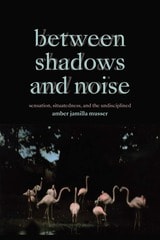
cover of Between Shadows and Noise: Sensation, Situatedness, and the Undisciplined

Between Shadows and Noise

Sensation, Situatedness, and the Undisciplined

Amber Jamilla Musser

Duke University Press, 2024
In Between Shadows and Noise Amber Jamilla Musser theorizes sensation as a Black feminist method for aesthetic interpretation and criticism that uses the knowledges held by the body to access the unrepresentable. Thinking through Blackness, empire, and colonialism, Musser examines artworks ranging from Ming Smith’s Flamingo Fandango, Jordan Peele’s Us, and Katherine Dunham’s Shango to Samita Sinha’s This ember state, Titus Kaphar’s A Pillow for Fragile Fictions, and Teresita Fernández’s Puerto Rico (Burned) 6. She engages with these works from an embodied situatedness to grapple with the questions and sensations of racialization and difference that the works produce. Throughout, Musser rethinks how we consider the relationships between race, representation, and politics by dwelling in those spaces and concepts that elude Western norms of representation, objectivity, and logic. In so doing, she explores ways of being and knowing that exceed overdetermined parameters while offering a blueprint for sensing, imagining, and living otherwise.
[more]
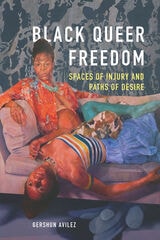
cover of Black Queer Freedom: Spaces of Injury and Paths of Desire

Black Queer Freedom

Spaces of Injury and Paths of Desire

GerShun Avilez

University of Illinois Press, 2020

Whether engaged in same-sex desire or gender nonconformity, black queer individuals live with being perceived as a threat while simultaneously being subjected to the threat of physical, psychological, and socioeconomical injury. Attending to and challenging threats has become a defining element in queer black artists’ work throughout the black diaspora. GerShun Avilez analyzes the work of diasporic artists who, denied government protections, have used art to create spaces for justice. He first focuses on how the state seeks to inhibit the movement of black queer bodies through public spaces, whether on the street or across borders. From there, he pivots to institutional spaces—specifically prisons and hospitals—and the ways such places seek to expose queer bodies in order to control them. Throughout, he reveals how desire and art open routes to black queer freedom when policy, the law, racism, and homophobia threaten physical safety, civil rights, and social mobility.
[more]
cover of Black Trans Feminism

Black Trans Feminism

Marquis Bey

Duke University Press, 2022

In Black Trans Feminism Marquis Bey offers a meditation on blackness and gender nonnormativity in ways that recalibrate traditional understandings of each. Theorizing black trans feminism from the vantages of abolition and gender radicality, Bey articulates blackness as a mutiny against racializing categorizations; transness as a nonpredetermined, wayward, and deregulated movement that works toward gender’s destruction; and black feminism as an epistemological method to fracture hegemonic modes of racialized gender. In readings of the essays, interviews, and poems of Alexis Pauline Gumbs, jayy dodd, and Venus Di’Khadijah Selenite, Bey turns black trans feminism away from a politics of gendered embodiment and toward a conception of it as a politics grounded in fugitivity and the subversion of power. Together, blackness and transness actualize themselves as on the run from gender. In this way, Bey presents black trans feminism as a mode of enacting the wholesale dismantling of the world we have been given.
[more]
cover of Black Undertow

Black Undertow

Hugo ka Canham

Duke University Press, 2026

Meditative and theoretical, Black Undertow reorients the thinking of blackness away from the Atlantic to the African shorelines of the Indian Ocean, places where queerness and black life frequently brush up against one another. Hugo ka Canham listens for what he names the buzz of the undertow, the traces of African ancestors who linger in water, sand, coastal forts, corals, ritual practices, and unruly imaginations along the shore. In tracking these elusive figures, he develops an approach that honors a queer right to opacity. Canham reconstitutes the siloed disciplinarity that imagines African studies, Black studies, Queer African studies, and Queer studies as necessarily different. When read as coconstitutive instead, Canham demonstrates that they better allow for explicating local life, history, poetics, and theory. In so doing, he forges methods of studying black life that think beyond the limits of traditional, textual archives.
[more]
cover of Blue Roses: Tennessee Williams, Memory, and the Queer Archive

Blue Roses

Tennessee Williams, Memory, and the Queer Archive

Daniel Ciba

University of Iowa Press, 2026

Blue Roses documents a queer response to one of the most popular American playwrights of the twentieth century: Tennessee Williams. Referencing Williams’s symbolic nickname for Laura in The Glass Menagerie, Daniel Ciba arranges archival memories that provoke, resist, and reimagine Williams’s contribution to LGBTQ+ culture. Ciba theorizes new archival methodologies that blend memory studies, queer theory, and theatre historiography. Each blue rose is an untold story of queer history that corresponds to a different period of Williams’s life, from World War II to the Lavender Scare and the Stonewall uprising.
[more]
cover of Breathing Aesthetics

Breathing Aesthetics

Jean-Thomas Tremblay

Duke University Press, 2022

In Breathing Aesthetics Jean-Thomas Tremblay argues that difficult breathing indexes the uneven distribution of risk in a contemporary era marked by the increasing contamination, weaponization, and monetization of air. Tremblay shows how biopolitical and necropolitical forces tied to the continuation of extractive capitalism, imperialism, and structural racism are embodied and experienced through respiration. They identify responses to the crisis in breathing in aesthetic practices ranging from the film work of Cuban American artist Ana Mendieta to the disability diaries of Bob Flanagan, to the Black queer speculative fiction of Renee Gladman. In readings of these and other minoritarian works of experimental film, endurance performance, ecopoetics, and cinema-vérité, Tremblay contends that articulations of survival now depend on the management and dispersal of respiratory hazards. In so doing, they reveal how an aesthetic attention to breathing generates historically, culturally, and environmentally situated tactics and strategies for living under precarity.
[more]
cover of Bridging: How Gloria Anzaldúa's Life and Work Transformed Our Own

Bridging

How Gloria Anzaldúa's Life and Work Transformed Our Own

Edited by AnaLouise Keating and Gloria González-López

University of Texas Press, 2011

The inspirational writings of cultural theorist and social justice activist Gloria Anzaldúa have empowered generations of women and men throughout the world. Charting the multiplicity of Anzaldúa's impact within and beyond academic disciplines, community trenches, and international borders, Bridging presents more than thirty reflections on her work and her life, examining vibrant facets in surprising new ways and inviting readers to engage with these intimate, heartfelt contributions.

Bridging is divided into five sections: The New Mestizas: "transitions and transformations"; Exposing the Wounds: "You gave me permission to fly in the dark"; Border Crossings: Inner Struggles, Outer Change; Bridging Theories: Intellectual Activism with/in Borders; and "Todas somos nos/otras": Toward a "politics of openness." Contributors, who include Norma Elia Cantú, Elisa Facio, Shelley Fisher Fishkin, Aída Hurtado, Andrea Lunsford, Denise Segura, Gloria Steinem, and Mohammad Tamdgidi, represent a broad range of generations, professions, academic disciplines, and national backgrounds. Critically engaging with Anzaldúa's theories and building on her work, they use virtual diaries, transformational theory, poetry, empirical research, autobiographical narrative, and other genres to creatively explore and boldly enact future directions for Anzaldúan studies.

A book whose form and content reflect Anzaldúa's diverse audience, Bridging perpetuates Anzaldúa's spirit through groundbreaking praxis and visionary insights into culture, gender, sexuality, religion, aesthetics, and politics. This is a collection whose span is as broad and dazzling as Anzaldúa herself.
[more]
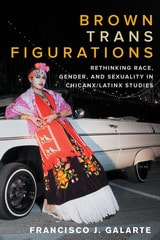
cover of Brown Trans Figurations: Rethinking Race, Gender, and Sexuality in Chicanx/Latinx Studies

Brown Trans Figurations

Rethinking Race, Gender, and Sexuality in Chicanx/Latinx Studies

By Francisco J. Galarte

University of Texas Press, 2021

Honorable Mention for the National Women’s Studies Association's 2021 Gloria E. Anzaldúa Book Prize
2021 Finalist Best LGBTQ+ Themed Book, International Latino Book Awards
2022 John Leo & Dana Heller Award for Best Single Work, Anthology, Multi-Authored, or Edited Book in LGBTQ Studies, Popular Culture Association
The Alan Bray Memorial Book Prize, GL/Q Caucus, Modern Language Association (MLA)
2022 AAHHE Book of the Year Award, American Association of Hispanics in Higher Education

Within queer, transgender, and Latinx and Chicanx cultural politics, brown transgender narratives are frequently silenced and erased. Brown trans subjects are treated as deceptive, unnatural, nonexistent, or impossible, their bodies, lives, and material circumstances represented through tropes and used as metaphors. Restoring personhood and agency to these subjects, Francisco J. Galarte advances “brown trans figuration” as a theoretical framework to describe how transness and brownness coexist within the larger queer, trans, and Latinx historical experiences.

Brown Trans Figurations presents a collection of representations that reveal the repression of brown trans narratives and make that repression visible and palpable. Galarte examines the violent deaths of two transgender Latinas and the corresponding narratives that emerged about their lives, analyzes the invisibility of brown transmasculinity in Chicana feminist works, and explores how issues such as transgender politics can be imagined as part of Chicanx and Latinx political movements. This book considers the contexts in which brown trans narratives appear, how they circulate, and how they are reproduced in politics, sexual cultures, and racialized economies.

[more]