123 books match the query 'Religious life' and 3 start with b
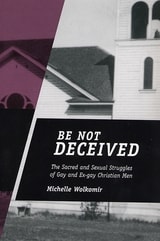
cover of Be Not Deceived: The Sacred and Sexual Struggles of Gay and Ex-gay Christian Men

Be Not Deceived

The Sacred and Sexual Struggles of Gay and Ex-gay Christian Men

Wolkomir, Michelle

Rutgers University Press, 2006

Homosexuality has become increasingly accepted in mainstream America over the past two decades. Yet despite indications of progress that can be found everywhere from academia to popular culture, gay men and women remain the target of much discrimination and stigma, particularly within conservative Christianity.

In Be Not Deceived, Michelle Wolkomir explores the difficult dilemma that gay Christians face in their attempts to reconcile their religious and sexual identities. She introduces the ideologies and practices of two alternative and competing ministries that offer solutions for Christians who experience homosexual desire.

One organization—the Universal Fellowship of Metropolitan Community Churches—believes that God made people gay to suit divine purposes.  Changing one’s sexuality is therefore impossible and a defiance of God.  In contrast, Exodus International preaches that homosexuality is a sin and a symptom of disordered psychological development—one that can be cured through redemptive prayer.  By comparing participant experiences in these ministries, Wolkomir explores the paths and processes by which members learn to become gay or ex-gay Christians.

Through careful analysis of the groups’ ideologies, interactions, and symbolic resources, Be Not Deceived goes far beyond the obvious differences between the ministries to uncover their similarities, namely that both continue to define heterosexuality as the normative and dominant lifestyle.
[more]
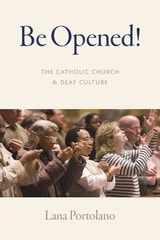
cover of Be Opened! The Catholic Church and Deaf Culture

Be Opened! The Catholic Church and Deaf Culture

Lana Portolano

Catholic University of America Press, 2021
Be Opened! The Catholic Church and Deaf Culture offers readers a people’s history of deafness and sign language in the Catholic Church. Paying ample attention to the vocation stories of deaf priests and pastoral workers, Portolano traces the transformation of the Deaf Catholic community from passive recipients of mercy to an active language minority making contributions in today’s globally diverse church. Background chapters familiarize readers with early misunderstandings about deaf people in the church and in broader society, along with social and religious issues facing deaf people throughout history. A series of connected narratives demonstrate the strong Catholic foundations of deaf education in sign language, including sixteenth-century monastic schools for deaf children and nineteenth-century French education in sign language as a missionary endeavor. The author explains how nineteenth-century schools for deaf children, especially those founded by orders of religious sisters, established small communities of Deaf Catholics around the globe. A series of portraits illustrates the work of pioneering missionaries in several different countries—“apostles to the Deaf”—who helped to establish and develop deaf culture in these communities through adult religious education and the sacraments in sign language. In several chapters focused on the twentieth century, the author describes key events that sparked a modern transformation in Deaf Catholic culture. As linguists began to recognize sign languages as true human languages, deaf people borrowed the practices of Civil Rights activists to gain equality both as citizens and as members of the church. At the same time, deaf people drew inspiration and cultural validation from key documents of Vatican II, and leadership of the Deaf Catholic community began to come from the deaf community rather than to it through missionaries. Many challenges remain, but this book clearly presents Deaf Catholic culture as an important and highly visible embodiment of Catholic heritage.
[more]
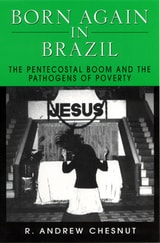
cover of Born Again in Brazil: The Pentecostal Boom and the Pathogens of Poverty

Born Again in Brazil

The Pentecostal Boom and the Pathogens of Poverty

R. Andrew Chesnut

Rutgers University Press, 1997

A spiritual revolution is transforming the religious landscape of Latin America. Evangelical Protestantism, particularly Pentecostalism, has replaced Catholicism as the leading religion in thousands of barrios on the urban periphery. But in few Latin American nations have Protestants multiplied as rapidly as in Brazil. What accounts for this rise? Combining historical, political, and ethnographic research, R. Andrew Chestnut shows that the relationship between faith healing and illness in the conversion process is integral to the popularity of Pentecostalism among Brazil's poor. He augments his analysis of the economic and political factors with extensive interview material to capture his informants' conversion experience. In doing so, he presents both a historical framework for a broad understanding of Pentecostalism in Latin America and insight into the personal motivations and beliefs of the crentes themselves.
[more]