Results by title
119 books match the query 'Religious life and customs' and 4 start with b
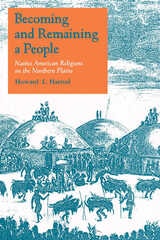
Becoming and Remaining a People
Native American Religions on the Northern PlainsHoward L. Harrod
University of Arizona Press, 1995
This book offers a bold new interpretation of anthropological studies, demonstrating how religious traditions and ritual processes became sources of group and individual identity for many people. Harrod reconstructs the long religious development of two village peoples, the Mandans and the Hidatsas, describing how their oral traditions enabled them to reinterpret their experiences as circumstances changed. He then shows how these and other groups on the Northern Plains remained distinct peoples in the face of increased interactions with Euro-Americans, other Indians,.and the new religion of Christianity.
Harrod proposes that other interpretations of culture change may fail to come to terms with the role that religion plays in motivating both cultural conservatism and social change. For Northern Plains peoples, religion was at the heart of social identity and thus resisted change, but religion was also the source of creative reinterpretation, which produced culture change. Viewed from within the group, such change often seemed natural and was understood as an elaboration of traditions having roots in a deeper shared past. In addition to demonstrating religious continuity and change among the Mandans and the Hidatsas, he also describes instances of religious and social transformation among the peoples who became the Crows and the Cheyennes.
Becoming and Remaining a People adopts a challenging analytical approach that draws on the author's creative interpretations of rituals and oral traditions. By enabling us to understand the relation of religion both to the construction of social identity and to the interpretation of social change, it reveals the richness, depth, and cultural complexity of both past Native American people and their contemporary successors.
Beliefs and Holy Places
A Spiritual Geography of the Pimería AltaJames S. Griffith
University of Arizona Press, 1992
Folklorist Jim Griffith has lived in the Pimería Alta for more than thirty years, visiting its holy places and attending its fiestas, and has uncovered a background of belief, tradition, and history lying beneath the surface of these cultural expressions. In Beliefs and Holy Places, he reveals some of the supernaturally sanctioned relationships that tie people to places within that region, describing the cultural and religious meanings of locations and showing how bonds between people and places have in turn created relationships between places, a spiritual geography undetectable on physical maps.
Throughout the book, Griffith shows how culture moves from legend to art to belief to practice, all the while serving as a dynamic link between past and future. Now as the desert gives way to newcomers, Griffith's book offers visitors and residents alike a rare opportunity to share in these rich traditions.
Believing In Place
A Spiritual Geography Of The Great BasinRichard V. Francaviglia
University of Nevada Press, 2016
The austere landscape of the Great Basin has inspired diverse responses from the people who have moved through or settled in it. Author Richard V. Francaviglia is interested in the connection between environment and spirituality in the Great Basin, for here, he says, "faith and landscape conspire to resurrect old myths and create new ones." As a geographer, Francaviglia knows that place means more than physical space. Human perceptions and interpretations are what give place its meaning. In Believing in Place, he examines the varying human perceptions of and relationships with the Great Basin landscape, from the region's Native American groups to contemporary tourists and politicians, to determine the spiritual issues that have shaped our connections with this place. In doing so, he considers the creation and flood myths of several cultures, the impact of the Judeo-Christian tradition and individualism, Native American animism and shamanist traditions, the Mormon landscape, the spiritual dimensions of gambling, the religious foundations of Cold War ideology, stories of UFOs and alien presence, and the convergence of science and spirituality.
Believing in Place is a profound and totally engaging reflection on the ways that human needs and spiritual traditions can shape our perceptions of the land. That the Great Basin has inspired such a complex variety of responses is partly due to its enigmatic vastness and isolation, partly to the remarkable range of peoples who have found themselves in the region. Using not only the materials of traditional geography but folklore, anthropology, Native American and Euro-American religion, contemporary politics, and New Age philosophies, Francaviglia has produced a fascinating and timely investigation of the role of human conceptions of place in that space we call the Great Basin.
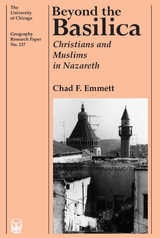
Beyond the Basilica
Christians and Muslims in NazarethChad F. Emmett
University of Chicago Press, 1994
Emmett describes both the positive and negative effects of Nazareth’s residential patterns. He shows that the addition of new and ethnically mixed quarters has promoted mixed schools, joint holiday celebrations, a common political culture, and social networks that cross ethnic boundaries. But he also finds that tensions exist among Christian groups and between Muslims and Christians in regard to intersectarian marriages, religious conversion, attempts to establish a joint Christian cemetery, and the emergence of a local Islamic party.
Extensive interviews with leaders of religious groups, political parties, and residents reveal the way in which members of each ethnic community perceive one another. A survey of 300 families gives a wealth of details about the make-up of Nazareth’s population, including residential histories, religion, level of religious conviction, friendship and shopping patterns, and much more. Fourteen maps trace changes in the distribution of religious groups and political affiliation in Nazareth from the mid-nineteenth century to the present.
Beyond the Basilica will interest cultural geographers, historians, demographers, political scientists, and anyone who would like to learn more about an ethnically divided community in the residents cooperate more than they fight.