Results by title
117 books match the query 'Rural conditions' and 8 start with b
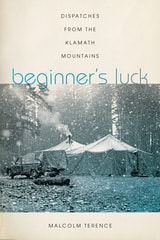
Beginner's Luck
Dispatches from the Klamath MountainsMalcolm Terence
Oregon State University Press, 2018
In the late 1960s, Malcolm Terence left his job as a reporter for the Los Angeles Times to look for adventure and may have found more than he bargained for. The era had triggered unprecedented social and political changes in America, tectonic shifts that challenged war and the social order that oppressed people along lines of class, gender, and race. One branch was a back-to-the-land movement, and Terence, who had just traveled for a year managing a rock band, strayed into Black Bear Ranch, a commune just starting in a remote corner of the Klamath Mountains near the California-Oregon border.
Black Bear Ranch still exists, but many of its early residents eventually returned to urban civilization. A few, Terence among them, stayed on in neighboring river towns. Some tried logging, others gold mining, and some tried growing marijuana, all with mixed success. The local mining and timber communities had a checkered opinion of their new hippie neighbors, as did the Native tribes, but it was the kind of place where people helped each other out, even if they didn’t always agree.
When wildfires grew large, Terence and other veterans of the commune joined the fire crews run by the US Forest Service. In between, the Black Bear expats built homesteads, planted gardens, delivered babies, and raised their children. They gradually overcame the skepticism of the locals and joined them in political battles against the use of herbicides in the forest and the Forest Service’s campaign to close all the mining claims. As in the best of organizing efforts, the organizers learned as much as they led.
Beginner’s Luck will appeal to anyone who experienced life on a commune in the 1960s–1970s or who wants to learn about this chapter in modern American history. Terence offers insight into environmental activism and the long history of conflict between resource exploitation and Native American rights without lecturing or pontificating. With wit, humor, and humility, his anecdotal essays chronicle a time and place where disparate people came together to form an unlikely community.
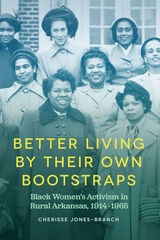
Better Living by Their Own Bootstraps
Black Women's Activism in Rural Arkansas, 1914-1965Cherisse Jones-Branch
University of Arkansas Press, 2021
The first major study to consider Black women’s activism in rural Arkansas, Better Living by Their Own Bootstraps foregrounds activists’ quest to improve Black communities through language and foodways as well as politics and community organizing. In reexamining these efforts, Cherisse Jones-Branch lifts many important figures out of obscurity, positioning them squarely within Arkansas’s agrarian history.
The Black women activists highlighted here include home demonstration agents employed by the Arkansas Agricultural Cooperative Extension Service and Jeanes Supervising Industrial Teachers, all of whom possessed an acute understanding of the difficulties that African Americans faced in rural spaces. Examining these activists through a historical lens, Jones-Branch reveals how educated, middle-class Black women worked with their less-educated rural sisters to create all-female spaces where they confronted economic, educational, public health, political, and theological concerns free from white regulation and interference.
Centered on the period between 1914 and 1965, Better Living by Their Own Bootstraps brings long-overdue attention to an important chapter in Arkansas history, spotlighting a group of Black women activists who uplifted their communities while subverting the formidable structures of white supremacy.
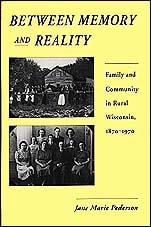
Between Memory and Reality
Family and Community in Rural Wisconsin, 1870–1970Jane Marie Pederson
University of Wisconsin Press, 1992
An Osseo native looks at the enduring power of immigrant traditions in rural Trempealeau County, from its pioneer days to recent decades.
Big House on the Prairie
Rise of the Rural Ghetto and Prison ProliferationJohn M. Eason
University of Chicago Press, 2017
In 2007, John M. Eason moved his family to Forrest City, Arkansas, in search of answers to key questions about this trend: Why is America building so many prisons? Why now? And why in rural areas? Eason quickly learned that rural demand for prisons is complicated. Towns like Forrest City choose to build prisons not simply in hopes of landing jobs or economic wellbeing, but also to protect and improve their reputations. For some rural leaders, fostering a prison in their town is a means of achieving order in a rapidly changing world. Taking us into the decision-making meetings and tracking the impact of prisons on economic development, poverty, and race, Eason demonstrates how groups of elite whites and black leaders share power. Situating prisons within dynamic shifts that rural economies are undergoing and showing how racially diverse communities lobby for prison construction, Big House on the Prairie is a remarkable glimpse into the ways a prison economy takes shape and operates.

Bomb Children
Life in the Former Battlefields of LaosLeah Zani
Duke University Press, 2019

Bridging the Distance
Common Issues of the Rural WestDavid B. Danbom
University of Utah Press, 2015
The essays in Bridging the Distance are fresh, informative, and insightful examinations of the complex problems facing the rural West. This is a book that will spur both conversations and the search for solutions.
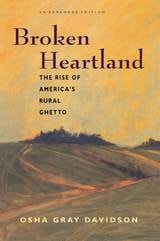
Broken Heartland
The Rise of America's Rural GhettoOsha Gray Davidson
University of Iowa Press, 1996
Between 1940 and the mid 1980s, farm production expenses in America's Heartland tripled, capital purchases quadrupled, interest payments jumped tenfold, profits fell by 10 percent, the number of farmers decreased by two-thirds, and nearly every farming community lost population, businesses, and economic stability. Growth for these desperate communities has come to mean low-paying part-time jobs, expensive tax concessions, waste dumps, and industrial hog farming, all of which come with environmental and psychological price tags. In Broken Heartland, Osha Gray Davidson chronicles the decline of the Heartland and its transformation into a bitterly divided and isolated regional ghetto. Through interviews with more than two hundred farmers, social workers, government officials, and scholars, he puts a human face on the farm crisis of the 1980s.
In this expanded edition Davidson emphasizes the tenacious power of far-right-wing groups; his chapter on these burgeoning rural organizations in the original edition of Broken Heartland was the first in-depth look—six years before of the Oklahoma City bombing—at the politics of hate they nurture. He also spotlights NAFTA, hog lots, sustainable agriculture, and the other battles and changes over the past six years in rural America.

Broker, Mediator, Patron, and Kinsman
An Historical Analysis of Key Leadership Roles in a Rural Malaysian DistrictConner Bailey
Ohio University Press, 1976
This study attempts to relate questions of rural leadership to the constantly changing social and economic environment of a rural district in Malaysia during the twentieth century. The study itself began as an effort to analyze a single instance of structural change in Malay village leadership which occurred while the author worked in Sik District as a Peace Corps Volunteer (1968–1971). A research proposal was developed positing a traditional pattern of behavior which could be identified as traditional leadership, the better to contrast this with the bureaucratic style of the district’s new penghulus (headmen of a mukim, or subdistrict).
As research progressed, it became obvious that there was in fact no single traditional leadership pattern to be discovered, but rather that over time adaptations were regularly made whenever a significant change in Sik’s social and economic environment occurred. Although the study has retained rural leadership as a primary concern, it has been found necessary to relate it to Sik’s social and economic history.