Results by title
66 books match the query 'Sex differences' and 5 start with b

Backtalk
Women Writers Speak OutDonna Perry
Rutgers University Press, 1993
Agents or victims, liberated or oppressed, "bad girls" or "good girls." What do these labels mean and do they further or hinder women's progress? How are today's visions of female sexuality and power like or unlike those of the past? How do younger women define feminism? Isn't the personal still political?
Dismayed by the media's tendency to reduce the feminist enterprise to labels and superstars, Donna Perry and Nan Bauer Maglin decided to find out what a diverse group of feminists think about women, sex, and power in the nineties. The result is a provocative and varied collection of twenty-four essays by second- and third-wave feminists; artists and activists; professors and graduate students; professional journalists and just-published writers; mothers and daughters. By focusing on society's construction, containment, and exploitation of female sexuality, in particular, these essays offer fresh perspectives on women's agency or lack of it.
The contributors focus on the oversimplifications and false dichotomies in current discussions of female sexuality, as well as the privileged perspective and individualism that currently dominate the popularized feminist message. Individual writers--including Emma Amos, bell hooks, Ann Jones, Lisa Jones, Paula Kamen, Matuschka, Marge Piercy, Katha Pollitt, Anna Quindlen, Elayne Rapping, Lillian S. Robinson, and Ellen Willis--reexamine women's empowerment in the light of issues like AIDS, battering, acquaintance rape, narratives of childhood sexual abuse, and pornography. Several draw political conclusions from their personal struggles, while others read stories and texts--from history, the art world, the media, popular culture, and social science research--in new and controversial ways.

Being a Minor Writer
Gail Gilliland
University of Iowa Press, 1994
There are countless theoretical arguments that attempt to define “major” and “minor” literatures, but this lively and deeply felt work is one of the first to speak from the authority of the experience of being minor—of being the “minor writer” who, according to the definition of “author” given by Michel Foucault, does not possess a “name.” This book, then, is an impassioned critical and ethical defense of the act of writing for purposes other than critical acclaim.
In the tradition of Horace's
Ars Poetica,Gilliland uses comments by a broad range of writers, as well as her own experience as a minor woman writer, to consider the basic Horatian questions of purpose, choice of subject matter and genre, diction, characterization, setting, and style. She points out that in the absence of major recognition, the minor writer is continually confronted by the existential question, why do I (still) write? This book offers not only a challenge to existing critical theories but an argument in favor of being—for
stillbeing, for continuing
anywaywith one's life and art

Biology at Work
Rethinking Sexual EqualityKingsley R. Browne
Rutgers University Press, 2002
Does biology help explain why women, on average, earn less money than men? Is there any evolutionary basis for the scarcity of female CEOs in Fortune 500 companies? According to Kingsley Browne, the answer may be yes.
Biology at Work brings an evolutionary perspective to bear on issues of women in the workplace: the "glass ceiling," the "gender gap" in pay, sexual harassment, and occupational segregation. While acknowledging the role of discrimination and sexist socialization, Browne suggests that until we factor real biological differences between men and women into the equation, the explanation remains incomplete.
Browne looks at behavioral differences between men and women as products of different evolutionary pressures facing them throughout human history. Womens biological investment in their offspring has led them to be on average more nurturing and risk averse, and to value relationships over competition. Men have been biologically rewarded, over human history, for displays of strength and skill, risk taking, and status acquisition. These behavioral differences have numerous workplace consequences. Not surprisingly, sex differences in the drive for status lead to sex differences in the achievement of status.
Browne argues that decision makers should recognize that policies based on the assumption of a single androgynous human nature are unlikely to be successful. Simply removing barriers to inequality will not achieve equality, as women and men typically value different things in the workplace and will make different workplace choices based on their different preferences.
Rather than simply putting forward the "nature" side of the debate, Browne suggests that dichotomies such as nature/nurture have impeded our understanding of the origins of human behavior. Through evolutionary biology we can understand not only how natural selection has created predispositions toward certain types of behavior but also how the social environment interacts with these predispositions to produce observed behavioral patterns.
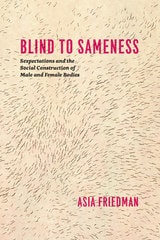
Blind to Sameness
Sexpectations and the Social Construction of Male and Female BodiesAsia Friedman
University of Chicago Press, 2013
Drawing on more than sixty interviews with two decidedly different populations—the blind and the transgendered—Blind to Sameness answers provocative questions about the relationships between sex differences, biology, and visual perception. Both groups speak from unique perspectives that magnify the social construction of dominant visual conceptions of sex, allowing Friedman to examine the visual construction of the sexed body and highlighting the processes of social perception underlying our everyday experience of male and female bodies. The result is a notable contribution to the sociologies of gender, culture, and cognition that will revolutionize the way we think about sex.

Blue Studios
Poetry and Its Cultural WorkRachel Blau DuPlessis
University of Alabama Press, 2006