Results by title
10 books match the query 'Mahabharata'
Mahabharata
Adapted and edited by David R. Slavitt
Northwestern University Press, 2015
Within its 200,000 verse lines in Sanskrit the Mahabharata takes on many roles: epic poem, foundational text of Hinduism, and, more broadly, the engaging story of a dynastic struggle and the passing of an age when man and gods intermingled. David R. Slavitt’s sparkling new edition condenses the epic for the general reader.
At its core, the Mahabharata is the story of the rivalry between the Pandavas and the Kauravas, two related noble families who are struggling for control of a kingdom in ancient northern India. Slavitt’s readable, plot-driven, single-volume account describes an arc from the conception and birth of Bhishma to that hero's death, while also introducing the four goals of life at the center of Hinduism: dharma (righteousness, morality, duty), artha (purpose), kāma (pleasure), and moksa (spiritual liberation). The Mahabharata is engaging, thrilling, funny, charming, and finally awesome, with a range in timbre from the impish naivete of fairy tales to the solemnity of our greatest epics, and this single-volume edition is the best introduction available.
Rethinking the Mahabharata
A Reader's Guide to the Education of the Dharma KingAlf Hiltebeitel
University of Chicago Press, 2001
This work is the fourth volume in Hiltebeitel's study of the Draupadi cult. Other volumes include Mythologies: From Gingee to Kuruksetra (Volume One), On Hindu Ritual and the Goddess (Volume Two), and Rethinking India's Oral and Classical Epics (Volume Three).
The Bhagavadgita in the Mahabharata
Edited by J. A. B. van Buitenen
University of Chicago Press, 1981
The Bhagavadgita ("Song of the Lord") tells of the young and virtuous Prince Arjuna who is driven to lead his forces into battle against an opposing army composed of close relatives and others whom he loves. The Lord Krsna, appearing in the poem as Arjuna's friend and charioteer, persuades him that he must do battle, and we see Arjuna changing from revulsion at the thought of killing members of his family to resignation and awareness of duty, to manly acceptance of his role as warrior and defender of his kingdom.
The Bhagavadgita is a self-contained episode in the Mahabharata, a vast collection of epics, legends, romances, theology, and metaphysical doctrine that reflects the history and culture of the whole of Hindu civilization. The present edition forms a part of J. A. B. van Buitenen's widely acclaimed translation of this great work. Here English and Sanskrit are printed on facing pages, enabling those with some knowledge of Sanskrit to appreciate van Buitenen's accurate rendering of the intimate, familial tone and directness of the original poem.
The Mahabharata, Volume 1
Book 1: The Book of the BeginningEdited by J. A. B. van Buitenen
University of Chicago Press, 1974
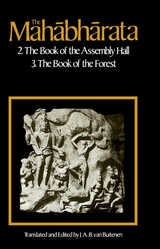
The Mahabharata, Volume 2
Book 2: The Book of Assembly; Book 3: The Book of the ForestEdited by J. A. B. van Buitenen
University of Chicago Press, 1975
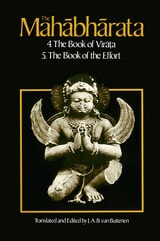
The Mahabharata, Volume 3
Book 4: The Book of the Virata; Book 5: The Book of the EffortEdited by J. A. B. van Buitenen
University of Chicago Press, 1978
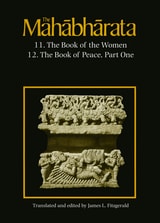
The Mahabharata, Volume 7
Book 11: The Book of the Women Book 12: The Book of Peace, Part 1Edited by James L. Fitzgerald
University of Chicago Press, 2004
What is not in this epic is nowhere else.
—from The Mahabharata
The second longest poem in world literature, The Mahabharata is an epic tale, replete with legends, romances, theology, and metaphysical doctrine written in Sanskrit. One of the foundational elements in Hindu culture, this great work consists of nearly 75,000 stanzas in eighteen books, and this volume marks the much anticipated resumption of its first complete modern English translation. With the first three volumes, the late J. A. B. van Buitenen had taken his translation up to the threshold of the great war that is central to the epic. Now James Fitzgerald resumes this work with translations of the books that chronicle the wars aftermath: The Book of Women and part one of The Book of Peace. These books constitute volume 7 of the projected ten-volume edition. Volumes 4, 5, 6, 8, 9, and 10 of the series will be published over the next several years.
In his introductions to these books, Fitzgerald examines the rhetoric of The Mahabharatas representations of the wars aftermath. Indeed, the theme of The Book of Women is the grief of the women left by warriors slain in battle. The book details the keening of palace ladies as they see their dead husbands and sons, and it culminates in a mass cremation where the womens tears turn into soothing libations that help wash the deaths away. Fitzgerald shows that the portrayal of the womens grief is much more than a sympathetic portrait of the sufferings of war. The scenes of mourning in The Book of Women lead into a crisis of conscience that is central to The Book of Peace and, Fitzgerald argues, the entire Mahabharata. In this book, the man who has won power in the great war is torn between his own sense of guilt and remorse and the obligation to rule which ultimately he is persuaded to embrace.
The Mahabharata is a powerful work that has inspired awe and wonder for centuries. With a penetrating glimpse into the trauma of war, this volume offers two of its most timely and unforgettable chapters.
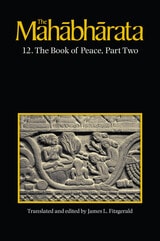
The Mahabharata, Volume 8
Book 12, The Book of Peace, Part 2Translated and Edited by James L. Fitzgerald
University of Chicago Press, 2026
A remarkable composition of 100,000 couplets, The Mahābhārata is the second-longest poem in world literature. In this volume, James L. Fitzgerald completes his translation of the twelfth of The Mahābhārata’s eighteen books, the vast Shanti Parvan, or The Book of Peace. Covering a wide range of ancient Indian intellectual history, The Book of Peace was intended to serve as a comprehensive, brahmin-inspired basis for living a Good Life in a Good Society in a Good Polity and is one of the most important and complex books of the poem.
Fitzgerald’s previous contribution to the Chicago edition of The Mahābhārata, volume 7, opened with Book 11, The Book of the Women, which movingly portrayed the grief of the wives, mothers, and sisters of the many warriors slain in the epic’s central war narrative. The crises of grief presented in The Book of the Women give particular poignancy and depth to the shanti, or pacification, that is the theme of Book 12, The Book of Peace. Volume 7 included the first half of The Book of Peace, and volume 8 now completes it with the second half, which is focused particularly on the ways people can escape the cycle of rebirth and realize sublime beatitude by way of saving knowledge or yoga meditation or devotion to God Viṣṇu-Nārāyaṇa. Supported by an extensive introduction and notes, this publication will be greeted as a major event in Sanskrit studies.
The Mahabharata
A Shortened Modern Prose Version of the Indian EpicR. K. Narayan
University of Chicago Press, 2000
The Mahabharata
A Shortened Modern Prose Version of the Indian EpicR. K. Narayan
University of Chicago Press, 2013
Centuries of listeners and readers have been drawn to The Mahabharata, which began as disparate oral ballads and grew into a sprawling epic. The modern version is famously long, and at more than 1.8 million words—seven times the combined lengths of the Iliad and Odyssey—it can be incredibly daunting.
Contemporary readers have a much more accessible entry point to this important work, thanks to R. K. Narayan’s masterful translation and abridgement of the poem. Now with a new foreword by Wendy Doniger, as well as a concise character and place guide and a family tree, The Mahabharata is ready for a new generation of readers. As Wendy Doniger explains in the foreword, “Narayan tells the stories so well because they’re all his stories.” He grew up hearing them, internalizing their mythology, which gave him an innate ability to choose the right passages and their best translations.
In this elegant translation, Narayan ably distills a tale that is both traditional and constantly changing. He draws from both scholarly analysis and creative interpretation and vividly fuses the spiritual with the secular. Through this balance he has produced a translation that is not only clear, but graceful, one that stands as its own story as much as an adaptation of a larger work.