127 books match the query 'Sexual behavior' and 9 start with b

cover of Be Not Deceived: The Sacred and Sexual Struggles of Gay and Ex-gay Christian Men

Be Not Deceived

The Sacred and Sexual Struggles of Gay and Ex-gay Christian Men

Wolkomir, Michelle

Rutgers University Press, 2006

Homosexuality has become increasingly accepted in mainstream America over the past two decades. Yet despite indications of progress that can be found everywhere from academia to popular culture, gay men and women remain the target of much discrimination and stigma, particularly within conservative Christianity.

In Be Not Deceived, Michelle Wolkomir explores the difficult dilemma that gay Christians face in their attempts to reconcile their religious and sexual identities. She introduces the ideologies and practices of two alternative and competing ministries that offer solutions for Christians who experience homosexual desire.

One organization—the Universal Fellowship of Metropolitan Community Churches—believes that God made people gay to suit divine purposes.  Changing one’s sexuality is therefore impossible and a defiance of God.  In contrast, Exodus International preaches that homosexuality is a sin and a symptom of disordered psychological development—one that can be cured through redemptive prayer.  By comparing participant experiences in these ministries, Wolkomir explores the paths and processes by which members learn to become gay or ex-gay Christians.

Through careful analysis of the groups’ ideologies, interactions, and symbolic resources, Be Not Deceived goes far beyond the obvious differences between the ministries to uncover their similarities, namely that both continue to define heterosexuality as the normative and dominant lifestyle.

[more]
cover of Beauvoir and Her Sisters: The Politics of Women's Bodies in France

Beauvoir and Her Sisters

The Politics of Women's Bodies in France

Sandra Reineke

University of Illinois Press, 2011

Beauvoir and Her Sisters investigates how women's experiences, as represented in print culture, led to a political identity of an "imagined sisterhood" through which political activism developed and thrived in postwar France. Through the lens of women's political and popular writings, Sandra Reineke presents a unique interpretation of feminist and intellectual discourse on citizenship, identity, and reproductive rights.
 
Drawing on feminist writings by Simone de Beauvoir, feminist reviews from the women's liberation movement, and cultural reproductions from French women's fashion and beauty magazines, Reineke illustrates how print media created new spaces for political and social ideas. This sustained study extends from 1944, when women received the right to vote in France, to 1993, when the French government outlawed anti-abortion activities. Touching on the relationship between consumer culture and feminist practice, Reineke's analysis of a selection of women's writings underlines how these texts challenged traditional gender models and ideals.
 
In revealing that women collectively used texts to challenge the state to redress its abortion laws, Reineke renders the act of writing as a form of political action and highlights the act of reading as an essential but often overlooked space in which marginalized women could exercise dissent and create solidarity.
[more]
cover of Between You and Me: Queer Disclosures in the New York Art World, 1948-1963

Between You and Me

Queer Disclosures in the New York Art World, 1948-1963

Gavin Butt

Duke University Press, 2005

In the decades preceding the Stonewall riots—in the wake of the 1948 publication of Alfred Kinsey’s controversial report on male sexuality and in the midst of a cold war culture of suspicion and paranoia—discussions of homosexuality within the New York art world necessarily circulated via gossip and rumor. Between You and Me explores this informal, everyday talk and how it shaped artists’ lives, their work, and its reception. Revealing the “trivial” and “unserious” aspects of the postwar art scene as key to understanding queer subjectivity, Gavin Butt argues for a richer, more expansive concept of historical evidence, one that supplements the verifiable facts of traditional historical narrative with the gossipy fictions of sexual curiosity.

Focusing on the period from 1948 to 1963, Butt draws on the accusations and denials of homosexuality that appeared in the popular press, on early homophile publications such as One and the Mattachine Review, and on biographies, autobiographies, and interviews. In a stunning exposition of Larry Rivers’s work, he shows how Rivers incorporated gossip into his paintings, just as his friend and lover Frank O’Hara worked it into his poetry. He describes how the stories about Andy Warhol being too “swish” to be taken seriously as an artist changed following his breakthrough success, reconstructing him as an asexual dandy. Butt also speculates on the meanings surrounding a MoMA curator’s refusal in 1958 to buy Jasper Johns’s Target with Plaster Casts on the grounds that it was too scandalous for the museum to acquire. Between You and Me sheds new light on a pivotal moment in American cultural production as it signals new directions for art history.
[more]
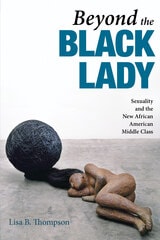
cover of Beyond the Black Lady: Sexuality and the New African American Middle Class

Beyond the Black Lady

Sexuality and the New African American Middle Class

Lisa B. Thompson

University of Illinois Press, 2012

In this book, Lisa B. Thompson explores the representation of black middle-class female sexuality by African American women authors in narrative literature, drama, film, and popular culture, showing how these depictions reclaim black female agency and illustrate the difficulties black women confront in asserting sexual agency in the public sphere. Thompson broadens the discourse around black female sexuality by offering an alternate reading of the overly determined racial and sexual script that casts the middle class "black lady" as the bastion of African American propriety. Drawing on the work of black feminist theorists, she examines symptomatic autobiographies, novels, plays, and key episodes in contemporary American popular culture, including works by Anita Hill, Judith Alexa Jackson, P. J. Gibson, Julie Dash, Kasi Lemmons, Jill Nelson, Lorene Cary, and Andrea Lee.
[more]
cover of Black Female Sexualities

Black Female Sexualities

Melancon, Trimiko

Rutgers University Press, 2015

Western culture has long regarded black female sexuality with a strange mix of fascination and condemnation, associating it with everything from desirability, hypersexuality, and liberation to vulgarity, recklessness, and disease. Yet even as their bodies and sexualities have been the subject of countless public discourses, black women’s voices have been largely marginalized in these discussions. In this groundbreaking collection, feminist scholars from across the academy come together to correct this omission—illuminating black female sexual desires marked by agency and empowerment, as well as pleasure and pain, to reveal the ways black women regulate their sexual lives. 

The twelve original essays in Black Female Sexualities reveal the diverse ways black women perceive, experience, and represent sexuality. The contributors highlight the range of tactics that black women use to express their sexual desires and identities. Yet they do not shy away from exploring the complex ways in which black women negotiate the more traumatic aspects of sexuality and grapple with the legacy of negative stereotypes. 

Black Female Sexualities takes not only an interdisciplinary approach—drawing from critical race theory, sociology, and performance studies—but also an intergenerational one, in conversation with the foremothers of black feminist studies. In addition, it explores a diverse archive of representations, covering everything from blues to hip-hop, from Crash to Precious, from Sister Souljah to Edwidge Danticat. Revealing that black female sexuality is anything but a black-and-white issue, this collection demonstrates how to appreciate a whole spectrum of subjectivities, experiences, and desires.  
[more]
cover of Black Sexual Economies: Race and Sex in a Culture of Capital

Black Sexual Economies

Race and Sex in a Culture of Capital

Edited by Adrienne D. Davis and the BSE Collective

University of Illinois Press, 2019

A daring collaboration among scholars, Black Sexual Economies challenges thinking that sees black sexualities as a threat to normative ideas about sexuality, the family, and the nation. The essays highlight alternative and deviant gender and sexual identities, performances, and communities, and spotlights the sexual labor, sexual economy, and sexual agency to black social life. Throughout, the writers reveal the lives, everyday negotiations, and cultural or aesthetic interventions of black gender and sexual minorities while analyzing the systems and beliefs that structure the possibilities that exist for all black sexualities. They also confront the mechanisms of domination and subordination attached to the political and socioeconomic forces, cultural productions, and academic work that interact with the energies at the nexus of sexuality and race. Contributors: Marlon M. Bailey, Lia T. Bascomb, Felice Blake, Darius Bost, Ariane Cruz, Adrienne D. Davis, Pierre Dominguez, David B. Green Jr., Jillian Hernandez, Cheryl D. Hicks, Xavier Livermon, Jeffrey McCune, Mireille Miller-Young, Angelique Nixon, Shana L. Redmond, Matt Richardson, L. H. Stallings, Anya M. Wallace, and Erica Lorraine Williams
[more]
cover of Black Sexualities: Probing Powers, Passions, Practices, and Policies

Black Sexualities

Probing Powers, Passions, Practices, and Policies

Edited and with an Introduction by Juan Battle and Sandra L. Barnes

Rutgers University Press, 2009

Why does society have difficulty discussing sexualities? Where does fear of Black sexualities emerge and how is it manifested? How can varied experiences of Black females and males who are lesbian, gay, bisexual, transgender (LGBT), or straight help inform dialogue and academic inquiry?

From questioning forces that have constrained sexual choices to examining how Blacks have forged healthy sexual identities in an oppressive environment, Black Sexualities acknowledges the diversity of the Black experience and the shared legacy of racism. Contributors seek resolution to Blacks' understanding of their lives as sexual beings through stories of empowerment, healing, self-awareness, victories, and other historic and contemporary life-course panoramas and provide practical information to foster more culturally relative research, tolerance, and acceptance.

[more]
cover of Black, Quare, and Then to Where: Theories of Justice and Black Sexual Ethics

Black, Quare, and Then to Where

Theories of Justice and Black Sexual Ethics

jennifer susanne leath

Duke University Press, 2023

In Black, Quare, and Then to Where jennifer susanne leath explores the relationship between Afrodiasporic theories of justice and Black sexual ethics through a womanist engagement with Maât the ancient Egyptian deity of justice and truth. Maât took into account the historical and cultural context of each human’s life, thus encompassing nuances of politics, race, gender, and sexuality. Arguing that Maât should serve as a foundation for reconfiguring Black sexual ethics, leath applies ancient Egyptian moral codes to quare ethics of the erotic, expanding what relationships and democratic practices might look like from a contemporary Maâtian perspective. She also draws on Pan-Africanism and examines the work of Alice Walker, E. Patrick Johnson, Cheikh Anta Diop, Sylvia Wynter, Sun Ra, and others. She shows that together these thinkers and traditions inform and expand the possibilities of Maâtian justice with respect to Black sexual experiences. As a moral force, leath contends, Maât opens new possibilities for mapping ethical frameworks to understand, redefine, and imagine justices in the United States.
[more]
cover of Bodies of Knowledge: Sexuality, Reproduction, and Women's Health in the Second Wave

Bodies of Knowledge

Sexuality, Reproduction, and Women's Health in the Second Wave

Wendy Kline

University of Chicago Press, 2010

Throughout the 1970s and ’80s, women argued that unless they gained access to information about their own bodies, there would be no equality. In Bodies of Knowledge, Wendy Kline considers the ways in which ordinary women worked to position the female body at the center of women’s liberation.

As Kline shows, the struggle to attain this knowledge unified women but also divided them—according to race, class, sexuality, or level of professionalization. Each of the five chapters of Bodies of Knowledge examines a distinct moment or setting of the women’s movement in order to give life to the ideas, expectations, and pitfalls encountered by the advocates of women’s health: the making of Our Bodies, Ourselves (1973); the conflicts surrounding the training and practice of women’s pelvic exams; the emergence of abortion as a feminist issue; the battles over contraceptive regulation at the 1983 Depo-Provera FDA hearings; and the rise of the profession of midwifery. Including an epilogue that considers the experiences of the daughters of 1970s feminists, Bodies of Knowledge is an important contribution to the study of the bodies—that marked the lives—of feminism’s second wave.

[more]